Saklar Kartu Universal vs Terenkripsi: Perbandingan Keamanan
Saklar kartu universal membaca UID kartu M1 apa pun tanpa re-carding; saklar terenkripsi memvalidasi kunci sektor MIFARE agar hanya kartu kamar sendiri yang sah.
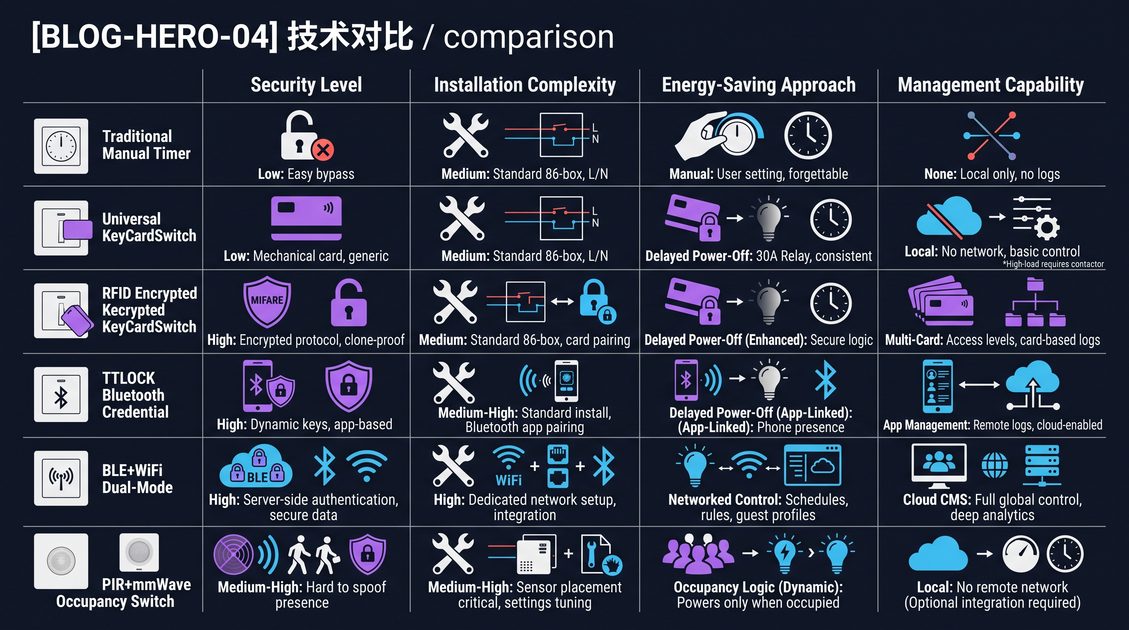
Saklar kartu universal hanya membaca UID kartu dan menerima kartu M1 tak terenkripsi apa pun, sedangkan saklar kartu terenkripsi memvalidasi kunci sektor MIFARE sebelum menutup relai, sehingga hanya kartu kamar sendiri yang dapat menyalakan kamar. Keputusan saklar kartu universal vs terenkripsi adalah pertimbangan utama dalam setiap penerapan penghematan energi hotel: model universal tidak pernah memaksa penerbitan ulang kartu dan dapat dipasang dalam hitungan menit, tetapi tidak dapat menghentikan tamu yang membawa kartu dari kamar 201 untuk tetap menyalakan kamar 202; model terenkripsi menutup celah tersebut melalui autentikasi kunci sektor, dengan konsekuensi mengikat setiap saklar pada sistem kartu tertentu. Keduanya memakai relai 30A, input AC 180–250V, dan delay-off 15 detik yang sama, sehingga perbedaannya sepenuhnya terletak pada cara saklar kartu menentukan siapa yang dipercaya.
Cara Saklar Kartu Universal Menentukan Kepercayaan
Saklar kartu universal menangkap nomor seri kartu (UID) pada fase anti-collision ISO 14443 dan menerimanya tanpa pemeriksaan kunci apa pun. Karena UID bersifat publik dan tidak terautentikasi, kartu 125kHz Temic atau 13.56MHz MIFARE apa pun — kartu tamu, kartu staf, bahkan kartu transportasi umum — dapat mengaktifkan kamar. Hal ini menjadikan saklar kartu universal sebagai retrofit dengan hambatan paling kecil: properti dengan kartu campuran atau tidak dikenal dapat memasangnya di ratusan kamar tanpa re-carding. Kelemahannya adalah berbagi kartu. Tamu yang check-in di kamar 201 sekaligus memegang kartu kamar 202 dapat meninggalkan kartu 201 di saklar kamar 202 dan menjaga kamar tersebut tetap menyala, diam-diam mengikis penghematan energi yang menjadi tujuan pembelian saklar ini. Untuk properti beranggaran terbatas dan asrama yang mengutamakan kenyamanan dibanding penegakan aturan, kompromi tersebut biasanya dapat diterima.
Cara Saklar Kartu Terenkripsi Menentukan Kepercayaan
Saklar kartu terenkripsi melampaui UID dan melakukan autentikasi timbal balik Crypto-1 (MIFARE Classic) atau AES (MIFARE Plus/DESFire) terhadap kunci sektor sebelum mengalirkan daya. Kartu kosong atau hasil kloning tidak memiliki materi kunci dan akan gagal, sehingga hanya kartu yang ditulis dengan kunci sektor properti — umumnya kartu kamar sendiri — yang berfungsi. RFID energy saver terikat pada satu kamar; saklar kompatibel TTLOCK menambahkan jendela waktu sehingga daya terputus otomatis saat check-out. Inilah model yang menegakkan penghematan energi: berbagi kartu lintas kamar menjadi mustahil karena saklar tidak akan merespons kartu kamar yang salah. Konsekuensinya adalah ketergantungan pada satu sistem kartu dan, untuk TTLOCK, pada kunci sektor ekosistem TTLOCK. Saklar kartu terenkripsi adalah pilihan tepat ketika penghematan energi harus dapat diaudit, bukan sekadar tersedia.
Saklar Kartu Universal vs Terenkripsi: Tabel Keputusan
Pilihan saklar kartu universal vs terenkripsi mengikuti kondisi sistem kartu properti. Sistem kartu campuran atau tidak ada → saklar kartu universal, pengembalian tercepat. MIFARE atau Temic per kamar → RFID energy saver untuk pengikatan kamar. Kunci TTLOCK terpasang → saklar kompatibel TTLOCK yang berbagi kartu pintu. Program kamar terhubung yang menginginkan ponsel sebagai kunci → saklar pintar BLE dengan cadangan kartu MIFARE. Keempatnya pada dasarnya adalah saklar kartu; yang berbeda hanya aturan kepercayaannya. Konfirmasi tegangan (180–250V, 110V atas permintaan) dan finishing panel, lalu sesuaikan model dengan sistem kartu Anda dalam panduan pembelian saklar penghematan energi hotel.
A universal key card switch reads only the card UID and accepts any unencrypted M1 card, while an encrypted key card switch validates a MIFARE sector key before closing the relay, so only the room's own card can power the room. The universal vs encrypted key card switch decision is the central trade-off in any hotel energy saving rollout: the universal model never forces a card re-issue and retrofits in minutes, but it cannot stop a guest from taking a card from room 201 to keep room 202 powered; the encrypted model closes that gap through sector-key authentication, at the cost of binding each switch to a specific card system. Both share the same 30A relay, AC 180–250V input, and 15-second delay-off, so the difference is entirely in how the key card switch decides whom to trust.
How a Universal Key Card Switch Decides Trust
A universal key card switch captures the card serial (UID) during the ISO 14443 anti-collision phase and accepts it without any key check. Because the UID is public and unauthenticated, any 125kHz Temic or 13.56MHz MIFARE card — guest card, staff card, even a transit card — activates the room. This makes the universal key card switch the lowest-friction retrofit: a property with mixed or unknown cards deploys it across hundreds of rooms with no re-carding. The downside is card-sharing. A guest who checks into room 201 and also holds a card for room 202 can leave the 201 card in the 202 switch and keep that room powered, quietly eroding the energy saving the switch was bought to deliver. For budget properties and dorms where convenience beats enforcement, that trade is usually acceptable.
How an Encrypted Key Card Switch Decides Trust
An encrypted key card switch goes past the UID and performs a Crypto-1 (MIFARE Classic) or AES (MIFARE Plus/DESFire) mutual authentication against a sector key before energizing. A blank or cloned card has no key material and fails, so only a card written with the property's sector key — typically the room's own card — works. An RFID energy saver binds to a room; a TTLOCK compatible switch adds a time window so power auto-cuts at checkout. This is the model that enforces energy savings: cross-room sharing becomes impossible because the switch will not respond to a wrong-room card. The cost is lock-in to a card system and, for TTLOCK, to the TTLOCK ecosystem's sector keys. The encrypted key card switch is the right call where the energy saving must be auditable, not just available.
Universal vs Encrypted Key Card Switch: Decision Table
The universal vs encrypted key card switch choice follows the property's card posture. Mixed or no card system → universal key card switch, fastest payback. Per-room MIFARE or Temic → RFID energy saver for room binding. TTLOCK locks installed → TTLOCK compatible switch sharing the door card. Connected-rooms program wanting phone-as-key → BLE smart switch with a MIFARE card fallback. All four are a key card switch at heart; only the trust rule differs. Confirm voltage (180–250V, 110V on request) and panel finish, then match the model to your card system in the hotel energy saving switch buying guide.
blog.inArticleCta.title
blog.inArticleCta.description
contentGraph.title
contentGraph.description
contentGraph.sections.products
3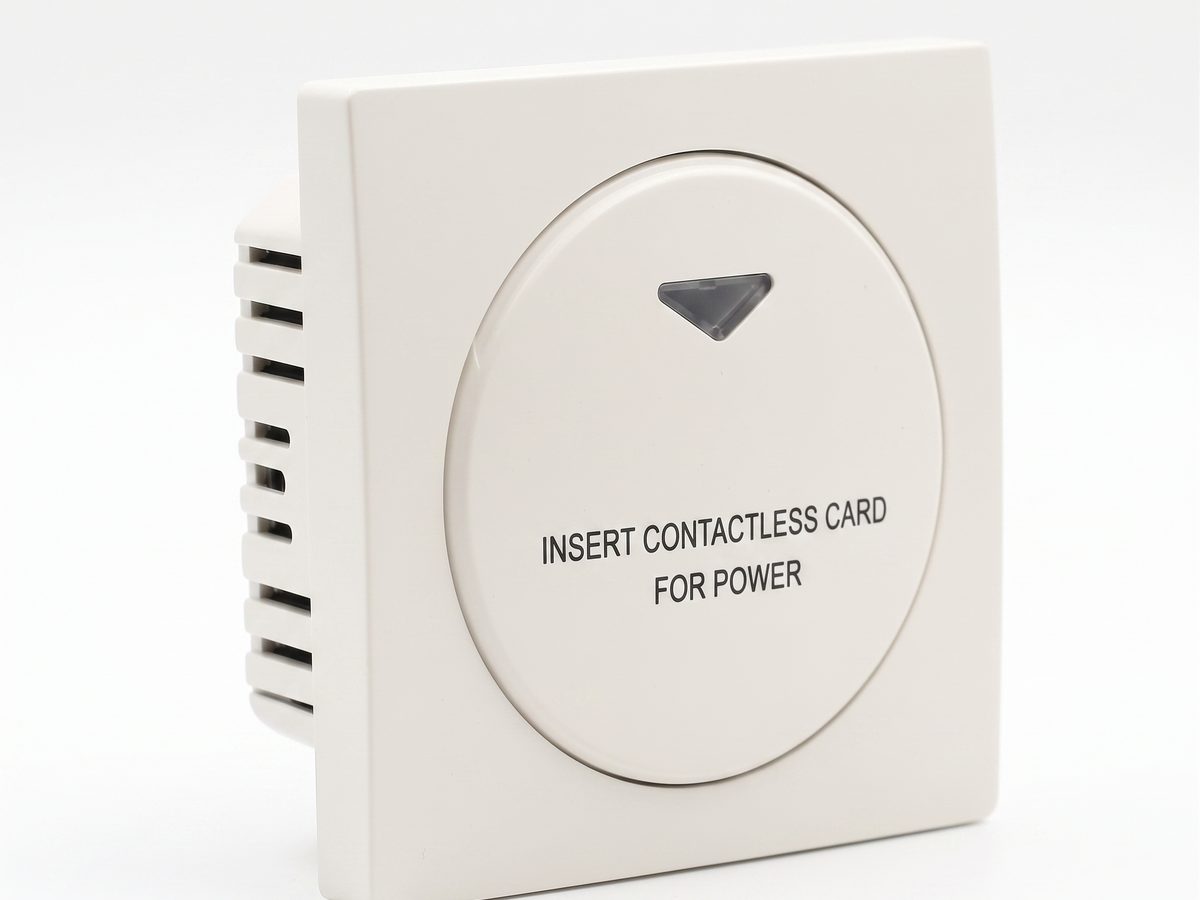
Hotel Key Card Switch — Kontrol Daya Kamar Tamu
Hotel key card switch untuk kontrol daya kamar tamu. Deteksi kartu RFID/IC, masukkan kartu untuk menyalakan daya, penundaan pemadaman saat kartu dilepas. 220V AC, 10A-16A, RS485 atau dry contact. CE RoHS. Pemasok OEM/ODM.
contentGraph.reasons.explicit
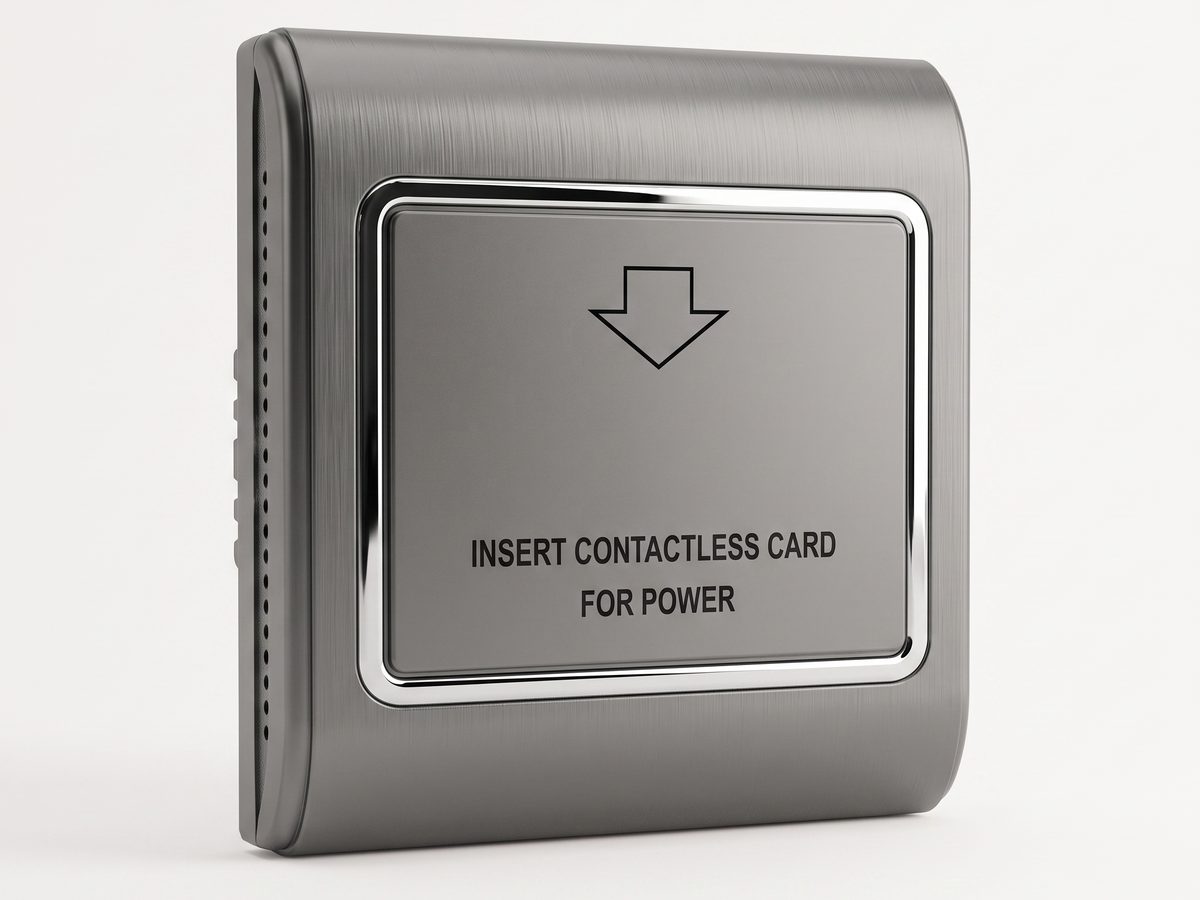
Sakelar Hemat Energi RFID — Kartu MIFARE Ruangan (Tipe B)
Sakelar hemat energi RFID yang mengikat daya ke kartu MIFARE ruangan tertentu. 13.56MHz MIFARE / 125kHz Temic, AC 180–250V, 30A, tunda mati 15 detik.
contentGraph.reasons.explicit
Saklar Energi TTLOCK — Terikat Kamar + Batas Waktu (Tipe C)
Saklar energi kompatibel TTLOCK dengan ID kamar dan batas waktu. Membaca kartu MIFARE TTLOCK / TTHotel via autentikasi sector-key, AC 180–250V, 30A.
contentGraph.reasons.explicit
contentGraph.sections.solutions
3 Panduan Pembelian Saklar Hemat Energi Hotel 2026
Panduan membeli saklar hemat energi hotel: kartu universal, RFID/MIFARE, kompatibel TTLOCK, pintar BLE, dan sensor okupansi. Pilih yang tepat untuk kamar Anda.
contentGraph.reasons.explicit
Sistem Manajemen Energi Hotel — Kontrol Daya Kamar Efisien
Sistem manajemen energi hotel berbasis sakelar kartu, penghemat energi RFID, dan sensor okupansi yang memangkas 25–40% listrik kamar tamu hotel.
contentGraph.reasons.explicit
Sistem Manajemen Kamar Hotel Berbasis Kartu Listrik
Sistem manajemen kamar hotel praktis untuk mengatur daya listrik kamar melalui saklar kartu kunci, kontaktor, dan aturan operasional yang terdokumentasi.
contentGraph.reasons.productContext
contentGraph.sections.blog
3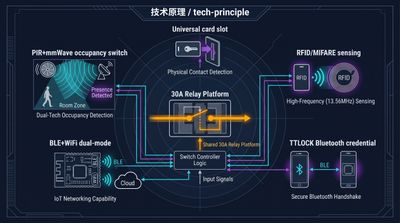
Hotel Key Card Switch: Jenis, Model, dan Cara Memilih
Panduan hotel key card switch mencakup model universal, RFID, TTLOCK, BLE, dan occupancy, serta cara memilih model yang sesuai dengan sistem kartu hotel Anda.
contentGraph.reasons.productContext
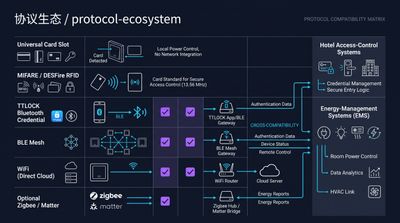
RFID vs NFC untuk Saklar Kartu Kunci Hotel: Pilih Mana?
RFID vs NFC pada saklar kartu kunci hotel berujung pada jangkauan dan penguncian: RFID 125kHz / 13.56MHz (MIFARE, Temic) adalah standar daya kamar hotel…
contentGraph.reasons.productContext
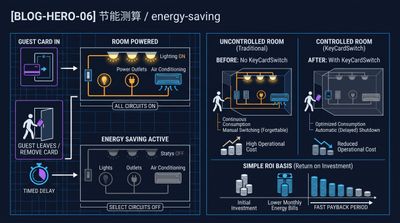
Apa Itu Hotel Key Card Switch dan Cara Hemat Energi Kamar
Hotel key card switch adalah perangkat dinding yang menyalakan listrik kamar saat kartu dimasukkan dan memutusnya saat kartu ditarik, hemat 25–40%…
contentGraph.reasons.productContext
nextStep.blog.title
nextStep.blog.description
- nextStep.blog.points.one
- nextStep.blog.points.two
- nextStep.blog.points.three