PIR vs mmWave: Saklar Sensor Hunian Hotel Mana Lebih Andal
PIR vs mmWave adalah pilihan deteksi saklar sensor hunian hotel. PIR murah untuk deteksi gerakan; mmWave mendeteksi hunian dalam keadaan diam…
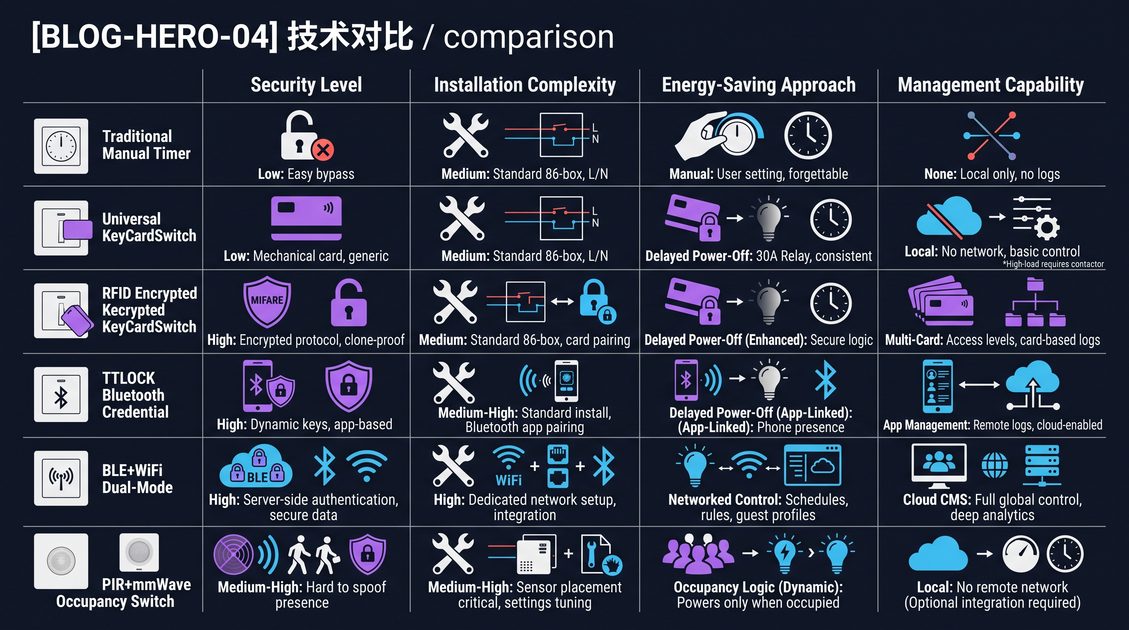
PIR vs mmWave adalah pilihan teknologi deteksi yang menentukan bagaimana saklar sensor hunian hotel mengetahui sebuah ruangan kosong, serta saklar sensor hunian hotel mana yang cocok untuk ruangan tertentu. PIR (passive infrared) adalah sensor berbiaya rendah yang aktif saat benda hangat bergerak melintasi bidang pandangnya, sehingga murah namun buta terhadap orang yang diam di tempat; mmWave (radar gelombang milimeter) merasakan mikro-gerakan seperti pernapasan, sehingga mampu mendeteksi hunian dalam keadaan diam dan tidak akan mematikan daya pada tamu yang sedang tidur. PIR vs mmWave dengan demikian langsung dipetakan ke jenis ruangan: saklar sensor hunian PIR cocok untuk lorong dan ruang rapat dengan lalu lintas pejalan kaki, sementara saklar deteksi kehadiran mmWave cocok untuk kamar tidur tempat tamu duduk atau berbaring diam selama berjam-jam. Keduanya terhubung ke relay 30A dan panel flush yang sama, sehingga saklar sensor hunian hotel hanya berbeda pada modul sensornya, bukan pada pengkabelannya. Saklar sensor hunian hotel menambahkan penghematan energi tanpa kartu dan anti lupa di atas saklar daya key card apa pun.
PIR vs mmWave: Saklar Sensor Hunian PIR untuk Deteksi Gerakan
Saklar sensor hunian PIR memantau perubahan panas inframerah di seluruh zona; saat seseorang berjalan melewatinya, relay tertutup dan ruangan menyala, lalu setelah batas waktu tanpa gerakan, sirkuit dibuka. Model PIR adalah pilihan dengan biaya terendah dan hampir tidak mengonsumsi daya, sehingga ideal untuk koridor, ruang toilet, dan ruang rapat yang kehadirannya selalu berarti gerakan. Keterbatasannya ada pada tamu yang tidur atau duduk: orang yang berhenti bergerak terbaca sebagai tidak hadir, sehingga saklar sensor hunian PIR dapat memutus daya pada seseorang yang sedang membaca di tempat tidur. Untuk ruangan tersebut, pasangkan saklar sensor hunian PIR dengan tautan kontakt pintu (daya mati hanya saat pintu tertutup pada ruangan kosong) atau naik kelas ke mmWave. Saklar PIR adalah pilihan tepat di area dengan lalu lintas yang selalu bergerak dan anggaran terbatas.
PIR vs mmWave: Saklar Deteksi Kehadiran mmWave untuk Hunian Diam
Saklar deteksi kehadiran mmWave memancarkan sinyal chirp radar 24GHz atau 60GHz dan menganalisis tanda mikro-Doppler dari pernapasan manusia pada 0.2–0.5 Hz, sehingga mampu mendeteksi orang yang duduk tanpa gerak atau berbaring tertidur. Karena merasakan kehadiran alih-alih gerakan, saklar sensor hunian mmWave menjaga ruangan tetap menyala bagi tamu yang tidur dan hanya mematikan daya setelah mereka benar-benar pergi. Biayanya lebih tinggi daripada PIR dan membutuhkan sedikit lebih banyak ketelitian desain RF, tetapi untuk kamar tidur, ini adalah satu-satunya sensor yang sesuai dengan hunian nyata. Saklar sensor hunian hotel dengan mmWave adalah padanan tanpa kartu dari saklar daya key card yang tidak pernah "hilang" — ruangan tetap nyaman saat terisi dan menghemat energi saat kosong. Gabungkan dengan saklar keterkaitan kontakt pintu untuk loop paling ketat.
PIR vs mmWave: Cara Memilih Saklar Sensor Hunian Hotel
Pilih berdasarkan perilaku ruangan, bukan hanya harga. Ruang rapat, koridor, ruang toilet → saklar sensor hunian PIR (gerakan berarti terisi). Kamar tidur tamu, ruang santai, area baca → saklar deteksi kehadiran mmWave (diam pun tetap terisi). Penghematan paling maksimal di mana pun → tambahkan input kontakt pintu agar daya terputus begitu pintu ruangan kosong tertutup, apa pun sensornya. Keduanya terpasang pada kotak flush 86×86×48mm yang sama dan mengalihkan beban ruangan 30A yang sama, sehingga saklar sensor hunian hotel dipasang semudah saklar kartu. Lihat sistem manajemen energi hotel untuk cara kombinasi kontrol hunian dan kartu di setiap ruangan.
PIR vs mmWave is the detection-technology choice that decides how a hotel occupancy sensor switch knows a room is empty, and which hotel occupancy sensor switch fits a given room. PIR (passive infrared) is a low-cost sensor that fires when a warm body moves across its field of view, so it is cheap but blind to a stationary person; mmWave (millimeter-wave radar) senses micro-motion such as breathing, so it detects a still-occupant and will not power off on a sleeping guest. PIR vs mmWave therefore maps directly to room type: a PIR occupancy sensor switch suits hallways and meeting rooms with walk-in traffic, while an mmWave presence-detection switch suits bedrooms where guests sit or lie still for hours. Both feed the same 30A relay and flush panel, so a hotel occupancy sensor switch differs only in its sensor module, not in the wiring. A hotel occupancy sensor switch adds card-free, forget-proof energy saving on top of any key card power switch.
PIR vs mmWave: PIR Occupancy Sensor Switch for Motion
A PIR occupancy sensor switch watches for changes in infrared heat across zones; when someone walks through, it closes the relay and the room powers up, and after a no-motion timeout it opens the circuit. The PIR model is the lowest-cost option and draws almost no power, which makes it ideal for corridors, restrooms, and meeting rooms where occupancy always means motion. Its limit is the sleeping or seated guest: a person who stops moving reads as absent, so a PIR occupancy sensor switch can cut power on someone reading in bed. For those rooms, pair a PIR occupancy sensor switch with a door-contact link (power off only when the door closes on an empty room) or step up to mmWave. A PIR switch is the right call where traffic is always moving and budget is tight.
PIR vs mmWave: mmWave Presence-Detection Switch for Still Occupancy
An mmWave presence-detection switch emits a 24GHz or 60GHz radar chirp and analyzes the micro-Doppler signature of human breathing at 0.2–0.5 Hz, so it detects a person who is sitting motionless or lying asleep. Because it senses presence rather than motion, an mmWave occupancy sensor switch keeps the room on for a sleeping guest and powers off only after they genuinely leave. The cost is higher than PIR and slightly more RF design care, but for bedrooms it is the only sensor that matches real occupancy. A hotel occupancy sensor switch with mmWave is the card-free equivalent of a key card power switch that never gets "lost" — the room stays comfortable while occupied and saves energy when empty. Combine it with a door-contact linkage switch for the tightest loop.
PIR vs mmWave: How to Choose a Hotel Occupancy Sensor Switch
Choose by room behavior, not by price alone. Meeting rooms, corridors, restrooms → PIR occupancy sensor switch (motion is occupancy). Guest bedrooms, lounges, reading areas → mmWave presence-detection switch (stillness is still occupancy). Tightest savings anywhere → add a door-contact input so power cuts the moment an empty room's door closes, regardless of sensor. Both mount in the same 86×86×48mm flush box and switch the same 30A room load, so a hotel occupancy sensor switch deploys as easily as a card switch. See the hotel energy management system for how occupancy and card control combine per room.
blog.inArticleCta.title
blog.inArticleCta.description
contentGraph.title
contentGraph.description
contentGraph.sections.products
2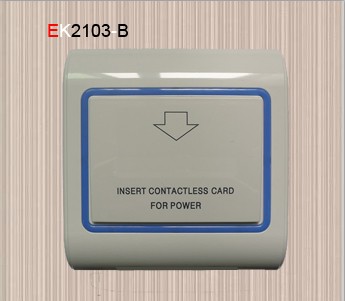
Saklar Sensor Okupansi Hotel — Kontrol Daya Kamar PIR/Radar
Saklar sensor okupansi hotel yang mengontrol daya kamar berdasarkan kehadiran, bukan kartu. Deteksi PIR atau mmWave, AC 180–250V, 30A, linkage kontak pintu.
contentGraph.reasons.explicit
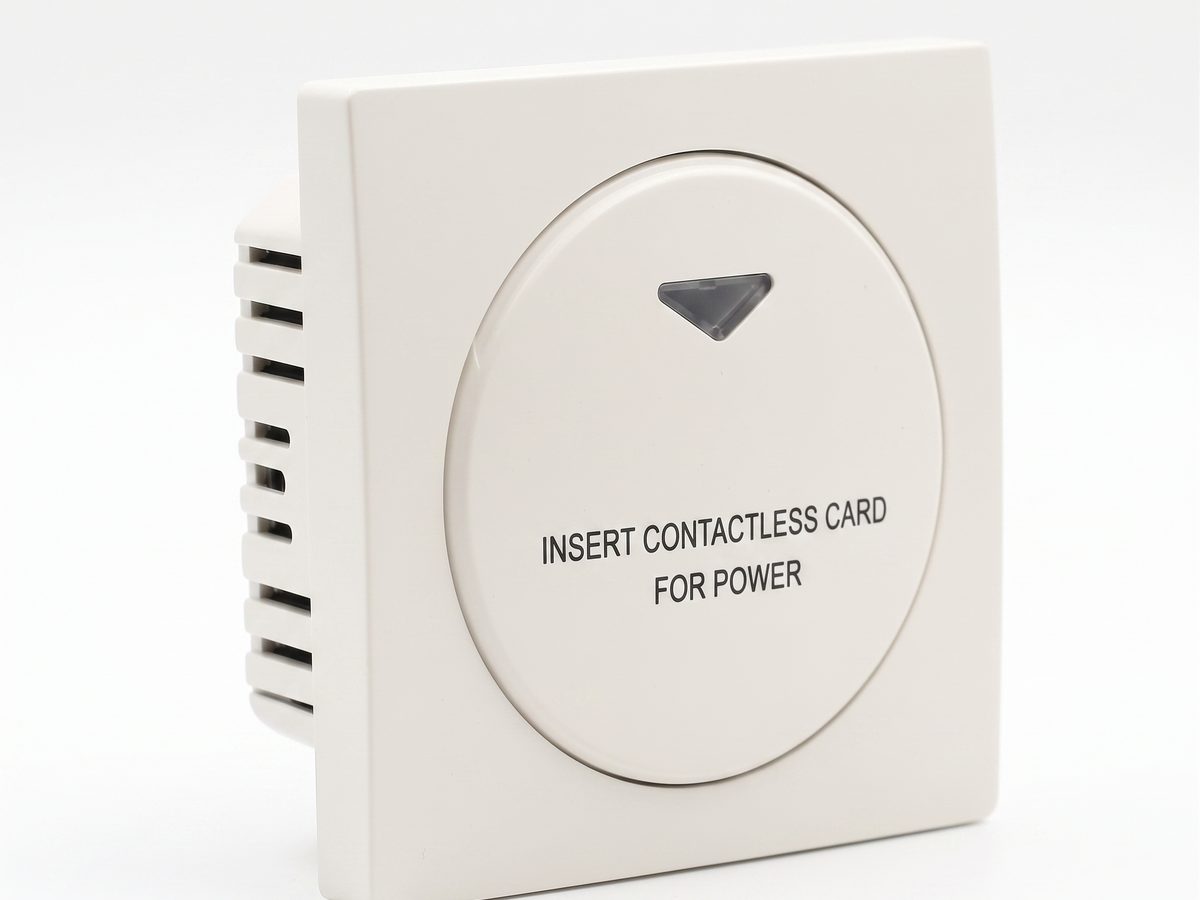
Hotel Key Card Switch — Kontrol Daya Kamar Tamu
Hotel key card switch untuk kontrol daya kamar tamu. Deteksi kartu RFID/IC, masukkan kartu untuk menyalakan daya, penundaan pemadaman saat kartu dilepas. 220V AC, 10A-16A, RS485 atau dry contact. CE RoHS. Pemasok OEM/ODM.
contentGraph.reasons.explicit
contentGraph.sections.solutions
3 Sistem Manajemen Energi Hotel — Kontrol Daya Kamar Efisien
Sistem manajemen energi hotel berbasis sakelar kartu, penghemat energi RFID, dan sensor okupansi yang memangkas 25–40% listrik kamar tamu hotel.
contentGraph.reasons.explicit
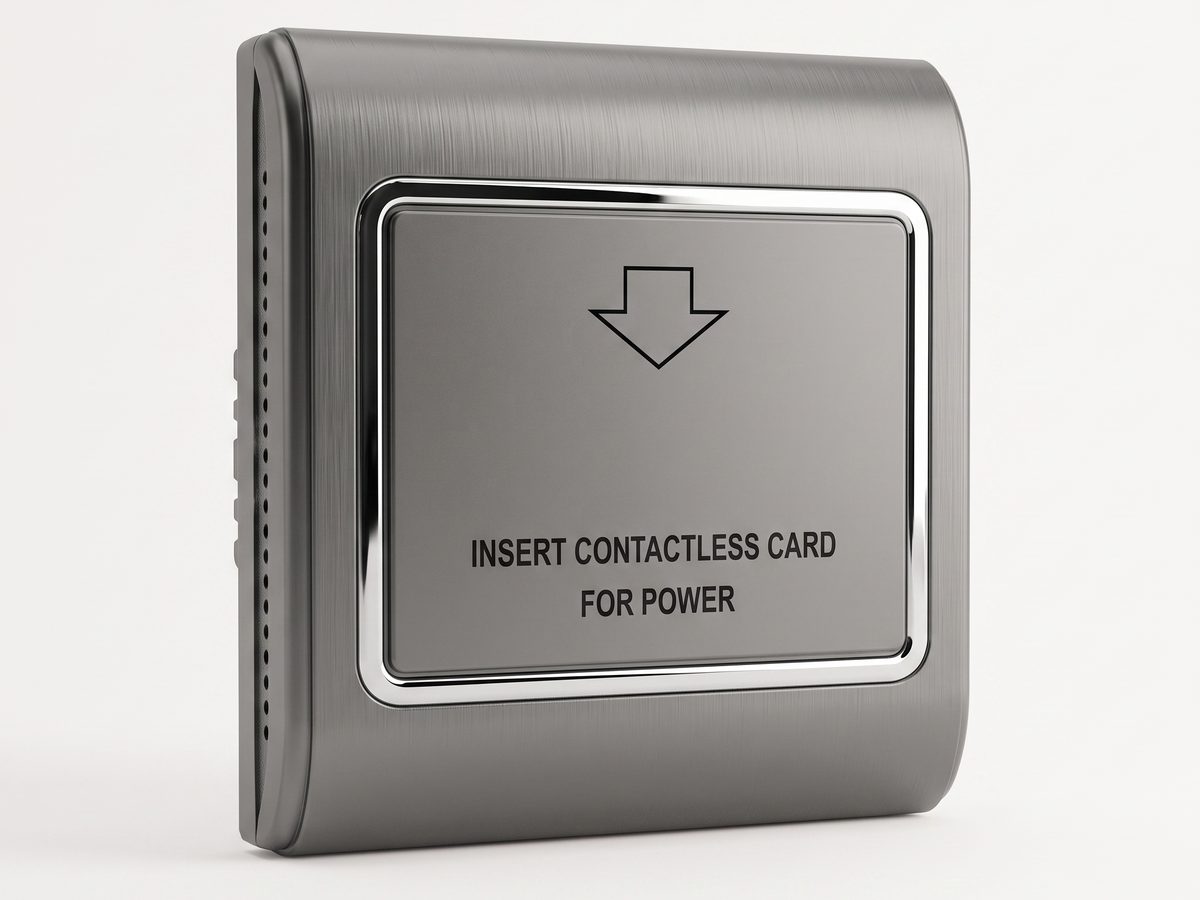
Panduan Pembelian Saklar Hemat Energi Hotel 2026
Panduan membeli saklar hemat energi hotel: kartu universal, RFID/MIFARE, kompatibel TTLOCK, pintar BLE, dan sensor okupansi. Pilih yang tepat untuk kamar Anda.
contentGraph.reasons.explicit
Sistem Manajemen Kamar Hotel Berbasis Kartu Listrik
Sistem manajemen kamar hotel praktis untuk mengatur daya listrik kamar melalui saklar kartu kunci, kontaktor, dan aturan operasional yang terdokumentasi.
contentGraph.reasons.productContext
contentGraph.sections.blog
3
Hotel Key Card Switch: Jenis, Model, dan Cara Memilih
Panduan hotel key card switch mencakup model universal, RFID, TTLOCK, BLE, dan occupancy, serta cara memilih model yang sesuai dengan sistem kartu hotel Anda.
contentGraph.reasons.productContext
RFID vs NFC untuk Saklar Kartu Kunci Hotel: Pilih Mana?
RFID vs NFC pada saklar kartu kunci hotel berujung pada jangkauan dan penguncian: RFID 125kHz / 13.56MHz (MIFARE, Temic) adalah standar daya kamar hotel…
contentGraph.reasons.productContext
Apa Itu Hotel Key Card Switch dan Cara Hemat Energi Kamar
Hotel key card switch adalah perangkat dinding yang menyalakan listrik kamar saat kartu dimasukkan dan memutusnya saat kartu ditarik, hemat 25–40%…
contentGraph.reasons.productContext
nextStep.blog.title
nextStep.blog.description
- nextStep.blog.points.one
- nextStep.blog.points.two
- nextStep.blog.points.three