Key Card Switch vs Sensor Kehadiran mmWave: Mana Lebih Hemat
Bandingkan key card switch vs sensor kehadiran mmWave untuk hotel: logika kontrol, biaya, instalasi, akurasi hunian, dan desain praktis kartu plus radar.
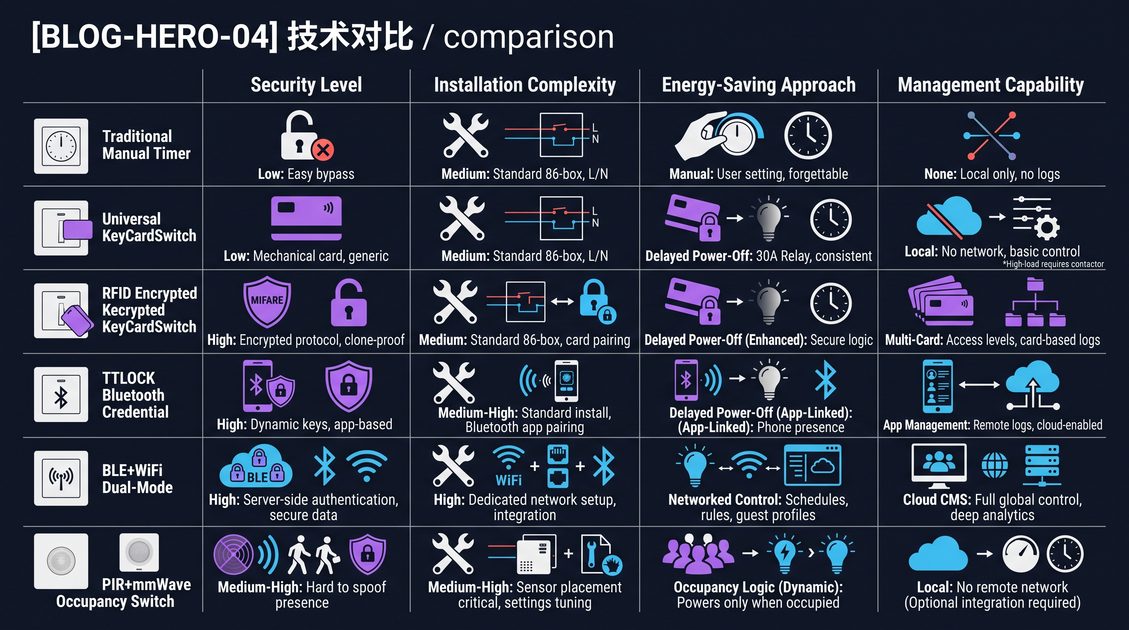
Perbandingan key card switch vs sensor kehadiran mmWave untuk hotel bukanlah persaingan antara dua produk serupa, melainkan keputusan antara dua filosofi berlawanan dalam pengendalian daya kamar tamu. Key card switch adalah perangkat deterministik: ia menyalakan kamar saat kartu yang valid berada di slot dan memutus sirkuit begitu kartu dikeluarkan, tanpa penilaian apakah ada orang yang benar-benar berada di dalam. Sensor kehadiran mmWave adalah perangkat induktif: ia menggunakan radar 24–60 GHz untuk mendeteksi manusia yang diam, termasuk gerakan mikro seperti pernapasan, dan menyalakan kamar hanya selama kehadiran terkonfirmasi. Jika card switch bertanya "apakah ada kartu," sensor kehadiran bertanya "apakah ada tubuh," dan satu perbedaan sederhana ini mendorong setiap keputusan turunan tentang biaya, wiring, upaya retrofit, dan perilaku tamu. Memahami trade-off key card switch vs sensor kehadiran mmWave penting karena sebagian besar hotel sedang memilih antara standar mapan berumur dua dekade dan teknologi sensing yang lebih baru yang, dalam tata letak yang tepat, dapat menghilangkan masalah pemindahan kartu sepenuhnya.
Key Card Switch vs Sensor Kehadiran mmWave untuk Hotel: Dua Filosofi Kontrol
Key card switch vs sensor kehadiran mmWave untuk hotel berbeda pada level logika kontrol sebelum perangkat keras dibandingkan: card switch bersifat deterministik dan digerakkan oleh peristiwa, sedangkan sensor kehadiran bersifat induktif dan digerakkan oleh keadaan. Model deterministik mengandalkan tindakan fisik eksplisit dari tamu: memasukkan kartu menyalakan kamar, dan mengeluarkannya mematikan beban setelah penundaan singkat, biasanya 10 hingga 30 detik. Karena pemicunya adalah objek fisik di dalam slot, keadaan kamar sepenuhnya dapat diprediksi dan setiap kegagalan bersifat mekanis serta terlihat. Model induktif justru menyimpulkan hunian dari pantulan radar, sehingga dapat menyalakan kamar tanpa tindakan tamu dan juga dapat mendeteksi ketika seseorang masih berada di dalam setelah kartu dikeluarkan. Ini berarti kedua perangkat tidak sekadar menempati posisi dinding yang sama secara berbeda; keduanya mewakili asumsi berbeda tentang siapa yang mengendalikan kamar. Card switch memercayai tangan tamu; sensor kehadiran memercayai pengamatan sensor. Bagi tim pengadaan, pertanyaan sebenarnya adalah apakah properti ingin daya terkait dengan token yang harus dibawa dan dimasukkan tamu, atau terkait dengan fakta fisik keberadaan secara kontinu.
Prinsip Deterministik Key Card Switch
Key card switch bekerja dengan aturan yang tidak pernah berubah: kartu masuk berarti daya nyala, kartu keluar berarti daya mati. Perangkat kerasnya adalah relay dengan rating sesuai beban kamar, reader yang menerima kartu yang diterbitkan, mikrokontroler yang memverifikasi validitas kartu, dan sirkuit penundaan yang menahan daya sesaat setelah kartu dikeluarkan sehingga tamu yang menukar atau lupa kartu tidak langsung tenggelam dalam gelap. Karena logikanya biner, hasilnya dapat diulang di setiap kamar dan untuk setiap tamu, serta mudah diaudit oleh housekeeping dan engineering: slot itu menampung kartu atau tidak. Sifat deterministik juga berarti tidak ada kalibrasi, tidak ada pengaturan sensitivitas, dan tidak ada risiko false negative dari tamu yang tidak bergerak. Biaya dari determinisme adalah masalah pemindahan, di mana tamu yang pergi tanpa mengeluarkan kartu, atau kartu yang tertinggal di slot saat housekeeping, membuat kamar tetap menyala.
Prinsip Induktif Sensor Kehadiran mmWave
Sensor kehadiran mmWave menggantikan kartu dengan pengamatan radar. Ia memancarkan sinyal gelombang milimeter pada pita 24 GHz atau 60 GHz dan menganalisis pergeseran frekuensi pantulan untuk mengklasifikasikan apakah ada manusia yang hadir, bergerak, atau diam. Berbeda dengan PIR yang hanya bereaksi pada gerakan besar, mmWave dapat mendeteksi orang yang duduk, tidur, atau membaca tanpa gerakan makro karena ia merasakan gerakan mikro pernapasan dan goyangan tubuh yang halus. Sensor menahan daya kamar terus-menerus selama kehadiran terkonfirmasi dan melepaskan daya hanya setelah vacancy timeout yang dapat disesuaikan, biasanya 5 hingga 15 menit, berlalu. Karena deteksinya induktif, perangkat tidak dapat mengetahui apakah orang tersebut tamu atau petugas housekeeping, dan tidak dapat mengetahui apakah kamar telah dibayar; ia hanya tahu bahwa ada tubuh di sana. Ini membuat sensor kehadiran sangat andal untuk kebenaran hunian tetapi buta terhadap fakta komersial siapa yang berhak berada di kamar.
Bagaimana Perbedaan Ini Mengubah Perilaku Tamu
Kedua filosofi ini mengubah apa yang diminta dari tamu. Dengan card switch, tamu harus memasukkan kartu saat tiba dan mengingat untuk mengeluarkannya saat meninggalkan, dan properti sering mengandalkan rambu serta naluri alami untuk mengambil kartu dari slot sebelum pergi. Dengan sensor kehadiran mmWave, tamu tidak diminta melakukan apa pun, karena kamar merasakan kedatangan dan kepergian dengan sendirinya. Konsekuensi perilakunya adalah card switch rentan terhadap tamu lupa yang meninggalkan kartu di tempatnya, sementara sensor kehadiran rentan terhadap kegagalan sebaliknya, yaitu tamu yang tidur atau berbaring diam sempat dinilai absen jika vacancy timeout diatur terlalu agresif. Tidak ada perangkat yang sempurna; keduanya gagal ke arah yang berlawanan, dan asimetri itulah yang menjadi dasar penggabungan keduanya.
Key Card Switch vs Sensor Kehadiran mmWave untuk Hotel: Bagaimana Masing-Masing Menentukan Daya Kamar
Key card switch vs sensor kehadiran mmWave untuk hotel juga berbeda dalam jalur listrik yang benar-benar mengendalikan beban AC. Key card switch umumnya adalah relay terhubung-seri pada kabel live yang mensaklar sirkuit 30A, sehingga ia terpasang inline dan memutus daya secara fisik. Sensor kehadiran mmWave umumnya adalah modul radar kecil, sering dipasang di plafon atau dinding, yang mendeteksi hunian lalu memberi sinyal ke relay terpisah atau energy-saving switch untuk membuka atau menutup sirkuit. Ini berarti sensor kehadiran sering kali bukan perangkat pembawa beban sama sekali; ia adalah sensor di hulu controller, yang dapat berupa relay DIN-rail, smart switch, atau modul building automation. Penempatan, wiring, dan catu dayanya berbeda sesuai hal itu, dan perbedaan inilah yang membuat jalur retrofit keduanya sangat berbeda.
| Atribut | Key card switch | Sensor kehadiran mmWave |
|---|---|---|
| Logika kontrol | Deterministik (kartu masuk = nyala) | Induktif (kehadiran = nyala) |
| Pemicu | Tamu memasukkan kartu valid | Radar mendeteksi manusia yang diam |
| Saklaran beban | Relay 30A bawaan pada kabel live | Sensor + relay/controller terpisah |
| Lokasi tipikal | Dinding di pintu masuk kamar | Plafon atau dinding, area deteksi |
| Tindakan tamu | Masukkan dan keluarkan kartu | Tidak ada |
| Pelepasan kosong | Segera + penundaan 10–30 detik | Timeout 5–15 menit yang dapat disesuaikan |
| Mode kegagalan | Kartu tertinggal di slot | Tamu diam dinilai absen (jika timeout terlalu singkat) |
Jalur Listrik Key Card Switch
Pada key card switch, relay adalah elemen pembawa beban, dan dirating untuk arus penuh kamar, biasanya 30A pada AC 180–250V. Switch dipasang tertanam pada dinding masuk dan diwire seri dengan jalur live kamar, sehingga saat relay membuka, seluruh sirkuit kamar kehilangan daya. Instalasinya adalah tugas listrik satu titik: bawa live dan netral ke box, terminasikan beban melalui relay, dan atur penundaan. Karena switch membawa beban, tidak diperlukan contactor atau smart relay tambahan, yang menjaga bill of materials tetap kecil dan wiring sederhana untuk retrofit. Perangkat harus dirating untuk arus surge kamar dari AC dan pemanas air, itulah mengapa rating relay dan penundaan 15 detik dispesifikasikan bersamaan.
Jalur Listrik Sensor Kehadiran mmWave
Sensor kehadiran mmWave biasanya tidak mensaklar beban kamar secara langsung karena modul radar adalah perangkat kontrol berdaya rendah, bukan contactor berarus tinggi. Dalam tata letak hotel tipikal, sensor diberi daya 5V atau 12V dan mengeluarkan dry contact, penutupan relay, atau sinyal hunian digital ke energy-saving switch atau relay yang membawa beban AC. Ini menciptakan arsitektur dua bagian: sensing dan saklaran dipisahkan. Keunggulannya adalah fleksibilitas, karena satu sensor dapat menggerakkan beberapa output atau seluruh zona koridor, dan vacancy timeout adalah parameter perangkat lunak, bukan sirkuit tetap. Biayanya adalah lebih banyak komponen, lebih banyak titik wiring, dan langkah commissioning untuk memasangkan setiap sensor dengan controllernya serta mengatur zona deteksi dan timeout-nya.
Mengapa Perbedaan Listrik Penting untuk Retrofit
Perbedaan listrik diterjemahkan langsung menjadi tingkat kesulitan retrofit. Mengganti wall switch manual yang ada dengan key card switch biasanya berupa penggantian satu-ke-satu: lepas switch, pasang card switch di box yang sama, dan hubungkan kembali kabel live yang sama, itulah sebabnya card switch terkenal cepat dalam instalasi per kamar. Menambahkan sensor kehadiran mmWave di mana tidak ada infrastruktur sensor sering kali berarti menambah perangkat baru, menjalankan daya tegangan rendahnya, dan mengintegrasikan output huniannya dengan controller atau energy-saving switch, yang dapat melibatkan lebih banyak profesi dan lebih banyak titik kegagalan. Untuk properti yang sudah ada, key card switch cenderung menang pada kesederhanaan instalasi murni, sementara sensor kehadiran cenderung menang pada fleksibilitas new-build, di mana sensor dapat tertanam sejak tahap konstruksi.
Key Card Switch vs Sensor Kehadiran mmWave untuk Hotel: Perbandingan Biaya dan Instalasi
Key card switch vs sensor kehadiran mmWave untuk hotel berbeda tajam pada biaya dan upaya instalasi, dan bagi sebagian besar properti total biaya kepemilikan adalah faktor penentu. Key card switch adalah perangkat mandiri dengan biaya per unit moderat, satu wall box, tanpa jaringan, dan retrofit cepat, sehingga biaya terpasangnya rendah dan dapat diprediksi. Sensor kehadiran mmWave biasanya memiliki harga per unit lebih tinggi untuk modul radar, ditambah biaya controller atau relay serta instalasi dan commissioning yang lebih rumit, sehingga biaya awalnya lebih tinggi. Kesenjangan itu tidak hanya ada di perangkat keras tetapi juga di tenaga kerja, karena card switch adalah penggantian listrik satu profesi sementara sensor kehadiran sering memerlukan koordinasi antara profesi listrik dan tegangan rendah. Untuk properti dengan ratusan kamar, perbedaan per kamar ini berlipat di seluruh gedung, itulah mengapa pemodelan biaya begitu sering menggeser keputusan ke card switch pada pembelian pertama.
| Faktor biaya | Key card switch | Sensor kehadiran mmWave |
|---|---|---|
| Perangkat keras per kamar | Lebih rendah (satu perangkat) | Lebih tinggi (sensor + relay/controller) |
| Wiring | Pakai ulang wall box yang ada | Mungkin perlu jalur daya tegangan rendah |
| Tenaga kerja per kamar | Lebih rendah, satu profesi | Lebih tinggi, dua profesi + commissioning |
| Perangkat keras jaringan | Tidak ada | Controller, mungkin gateway |
| Commissioning | Minimal (atur penundaan) | Deteksi zona + penyetelan timeout |
| Kecepatan retrofit | Cepat | Lebih lambat |
| Sensitivitas biaya unit | Sangat sensitif | Kurang sensitif |
Biaya Perangkat Keras Key Card Switch
Biaya perangkat keras key card switch didominasi satu bill of materials: card reader, mikrokontroler, relay 30A, dan panel tertanam. Karena tidak ada modul radio, antena, atau ketergantungan cloud, biaya unitnya tetap rendah dan stabil untuk pesanan besar, dan tidak berskala rumit dengan jumlah kamar. Reader sendiri dipilih berdasarkan sistem kartu, dan karena model universal membaca kartu M1 apa pun, switch yang sama bekerja apa pun jenis kartu yang diterbitkan properti, baik RFID, Temic, maupun TTLOCK. Ini menjadikan key card switch salah satu perangkat penghemat energi yang paling dapat diprediksi biayanya bagi hotel, tanpa posisi tersembunyi jaringan atau perangkat lunak per kamar.
Biaya Perangkat Keras Sensor Kehadiran mmWave
Biaya perangkat keras sensor kehadiran mmWave tersebar pada modul radar, catu dayanya, serta relay pembawa beban atau energy-saving switch yang digerakkannya. Chipset radar 24 GHz atau 60 GHz dengan antena, penguat, dan firmware pemrosesan sinyal lebih mahal daripada card reader dan relay, dan sensor biasanya memerlukan controller terpisah untuk menerjemahkan output huniannya menjadi saklaran AC. Pada desain kamar terhubung mungkin juga ada gateway atau bus controller per lantai. Hasilnya, solusi sensor kehadiran memiliki lebih banyak komponen untuk diadakan, lebih banyak titik stok cadangan, dan bill of materials per kamar sedikit lebih tinggi, meskipun harga chip mmWave terus turun dan kesenjangannya menyempit seiring volume.
Tenaga Kerja Instalasi dan Upaya Commissioning
Tenaga kerja instalasi adalah titik perbedaan terbesar kedua solusi dalam praktik. Retrofit key card switch adalah penggantian listrik: listrikian membuka wall box yang ada, memasang card switch, dan men-terminasikan kabel live dan netral yang sama, biasanya 15 hingga 30 menit per kamar tanpa gabung jaringan dan tanpa pengaturan perangkat lunak selain atur penundaan. Instalasi sensor kehadiran mmWave lebih rumit: sensor harus diposisikan dan diarahkan sesuai kebutuhan cakupan, diberi daya tegangan rendah, diwire ke relay atau energy-saving switch, lalu di-commissioning dengan zona deteksi disesuaikan agar radar tidak false-trigger pada korden, kipas, atau gerakan di koridor. Commissioning sensor kehadiran dengan baik dapat memakan waktu lebih lama per kamar dan lebih sulit distandarisasi di berbagai bentuk kamar, yang menaikkan tenaga kerja dan menaikkan total biaya terpasang.
Perspektif Total Biaya Kepemilikan
Saat membandingkan key card switch vs sensor kehadiran mmWave untuk hotel, framing yang jujur adalah total biaya kepemilikan selama masa kerja perangkat, bukan sekadar harga etalase. Card switch memiliki biaya awal lebih rendah, biaya operasional nyaris nol, dan umur mekanis panjang, tetapi bergantung pada perilaku tamu yang benar untuk memberikan penghematan. Sensor kehadiran memiliki biaya awal lebih tinggi dan risiko commissioning berkelanjutan, tetapi dapat meraih penghematan tanpa kerja sama tamu. Untuk retrofit imbal hasil cepat dengan modal ketat, card switch biasanya pembelian berisiko lebih rendah. Untuk properti yang prioritasnya menghilangkan pemindahan kartu dan mengotomatisasi kebenaran hunian di seluruh gedung, biaya lebih tinggi sensor kehadiran membeli kemampuan yang tidak dapat diberikan card switch.
Key Card Switch vs Sensor Kehadiran mmWave untuk Hotel: Akurasi Deteksi dan Hunian
Key card switch vs sensor kehadiran mmWave untuk hotel juga harus dinilai dari akurasi, meski keduanya mengukur hal berbeda. Key card switch akurat terhadap kartu: jika kartu di slot, kamar menyala, dan ini benar 100% waktu, sehingga sinyal huniannya eksak tetapi terikat pada objek, bukan orang. Sensor kehadiran mmWave akurat terhadap tubuh: ia dapat mendeteksi manusia yang diam dengan true-positive rate yang umumnya melampaui 99% dalam pengujian terkontrol, tetapi sinyal huniannya adalah inferensi probabilistik yang dipengaruhi jangkauan deteksi, sudut, oklusi, dan lingkungan. Card switch memiliki kepastian sempurna tentang hal yang salah, dan sensor kehadiran memiliki kepastian nyaris sempurna tentang hal yang benar, dan itulah persisnya alasan keduanya begitu komplementer dalam desain gabungan.
| Faktor akurasi | Key card switch | Sensor kehadiran mmWave |
|---|---|---|
| Sinyal hunian berdasarkan | Kehadiran kartu | Kehadiran tubuh |
| Deteksi orang diam | T/A (butuh kartu) | Ya, via gerakan mikro pernapasan |
| False negative (penghuni terlewat) | Kartu dikeluarkan | Tamu diam dinilai absen |
| False positive (kosong dinilai penuh) | Kartu tertinggal di slot | Korden/kipas/pantulan |
| Jangkauan deteksi | T/A | 6–8 m tipikal |
| Faktor lingkungan | Tidak ada | Mebel, kaca, oklusi |
| Kalibrasi diperlukan | Tidak ada | Penyetelan zona + timeout |
Apa yang Dideteksi Key Card Switch dan Titik Butanya
Key card switch mendeteksi satu hal dengan andal sepenuhnya: keberadaan kartu valid di slot. Ia tidak dan tidak dapat mendeteksi orang, sehingga tidak sadar akan tamu yang masuk kamar tanpa kartu, anak yang tinggal di dalam saat orang tuanya pergi, atau petugas housekeeping yang bekerja di kamar yang kartunya sudah dikeluarkan. Titik butanya adalah kartu yang tertinggal di slot: tamu yang meninggalkan kartu, pebisnis yang meninggalkannya sebagai kebiasaan, atau petugas housekeeping yang menyekap pintu dengan kartu, semuanya membuat kamar tetap menyala meski tidak ada orang di dalam. Karena switch tidak dapat mengamati tubuh, ia tidak pernah bisa mengoreksi kasus-kasus ini, dan properti kehilangan energi yang ingin dihematnya justru pada kamar-kamar yang mengalahkan sistem.
Apa yang Dideteksi Sensor Kehadiran mmWave dan Titik Butanya
Sensor kehadiran mmWave mendeteksi tubuh manusia dengan keandalan tinggi, termasuk orang yang diam, karena membaca gerakan mikro pernapasan pada jangkauan tipikal 6 hingga 8 meter. Titik butanya bersifat lingkungan, bukan perilaku: mebel padat, kaca tebal, sekat logam, atau sensor yang diarahkan menjauhi zona hunian dapat melemahkan atau memantulkan sinyal radar dan menyebabkan deteksi terlewat, sementara embusan AC yang kuat atau korden bergerak sesekali dapat diklasifikasikan sebagai kehadiran dan menahan kamar tetap menyala. Karena deteksinya inferensial, sensor memerlukan margin timeout yang wajar, itulah sebabnya sebagian besar pengaturan vacancy adalah 5 hingga 15 menit, bukan beberapa detik. Sensor sangat andal di titik buta card switch, dan hanya sedikit tidak sempurna di tempat card switch bersifat deterministik.
Mengapa Akurasi Saja Tidak Menentukan Pilihan
Akurasi saja tidak menentukan keputusan key card switch vs sensor kehadiran mmWave karena kedua perangkat akurat di domain berbeda. Properti yang menginginkan kepastian tentang fakta komersial, bahwa kamar telah diotorisasi dan kartu tersedia, menghargai sinyal deterministik card switch. Properti yang menginginkan kepastian tentang fakta fisik, bahwa ada tubuh yang benar-benar berada di kamar, menghargai deteksi sensor kehadiran. Tidak satu pun metrik merupakan definisi lengkap dari "terisi", itulah sebabnya banyak hotel menggabungkan keduanya: card switch menetapkan otorisasi dan memberi off instan yang deterministik saat kartu dikeluarkan, sementara sensor mmWave menjaga terhadap kartu yang tertinggal di slot dan tamu yang tinggal tanpa kartu.
Key Card Switch vs Sensor Kehadiran mmWave untuk Hotel: Perawatan dan Siklus Hidup
Key card switch vs sensor kehadiran mmWave untuk hotel berbeda dalam apa yang aus, apa yang perlu perawatan, dan berapa lama masing-masing bertahan dalam layanan. Key card switch sebagian besar mekanis dan pasif: relaynya punya jumlah operasi saklaran yang terbatas, readernya tanpa bagian bergerak, dan tidak ada ritme pembaruan firmware, sehingga cenderung berjalan bertahun-tahun dengan sedikit perhatian di luar pembersihan slot kartu sesekali. Sensor kehadiran mmWave adalah perangkat elektronik dengan transceiver radar, firmware, dan sensitivitas yang dapat bergeser atau perlu disetel ulang saat tata letak kamar berubah, sehingga mungkin memerlukan re-commissioning dan pembaruan perangkat lunak sesekali. Card switch adalah perangkat pasang-dan-lupakan; sensor kehadiran adalah perangkat terkelola. Bagi properti dengan staf engineering terbatas, perbedaan beban siklus hidup ini adalah biaya operasional nyata.
| Faktor siklus hidup | Key card switch | Sensor kehadiran mmWave |
|---|---|---|
| Bagian aus | Relay (siklus saklaran) | Tidak ada yang mekanis; firmware |
| Pembersihan | Debu slot kartu | Lensa/permukaan sensor |
| Pembaruan firmware | Umumnya tidak ada | Sesekali |
| Re-commissioning | Jarang | Setelah tata letak kamar berubah |
| Rata-rata waktu ke gagal | Tinggi (sedikit bagian) | Tinggi, tetapi elektronik |
| Strategi cadangan | Simpan satu model | Simpan model sensor + relay |
| Ketergantungan jaringan | Tidak ada | Mungkin bergantung pada controller |
Profil Perawatan Key Card Switch
Profil perawatan key card switch didominasi relay yang punya jumlah operasi saklaran terbatas sebelum aus kontak menjadi masalah, dan card reader yang kontak serta slotnya dapat mengumpulkan debu atau kotoran pada penggunaan berat. Dalam praktiknya card switch bersifat pasif, tanpa tautan jaringan, tanpa baterai, dan tanpa firmware yang dapat rusak, sehingga tugas perawatan utamanya adalah pembersihan berkala slot, verifikasi sesekali bahwa sirkuit penundaan bekerja, dan menyimpan stok cadangan kecil untuk relay. Karena perangkatnya deterministik, kegagalan biasanya terlihat dan mudah didiagnosis: kamar itu tetap menyala atau tetap mati. Profil minim sentuhan ini cocok untuk properti yang menginginkan kontrol energi tanpa anggaran perangkat lunak atau commissioning.
Profil Perawatan Sensor Kehadiran mmWave
Profil perawatan sensor kehadiran mmWave berpusat pada firmware dan lingkungan, bukan bagian aus. Sensor tidak ada keausan mekanis, tetapi firmwarenya mungkin menerima pembaruan untuk algoritma deteksi atau perubahan protokol, dan zona deteksinya mungkin perlu re-commissioning saat kamar difurnish ulang, saat TV atau objek logam besar ditambahkan, atau saat sensor tergeser tanpa sengaja. Karena sensor melaporkan hunian lewat inferensi, perilaku halus seperti false-positive ringan atau deteksi terlewat sesekali bisa lebih sulit dikenali staf daripada card switch yang gagal dengan jelas terbuka atau tertutup. Sensor juga hanya satu mata rantai yang mencakup catu dayanya dan relay pembawa bebannya, sehingga daftar cadangannya lebih panjang.
Biaya Siklus Hidup dan Strategi Suku Cadang
Perbandingan siklus hidup memengaruhi gambar suku cadang dan total biaya. Armada card switch dapat dipelihara dengan satu model cadangan untuk bodi switch dan relay, distok murah dan ditukar dalam hitungan menit oleh satu listrikian. Armada sensor kehadiran memerlukan cadangan untuk sensor, catu dayanya, dan relay saklaran atau controllernya, dan staf harus mampu melakukan re-commissioning pada unit pengganti, yang merupakan keterampilan lebih terspesialisasi. Dalam horizon lima tahun, card switch cenderung berbiaya tenaga kerja perawatan lebih rendah dan jalur cadangan lebih sederhana, sementara sensor kehadiran menawarkan kemampuan berkelanjutan tetapi membawa biaya manajemen operasional sedikit lebih tinggi, trade-off yang harus ditimbang hotel terhadap energi yang dihematnya.
Kapan Memilih Key Card Switch Daripada Sensor Kehadiran mmWave untuk Hotel
Key card switch vs sensor kehadiran mmWave untuk hotel berpihak jelas ke card switch dalam beberapa situasi properti umum. Key card switch adalah pilihan lebih baik saat retrofit harus cepat dan murah, saat properti sudah menerbitkan kartu dan tidak ingin perubahan perilaku tamu, saat tim engineering kecil dan lebih menyukai perangkat pasang-dan-lupakan, saat kamar berbentuk canggung atau berperabotan berat yang membuat deteksi radar tidak andal, atau saat anggaran tidak mencukupi sensor berjaringan dan commissioning. Bagi pemilik yang peduli anggaran meretrofit stok kamar standar yang sudah ada, card switch deterministik biasanya memberikan penghematan dapat diprediksi dengan biaya terpasang terendah dan tuntutan operasional paling sedikit.
- Retrofit cepat dan murah untuk banyak kamar dalam jendela waktu singkat
- Properti sudah menjalankan sistem kartu dan ingin penggantian satu-ke-satu
- Tim perawatan kecil atau non-teknis yang menyukai perangkat pasif
- Geometri kamar canggung atau perabot berat yang dapat mengalahkan radar
- Tidak berminat pada perangkat keras berjaringan atau waktu commissioning
- Prioritas adalah pemutusan energi yang terbukti, dapat diaudit, dan deterministik
Ketika Perilaku Tamu Sudah Disiplin
Key card switch bekerja paling baik di mana tamu sudah memperlakukan kartu sebagai kunci kamar, yaitu di sebagian besar hotel standar. Karena tamu mengeluarkan kartu untuk membawa kuncinya, tindakan pergi secara alami memicu pemadaman daya, dan tidak perlu kampanye rambu atau pelatihan ulang. Di properti di mana kartu adalah kunci pintu, card switch menyelaraskan pemicu penghematan energi dengan tindakan yang sudah dilakukan tamu, dan itulah argumen terkuat untuk model deterministik. Penghematan terwujud otomatis setiap kali tamu pergi, tanpa penilaian sensor dan tanpa deteksi palsu.
Ketika Sumber Daya Engineering Terbatas
Properti dengan tim engineering kecil atau kewalahan cenderung menyukai card switch karena tidak butuh jaringan, commissioning, pembaruan firmware, atau penyetelan sensitivitas. Kegagalan card switch bersifat mekanis dan terlihat, dan cadangan ditukar dalam hitungan menit tanpa alat khusus. Bagi waralaba atau hotel independen tanpa spesialis tegangan rendah internal, siklus hidup minim sentuhan card switch adalah keunggulan operasional menentukan dibanding sensor yang mungkin perlu re-commissioning setelah perubahan kamar.
Ketika Kecepatan Retrofit adalah Kendala
Saat jendela renovasi pendek, card switch menang pada kecepatan. Karena menggantikan wall switch yang ada di box yang sama dengan kabel live yang sama, listrikian kompeten dapat menyelesaikan banyak kamar per hari dengan gangguan minimal pada lantai terisi. Sensor kehadiran, sebaliknya, menambah penempatan, daya tegangan rendah, wiring ke relay, dan commissioning, yang memperpanjang siklus per kamar dan dapat memerlukan lebih dari satu profesi. Untuk renovasi musiman yang ketat, card switch adalah jalur berisiko lebih rendah untuk selesai sesuai jadwal.
Kapan Sensor Kehadiran mmWave Unggul Daripada Key Card Switch untuk Hotel
Key card switch vs sensor kehadiran mmWave untuk hotel berbalik arah saat properti membutuhkan kebenaran hunian, bukan otorisasi kartu. Sensor kehadiran mmWave adalah pilihan lebih baik di new-build di mana sensor dapat tertanam sejak konstruksi, di kamar premium di mana pengalaman tamu meniadakan pemindahan kartu apa pun, di suite dengan kamar mandi atau sudut yang tidak tercakup kartu, di kamar di mana tamu umumnya tinggal di dalam tanpa kartu, dan di program kamar terhubung yang menginginkan data kehadiran untuk otomasi HVAC dan pencahayaan. Sensor kehadiran juga menang di mana pun tujuannya menghilangkan kebocoran tamu lupa yang tidak dapat dikoreksi card switch.
- Konstruksi baru di mana sensor tertanam sejak saat pembangunan
- Kamar premium atau long-stay yang harus terasa mulus
- HVAC dan pencahayaan sadar hunian melampaui on-off sederhana
- Kamar di mana tamu tinggal di dalam tanpa memasukkan kartu
- Properti yang menginginkan data kehadiran, bukan sekadar kontrol daya
- Tata letak dengan garis pandang bersih yang menguntungkan radar
Ketika Pengalaman Tamu Menuntut Tanpa Kartu
Untuk properti premium, residensi long-stay, dan wellness suite, pemindahan kartu dapat terasa seperti gesekan, dan sensor kehadiran mmWave menghilangkannya sepenuhnya dengan menyalakan kamar saat kedatangan tanpa tindakan tamu apa pun. Pada segmen ini, biaya halus meminta tamu mengelola daya kamar melebihi penghematan energi, dan ketakterlihatan sensor kehadiran itu sendiri adalah nilainya. Sensor juga menangani tamu yang beranjak santai di kamar, bekerja di meja, atau tidur, menjaga daya terus menyala selama ada tubuh yang hadir, tanpa risiko pemadaman di tengah menginap akibat kartu salah tempat.
Ketika Data Hunian Menggerakkan Gedung
Saat properti ingin melampaui kontrol on-off sederhana menuju HVAC sadar hunian, scene pencahayaan, dan otomasi koridor, sensor kehadiran mmWave adalah fondasinya karena mengeluarkan sinyal hunian nyata yang dapat digunakan controller. Card switch hanya mengeluarkan biner ada-kartu yang tidak memberi tahu apa pun tentang posisi orang di kamar atau apakah ia aktif. Sinyal sensor kehadiran yang lebih kaya memungkinkan kontrol per zona, seperti menjaga kamar mandi tetap menyala sementara area tidur diredupkan, yang mustahil dengan satu wall card switch. Untuk program manajemen energi berbasis data, sensor kehadiran adalah platform yang lebih mampu.
Ketika Kamar Terisi Tanpa Kartu
Beberapa pola hunian mengalahkan card switch: pasangan di mana satu orang memegang kartu dan yang lain tinggal di dalam, orang tua yang meninggalkan kartu sementara anak tidur siang, atau tamu long-stay yang tidak pernah mengeluarkan kartu sepanjang hari. Dalam semua kasus ini card switch menyalakan kamar kosong atau gagal menyalakan kamar terisi. Sensor kehadiran mmWave tidak peduli kartu dan mengunci daya pada tubuh, sehingga menangkap penghematan dan menjaga kenyamanan tepat pada pola-pola di mana card switch salah. Bagi properti dengan porsi signifikan kamar multi-penghuni atau long-stay, kemampuan ini saja dapat membenarkan sensor tersebut.
Solusi Gabungan: mmWave Mendeteksi, Key Card Switch Menjadi Cadangan
Key card switch vs sensor kehadiran mmWave untuk hotel bukan pilihan biner, karena desain terkuat menggunakan keduanya. Dalam solusi gabungan, sensor kehadiran mmWave adalah detektor penghuni utama dan key card switch bertindak sebagai cadangan deterministik serta lapisan otorisasi. Keduanya bekerja bersama sehingga masing-masing menutupi titik buta yang lain: sensor mmWave menjaga terhadap kartu yang tertinggal di slot dengan melepaskan daya saat kamar benar-benar kosong, dan key card switch menjamin kamar tidak dapat menyala melampaui sinyal kartu yang diotorisasi serta memberikan off instan dan deterministik begitu kartu dikeluarkan. Redundansi ini mengubah sepasang perangkat tak sempurna menjadi satu sistem yang tangguh.
| Perilaku mode gabungan | Sensor | Cadangan card switch |
|---|---|---|
| Tamu mengeluarkan kartu dan pergi | — | Pemadaman instan (deterministik) |
| Tamu meninggalkan kartu di slot | Deteksi kamar kosong, lepaskan daya | Kartu saja akan tetap menyalakan |
| Tamu tinggal tanpa kartu | Tahan daya tetap menyala | Kartu saja akan memutusnya |
| Housekeeping di dalam | Deteksi kehadiran | Kartu mengatur otorisasi |
| Kamar kosong setelah vacancy | Melepaskan daya | Kartu saja tak bisa mengosongkan |
| Pemeriksaan otorisasi | t/a | Kartu valid wajib |
Bagaimana Logika Cadangan Bekerja
Dalam susunan wiring gabungan tipikal, key card switch membawa beban dan memerlukan kartu valid untuk menyalakan sirkuit, sementara sensor kehadiran mmWave berada di hulu dan juga dapat menahan sirkuit menyala selama mendeteksi tubuh. Logikanya adalah OR untuk menahan: kamar tetap menyala jika kartu ada atau sensor mendeteksi hunian, dan memutus daya hanya ketika kedua kondisi berakhir, yaitu ketika tidak ada kartu dan tidak ada tubuh yang terdeteksi. Ini mempertahankan off deterministik card switch saat tamu pergi membawa kartu, dan menambah kemampuan sensor melepaskan kamar yang kartunya tertinggal. Kedua kondisi tumpang tindih bersih dan masing-masing memberikan jaring pengaman atas mode kegagalan yang lain.
Mengapa Kombinasi Ini Layak dengan Perangkat Keras Tambahan
Desain gabungan layak dengan perangkat keras tambahannya di properti di mana kebocoran energi dari kartu yang dilupakan cukup besar untuk mengimbangi biaya sensor. Setiap kamar di mana tamu kebiasaan meninggalkan kartu di slot adalah kamar di mana card switch saja tidak menghemat apa pun, dan sensor mmWave menutup persis kebocoran itu dengan mengosongkan kamar saat kosong. Sebaliknya, setiap tamu premium yang beranjak santai tanpa kartu dilindungi oleh deteksi kehadiran sensor. Karena card switch tetap memberikan off instan yang deterministik dan pemeriksaan otorisasi, properti mempertahankan penghematan dapat diaudit dari sistem kartu sambil memperoleh kebenaran hunian dari radar, dan itulah sebabnya semakin banyak hotel peduli energi yang menspesifikasikan sepasang ini, bukan satu perangkat.
Commissioning Pasangan Ini Bersamaan
Commissioning sistem gabungan memerlukan tiga parameter yang harus selaras: penundaan pelepasan card switch, vacancy timeout sensor kehadiran, dan aturan koordinasi di antara keduanya. Vacancy timeout harus cukup panjang untuk menghindari memutus daya tamu yang diam, biasanya 5 hingga 15 menit, dan sedikit lebih panjang daripada penundaan singkat card switch agar sensor tidak saling melawan dengan switch. Zona deteksi sensor harus mencakup area hunian utama tanpa meluber ke koridor atau false-trigger pada korden. Saat semuanya diatur dengan benar, kedua perangkat berperilaku sebagai satu sistem, dan properti mendapatkan kontrol deterministik dengan jaring pengaman sensing, pendekatan terdekat dari kedua teknologi menuju jawaban lengkap atas pertanyaan daya kamar.
Key Card Switch vs Sensor Kehadiran mmWave untuk Hotel: Daftar Periksa Spesifikasi
Key card switch vs sensor kehadiran mmWave untuk hotel menyempit menjadi latihan spesifikasi setelah filosofi dipilih, dan daftar periksa ini menjaga keputusan tetap objektif. Apakah Anda memilih key card switch, sensor kehadiran mmWave, atau desain gabungan, kategori yang sama berlaku: voltase dan rating beban, pemasangan dan enklosure, logika kontrol dan timeout, protokol kartu atau deteksi, kepatuhan, dan suku cadang. Mengisi kolom-kolom ini terhadap stok kamar Anda mengubah perdebatan filosofis menjadi bill of materials konkret, dan memperlihatkan di mana deployment hibrida lintas tipe kamar adalah jawaban paling efisien.
| Kolom spesifikasi | Key card switch | Sensor kehadiran mmWave |
|---|---|---|
| Voltase | AC 180–250V (110V atas permintaan) | Sensor 5–12V; relay untuk AC |
| Rating beban | Relay 30A | Relay/controller disesuaikan beban |
| Pemicu | Kartu valid (M1 / MIFARE / Temic / TTLOCK) | Radar kehadiran 24/60 GHz |
| Timeout | Penundaan pelepasan 10–30 detik | Vacancy 5–15 menit |
| Jangkauan deteksi | t/a | 6–8 m tipikal |
| Pemasangan | Dinding di pintu masuk | Plafon atau dinding |
| Jaringan | Tidak ada | Controller / gateway opsional |
| Commissioning | Hanya penundaan | Zona + timeout |
| Kepatuhan | Sesuaikan standar listrik proyek | Sesuaikan standar listrik proyek |
| Suku cadang | Switch + relay | Sensor + relay + PSU |
Voltase, Beban, dan Keselamatan
Keputusan spesifikasi pertama adalah kelistrikan: konfirmasi voltase properti, yaitu AC 180–250V untuk sebagian besar proyek dan 110V atas permintaan pada properti Amerika Utara, dan ukur relay sesuai beban aktual kamar termasuk surge AC. Key card switch harus membawa relay dengan rating untuk arus surge tersebut, biasanya 30A, agar kontaknya tidak menyatu saat kompresor menyala. Sensor kehadiran mmWave, sebagai perangkat tegangan rendah, memerlukan catu daya sendiri serta relay atau energy-saving switch dengan rating untuk beban AC yang digerakkannya. Dalam kedua kasus, perangkat keras harus dipilih sesuai standar listrik dan keselamatan proyek, dan enklosure dipilih sesuai lokasi pemasangan.
Protokol Kartu dan Zona Deteksi
Keputusan berikutnya adalah antarmuka pemicu. Untuk key card switch, spesifikasikan reader terhadap sistem kartu yang sudah digunakan: model universal membaca UID kartu M1 apa pun tanpa re-carding, model RFID memvalidasi sector key MIFARE atau Temic untuk pengikatan kamar, dan model kompatibel TTLOCK membaca jendela waktu check-in. Untuk sensor kehadiran mmWave, spesifikasikan pita radar, jangkauan deteksi dalam meter, tipe pemasangan, dan vacancy timeout, serta konfirmasi sensor dapat mencakup area hunian utama tanpa false-trigger. Spesifikasi pemicu adalah kolom tunggal yang harus cocok dengan sisa armada, sehingga layak mendapat pemeriksaan paling ketat.
Retrofit, Kepatuhan, dan Suku Cadang
Terakhir, konfirmasi jalur retrofit, sikap kepatuhan, dan strategi suku cadang. Untuk retrofit, konfirmasi wall box yang ada dapat menampung perangkat pilihan dan tidak perlu re-carding, yang menjaga instalasi tetap satu profesi dan cepat. Konfirmasi perangkat keras memenuhi standar listrik dan lingkungan proyek untuk wilayah dan lokasi pemasangan yang dimaksud, tanpa melebih-lebihkan sertifikasi apa pun. Dan simpan rencana suku cadang untuk bagian yang dapat gagal atau hilang, baik itu satu model card switch dan relay, atau sensor, catu dayanya, dan relay saklarannya. Spesifikasi yang menyelesaikan kolom-kolom ini cukup lengkap untuk dikostkan dan ditenderkan.
Key Card Switch vs Sensor Kehadiran mmWave untuk Hotel: Jebalan Umum dan Retrofit
Key card switch vs sensor kehadiran mmWave untuk hotel penuh jebalan praktis yang menjatuhkan proyek setelah pilihan filosofis dibuat, dan mengetahuinya menghemat energi serta tenaga. Kesalahan paling umum adalah memperlakukan keduanya dapat dipertukarkan padahal tidak, memilih timeout sensor yang memutus daya tamu yang diam, mengarahkan sensor sehingga false-trigger pada korden atau koridor, memesan card switch yang tidak membaca kartu yang sudah digunakan, dan mengunder-spek relay untuk arus surge. Setiap jebalan terpetakan ke gejala level kamar yang mudah salah didiagnosis, sehingga kebiasaan troubleshooting yang jelas melindungi investasi.
- Memesan card reader yang tidak cocok dengan kartu yang diterbitkan
- Mengatur vacancy timeout terlalu singkat untuk tamu yang tidur
- Mengarahkan sensor ke korden, kipas, atau koridor
- Merating relay terlalu rendah untuk surge AC
- Memperlakukan otorisasi kartu dan kehadiran sebagai sinyal yang sama
- Melewatkan commissioning setelah kamar difurnish ulang
- Melupakan bahwa kartu yang tertinggal di slot mengalahkan desain kartu-saja
Jebalan Card Reader Tidak Cocok
Kegagalan card switch paling umum adalah memesan reader yang tidak dapat membaca kartu yang sudah ada di tangan tamu. Model universal membaca UID kartu M1 apa pun dan sepenuhnya menghindari ini, sementara model RFID terikat kamar atau TTLOCK harus cocok dengan format kartu persis milik properti atau switch menolak setiap kartu dan setiap kamar tetap gelap. Solusinya adalah menspesifikasikan reader terhadap sistem kartu yang ada sebelum pembelian dan menguji sampel terhadap kartu yang benar-benar diterbitkan, bukan kartu demo. Satu langkah ini mencegah retrofit yang tampak lengkap tetapi gagal di depan pintu.
Jebalan Timeout dan Arah Sensor
Kegagalan sensor paling umum adalah vacancy timeout yang diatur terlalu singkat dan zona deteksi yang diarahkan buruk. Timeout beberapa menit dapat memutus daya tamu yang berbaring diam atau tertidur, yang merusak pengalaman tamu dan membuat sistem dimatikan oleh front desk. Sensor yang diarahkan ke korden bergerak, ceiling fan, atau menembus jendela ke koridor dapat false-trigger dan menahan kamar tetap menyala, meniadakan penghematan. Kebiasaan korektifnya adalah melakukan commissioning sensor dengan timeout realistis 5 hingga 15 menit dan berjalan menyusuri kamar saat commissioning, memeriksa orang diam maupun korden bergerak sebelum penandatanganan.
Troubleshooting dan Deployment Hibrida
Saat masalah muncul, bedakan tipe perangkat dari tanda kegagalannya: kamar yang tidak mau menyala dengan kartu di tempatnya menunjuk masalah reader atau relay, sementara kamar yang menyala saat kosong atau memutus tamu yang diam menunjuk masalah timeout atau arah sensor. Banyak hotel menghindari kerentanan perangkat tunggal sepenuhnya dengan deployment hibrida lintas tipe kamar, menggunakan card switch di kamar standar dan desain gabungan kartu-plus-sensor di suite dan kamar long-stay di mana pola perilakunya membenarkannya. Pendekatan tertarget itu memusatkan biaya sensor tambahan di tempat yang paling banyak menghasilkan, menjaga kamar standar tetap sederhana dan cepat, dan memberikan yang terbaik dari kedua filosofi tanpa membayar radar di setiap kamar.
Sebagian konten artikel ini dihasilkan oleh AI dan dioptimalkan untuk akurasi profesional serta keterbacaan. A key card switch vs mmWave presence sensor for hotels is not a contest between two similar products but a decision between two opposite philosophies of guest-room power control. A key card switch is a deterministic device: it turns the room on when a valid card sits in the slot and cuts the circuit the moment the card leaves, with no judgment about whether a person is actually inside. An mmWave presence sensor is an inductive device: it uses 24–60 GHz radar to detect a stationary human, including micro-motion such as breathing, and keeps the room powered only while presence is confirmed. Where the card switch asks "is a card present," the presence sensor asks "is a body present," and that single difference drives every downstream decision about cost, wiring, retrofit effort, and guest behavior. Understanding the key card switch vs mmWave presence sensor trade-off matters because most hotels are deciding between a proven two-decade-old standard and a newer sensing technology that can, in the right layout, eliminate the card hand-off problem entirely.
Key Card Switch vs mmWave Presence Sensor for Hotels: Two Control Philosophies
A key card switch vs mmWave presence sensor for hotels differs at the control-logic level before any hardware is compared: the card switch is deterministic and event-driven, while the presence sensor is inductive and state-driven. The deterministic model relies on an explicit, physical act by the guest: inserting the card powers the room, and removing it drops the load after a short delay, usually 10 to 30 seconds. Because the trigger is a physical object in a slot, the room state is fully predictable and any failure is mechanical and visible. The inductive model instead infers occupancy from radar reflection, so it can power the room with no guest action and can also detect when a person remains inside after the card was removed. This means the two devices do not simply occupy the same wall position differently; they embody different assumptions about who controls the room. A card switch trusts the guest's hand; a presence sensor trusts the sensor's observation. For a procurement team the real question is whether the property wants power tied to a token the guest must carry and insert, or tied to the continuous physical fact of occupancy.
The Deterministic Principle of a Key Card Switch
A key card switch runs on a rule that never changes: card in equals power on, card out equals power off. The hardware is a relay rated for the room's load, a reader that accepts the issued card, a microcontroller that verifies the card is valid, and a delay circuit that holds power briefly after removal so a guest who swaps or forgets a card is not plunged into darkness instantly. Because the logic is binary, the outcome is repeatable across every room and every guest, and it is easy for housekeeping and engineering to audit: the slot either holds a card or it does not. The deterministic nature also means there is no calibration, no sensitivity setting, and no false-negative risk from a motionless guest. The cost of determinism is the hand-off problem, where a guest who leaves without removing the card, or a card left in the slot during housekeeping, keeps the room energized.
The Inductive Principle of an mmWave Presence Sensor
An mmWave presence sensor replaces the card with radar observation. It transmits millimeter-wave signals in the 24 GHz or 60 GHz band and analyzes the reflected frequency shift to classify whether a human is present, moving, or stationary. Unlike PIR, which only reacts to gross movement, mmWave can detect a person who is sitting, sleeping, or reading with no macro motion because it senses the micro-motion of breathing and slight body sway. The sensor holds the room powered continuously while presence is confirmed and releases power only after an adjustable vacancy timeout, typically 5 to 15 minutes, clears. Because detection is inductive, the device cannot tell whether the person is a guest or a housekeeper, and it cannot know whether the room was paid for; it only knows that a body is there. This makes the presence sensor powerful for occupancy-truth but blind to the commercial fact of who belongs in the room.
How the Difference Changes Guest Behavior
The two philosophies change what the guest is asked to do. With a card switch, the guest must insert the card at arrival and remember to remove it on departure, and properties often rely on signage and the natural instinct to retrieve a card from the slot before leaving. With an mmWave presence sensor, the guest is asked to do nothing, because the room senses arrival and departure by itself. The behavioral consequence is that a card switch is vulnerable to the forgetful guest who leaves the card in place, while a presence sensor is vulnerable to the reverse failure, where a sleeping or lying-still guest is briefly judged absent if the vacancy timeout is set too aggressively. Neither device is flawless; they simply fail in opposite directions, and that asymmetry is the basis for combining them.
Key Card Switch vs mmWave Presence Sensor for Hotels: How Each Decides Room Power
A key card switch vs mmWave presence sensor for hotels also differs in the electrical path that actually controls the AC load. A key card switch is normally a series-connected relay in the live wire that switches a 30A circuit, so it sits inline and physically interrupts power. An mmWave presence sensor is normally a small radar module, often ceiling-mounted or wall-mounted, that detects occupancy and then signals a separate relay or an energy-saving switch to open or close the circuit. This means the presence sensor is frequently not the load-carrying device at all; it is a sensor upstream of the controller, which can be a DIN-rail relay, a smart switch, or a building automation module. The placement, wiring, and power supply differ accordingly, and that difference is what makes the retrofit paths so unlike each other.
| Attribute | Key card switch | mmWave presence sensor |
|---|---|---|
| Control logic | Deterministic (card in = on) | Inductive (presence = on) |
| Trigger | Guest inserts a valid card | Radar detects a stationary human |
| Load switching | Built-in 30A relay in live wire | Sensor + separate relay/controller |
| Typical location | Wall at room entry | Ceiling or wall, presence coverage |
| Guest action required | Insert and remove card | None |
| Vacancy release | Immediate + 10–30s delay | Adjustable 5–15 min timeout |
| Failure mode | Forgets card left in slot | Judges still guest absent (if timeout too short) |
The Electrical Path of a Key Card Switch
In a key card switch, the relay is the load-carrying element, and it is rated for the full current of the room, typically 30A at AC 180–250V. The switch is mounted flush in the entry wall and wired in series with the room's live feed, so that when the relay opens, the entire room circuit is de-energized. The installation is a single-point electrical task: bring the live and neutral to the box, terminate the load through the relay, and set the delay. Because the switch carries the load, no additional contactor or smart relay is needed, which keeps the bill of materials small and the wiring simple for a retrofit. The device must be rated for the room's surge current from air conditioners and water heaters, which is why the relay rating and the 15-second delay are specified together.
The Electrical Path of an mmWave Presence Sensor
An mmWave presence sensor does not usually switch the room load directly because a radar module is a low-power control device, not a high-current contactor. In a typical hotel layout, the sensor is powered at 5V or 12V and outputs a dry contact, a relay closure, or a digital occupancy signal to an energy-saving switch or relay that carries the AC load. This creates a two-part architecture: sensing and switching are separated. The advantage is flexibility, because one sensor can drive multiple outputs or a whole corridor zone, and the vacancy timeout is a software parameter rather than a fixed circuit. The cost is more components, more wiring points, and a commissioning step to pair each sensor to its controller and set its detection zone and timeout.
Why the Electrical Difference Matters for Retrofits
The electrical difference translates directly into retrofit difficulty. Replacing an existing manual wall switch with a key card switch is usually a one-for-one swap: remove the switch, fit the card switch in the same box, and reconnect the same live wires, which is why card switches are famous for a fast per-room install. Adding an mmWave presence sensor where no sensor infrastructure exists often means adding a new device, running its low-voltage power, and integrating its occupancy output with a controller or energy-saving switch, which can involve more trades and more points of failure. For an existing property, the key card switch tends to win on pure installation simplicity, while the presence sensor tends to win on new-build flexibility, where the sensor can be embedded at construction stage.
Key Card Switch vs mmWave Presence Sensor for Hotels: Cost and Installation Compared
A key card switch vs mmWave presence sensor for hotels diverges sharply on cost and installation effort, and for most properties the total cost of ownership is the deciding factor. A key card switch is a self-contained device with a modest per-unit cost, a single wall box, no network, and a fast retrofit, so the installed cost is low and predictable. An mmWave presence sensor typically has a higher per-unit price for the radar module, plus the cost of a controller or relay and a more involved installation and commissioning, so the upfront cost is higher. The gap is not only in hardware but in labor, because the card switch is a one-trade electrical swap while the presence sensor often requires coordination between electrical and low-voltage trades. For a property with hundreds of rooms, this per-room difference is multiplied across the whole building, which is why cost modeling so often tips the decision toward the card switch on first purchase.
| Cost factor | Key card switch | mmWave presence sensor |
|---|---|---|
| Hardware per room | Lower (single device) | Higher (sensor + relay/controller) |
| Wiring | Existing wall box reuse | May need low-voltage power run |
| Labor per room | Lower, one trade | Higher, two trades + commissioning |
| Network hardware | None | Controller, possibly gateway |
| Commissioning | Minimal (delay set) | Zone detection + timeout tuning |
| Retrofit speed | Fast | Slower |
| Unit cost sensitivity | Very sensitive | Less sensitive |
The Hardware Cost of a Key Card Switch
The hardware cost of a key card switch is dominated by a single bill of materials: the card reader, the microcontroller, the 30A relay, and the flush panel. Because there is no radio module, no antenna, and no cloud dependency, the unit cost stays low and stable across large orders, and it does not scale with the number of rooms in any complicated way. The reader itself is chosen by the card system, and because a universal model reads any M1 card, the same switch works regardless of whether the property issues RFID, Temic, or TTLOCK cards. This makes the key card switch one of the most cost-predictable energy-saving devices a hotel can procure, with no hidden network or software line items per room.
The Hardware Cost of an mmWave Presence Sensor
The hardware cost of an mmWave presence sensor is spread across the radar module, its power supply, and the load-carrying relay or energy-saving switch it drives. A 24 GHz or 60 GHz radar chipset with its antenna, amplifier, and signal-processing firmware is more expensive than a card reader and relay, and the sensor usually needs a separate controller to translate its occupancy output into AC switching. In a connected-rooms design there may also be a gateway or bus controller per floor. The result is that the presence sensor solution has more components to procure, more points to stock as spares, and a slightly higher per-room bill of materials, though the price of mmWave chips has fallen steadily and the gap is narrowing with volume.
Installation Labor and Commissioning Effort
Installation labor is where the two solutions differ most in practice. A key card switch retrofit is an electrical swap: the electrician opens the existing wall box, mounts the card switch, and terminates the same live and neutral wires, typically in 15 to 30 minutes per room with no network join and no software setup beyond setting the delay. An mmWave presence sensor installation is more involved: the sensor must be positioned and aimed for the coverage it needs, powered with low voltage, wired to a relay or energy-saving switch, and then commissioned, with the detection zone adjusted so the radar does not false-trigger on a curtain, a fan, or movement in the corridor. Commissioning a presence sensor well can take longer per room and is harder to standardize across varied room shapes, which raises labor and drives up the total installed cost.
Total Cost of Ownership Perspective
When comparing a key card switch vs mmWave presence sensor for hotels, the honest framing is total cost of ownership over the device's working life rather than sticker price alone. The card switch has a lower upfront cost, near-zero operating cost, and a long mechanical life, but it depends on correct guest behavior to deliver savings. The presence sensor has a higher upfront cost and ongoing commissioning risk, but it can capture savings without any guest cooperation. For a quick-return retrofit where capital is tight, the card switch is usually the lower-risk purchase. For a property where the priority is eliminating the card hand-off and automating occupancy truth across the building, the presence sensor's higher cost is buying a capability the card switch cannot provide.
Key Card Switch vs mmWave Presence Sensor for Hotels: Detection and Occupancy Accuracy
A key card switch vs mmWave presence sensor for hotels must also be judged on accuracy, though the two measure different things. A key card switch is accurate to the card: if the card is in the slot, the room is powered, and this is true 100% of the time, which makes its occupancy signal exact but tied to an object rather than a person. An mmWave presence sensor is accurate to the body: it can detect a stationary human with a true-positive rate that commonly exceeds 99% in controlled testing, but its occupancy signal is a probabilistic inference subject to detection range, angle, occlusion, and environment. The card switch has perfect certainty about the wrong thing, and the presence sensor has near-perfect certainty about the right thing, which is exactly why the two are so complementary in a combined design.
| Accuracy factor | Key card switch | mmWave presence sensor |
|---|---|---|
| Occupancy signal based on | Card presence | Body presence |
| Stationary-person detection | N/A (needs card) | Yes, via breathing micro-motion |
| False negative (occupant missed) | Card left out | Still guest judged absent |
| False positive (empty judged full) | Card left in slot | Curtain/fan/reflection |
| Detection range | N/A | 6–8 m typical |
| Environmental factors | None | Furniture, glass, occlusion |
| Calibration needed | None | Zone + timeout tuning |
What a Key Card Switch Detects and Its Blind Spot
A key card switch detects one thing with total reliability: the presence of a valid card in the slot. It does not and cannot detect a person, so it has no awareness of a guest who enters a room without a card, a child who stays inside while the parents leave, or a housekeeper working in a room whose card was already removed. The blind spot is the card that stays in the slot: a guest who leaves the card behind, a business traveler who leaves it as a habit, or a housekeeper who props the door with a card, all keep the room powered even when nobody is inside. Because the switch cannot observe the body, it can never correct for these cases, and the property loses the energy it hoped to save on exactly the rooms that defeat the system.
What an mmWave Presence Sensor Detects and Its Blind Spot
An mmWave presence sensor detects a human body with high reliability, including a stationary person, because it reads the micro-motion of breathing at typical ranges of 6 to 8 meters. Its blind spot is environmental rather than behavioral: dense furniture, thick glass, metal screening, or a sensor aimed away from the occupied zone can attenuate or reflect the radar signal and cause a missed detection, and a strong air-conditioning draft or a moving curtain can occasionally be classified as presence and hold the room on. Because detection is inferential, the sensor needs a reasonable timeout margin, which is why most vacancy settings are 5 to 15 minutes rather than a few seconds. The sensor is powerful where the card switch is blind, and it is only modestly imperfect where the card switch is deterministic.
Why Accuracy Alone Does Not Settle the Choice
Accuracy alone does not settle the key card switch vs mmWave presence sensor decision because the two devices are accurate in different domains. A property that wants certainty about the commercial fact, that the room was authorized and the card is present, values the card switch's deterministic signal. A property that wants certainty about the physical fact, that a body is actually in the room, values the presence sensor's detection. Neither metric is a complete definition of "occupied," which is why many hotels combine them: the card switch establishes authorization and gives an instant, deterministic off when the card is removed, while the mmWave sensor guards against the card left in the slot and the guest who stays without a card.
Key Card Switch vs mmWave Presence Sensor for Hotels: Maintenance and Lifecycle
A key card switch vs mmWave presence sensor for hotels differs in what wears out, what needs maintenance, and how long each lasts in service. A key card switch is mostly mechanical and passive: its relay has a defined number of switching operations, its reader has no moving parts, and it has no firmware update cadence, so it tends to run for years with little attention beyond an occasional cleaning of the card slot. An mmWave presence sensor is an electronic device with a radar transceiver, firmware, and a sensitivity that can drift or need re-tuning as the room layout changes, so it may require occasional re-commissioning and software updates. The card switch is a fit-and-forget device; the presence sensor is a managed device. For properties with limited engineering staff, that difference in lifecycle burden is a real operational cost.
| Lifecycle factor | Key card switch | mmWave presence sensor |
|---|---|---|
| Wearing parts | Relay (switch cycles) | None mechanical; firmware |
| Cleaning | Card slot dust | Sensor lens/surface |
| Firmware updates | None typical | Occasional |
| Re-commissioning | Rare | After room layout changes |
| Mean time to failure | High (few parts) | High, but electronic |
| Spare strategy | Keep one model | Keep sensor + relay models |
| Network dependency | None | May depend on controller |
Maintenance Profile of a Key Card Switch
The maintenance profile of a key card switch is dominated by the relay, which has a finite number of switching operations before contact wear becomes a concern, and by the card reader, whose contacts and slot can collect dust or debris in heavy use. In practice a card switch is passive, has no network link, no battery, and no firmware that can corrupt, so the main maintenance tasks are periodic cleaning of the slot, occasional verification that the delay circuit works, and keeping a small stock of spares for the relay. Because the device is deterministic, a failure is usually visible and easy to diagnose: the room either stays on or stays off. This low-touch profile suits properties that want energy control without a software or commissioning budget.
Maintenance Profile of an mmWave Presence Sensor
The maintenance profile of an mmWave presence sensor is centered on firmware and environment rather than on wearing parts. The sensor has no mechanical wear, but its firmware may receive updates for detection algorithms or protocol changes, and its detection zone can need re-commissioning when a room is refurnished, when a TV or large metal object is added, or when the sensor is accidentally repositioned. Because the sensor reports occupancy by inference, a subtle misbehavior such as a slight false-positive or an occasional missed detection can be harder for staff to spot than a card switch that simply fails open or closed. The sensor is also only one link in a chain that includes its power supply and its load-carrying relay, so the spares list is longer.
Lifecycle Cost and Spare-Parts Strategy
The lifecycle comparison feeds a spare-parts and total-cost picture. A card switch estate can be maintained with a single spare model for the switch body and relay, stocked cheaply and swapped in minutes by one electrician. A presence sensor estate needs spares for the sensor, its power supply, and the switching relay or controller, and the staff must be able to re-commission a replacement, which is a more specialized skill. Over a five-year horizon, the card switch tends to have lower maintenance labor and a simpler spares pipeline, while the presence sensor offers ongoing capability but carries a slightly higher operational-management cost, a trade-off a hotel must weigh against the energy it saves.
When to Choose a Key Card Switch Over an mmWave Presence Sensor for Hotels
A key card switch vs mmWave presence sensor for hotels resolves clearly in favor of the card switch in several common property situations. A key card switch is the better choice when the retrofit must be fast and cheap, when the property already issues cards and wants no guest behavior change, when the engineering team is small and prefers a fit-and-forget device, when the rooms have awkward shapes or heavy furnishings that make radar detection unreliable, or when the budget does not extend to networked sensors and commissioning. For a budget-conscious owner retrofitting an existing stock of standard rooms, the deterministic card switch usually delivers predictable savings at the lowest installed cost and the fewest operational demands.
- Fast, low-cost retrofit of many rooms in a short window
- Property already runs a card system and wants a one-for-one swap
- Small or non-technical maintenance team that prefers passive devices
- Awkward room geometry or heavy furniture that would defeat radar
- No appetite for networked hardware or commissioning time
- Priority is a proven, auditable, deterministic energy cut
When Guest Behavior Is Already Disciplined
A key card switch works best where guests already treat the card as a room key, which is most standard hotels. Because the guest removes the card to take the key away, the act of leaving naturally triggers power-off, and no signage campaign or retraining is needed. In properties where the card is the door key, the card switch aligns the energy-saving trigger with an action the guest already performs, which is the single strongest argument for the deterministic model. The savings are realized automatically whenever the guest leaves, with no sensor judgment and no false detection.
When Engineering Resources Are Limited
Properties with a small or overstretched engineering team tend to prefer the card switch because it needs no network, no commissioning, no firmware updates, and no sensitivity tuning. A card switch failure is mechanical and visible, and a spare is swapped in minutes without specialized tools. For a franchise or independent hotel without an in-house low-voltage specialist, the card switch's low-touch lifecycle is a decisive operational advantage over a sensor that may need re-commissioning after any room change.
When Retrofit Speed Is the Constraint
When the renovation window is short, the card switch wins on speed. Because it replaces an existing wall switch in the same box using the same live wires, a competent electrician can complete many rooms per day with minimal disruption to occupied floors. The presence sensor, by contrast, adds placement, low-voltage power, wiring to a relay, and commissioning, which lengthens the per-room cycle and can require more than one trade. For a tight seasonal renovation, the card switch is the lower-risk path to finishing on schedule.
When an mmWave Presence Sensor Beats a Key Card Switch for Hotels
A key card switch vs mmWave presence sensor for hotels swings the other way when the property needs occupancy truth rather than card authorization. An mmWave presence sensor is the better choice in new builds where the sensor can be embedded at construction, in premium rooms where the guest experience rules out any card hand-off, in suites with bathrooms or corners a card would not cover, in rooms where guests commonly stay inside without a card, and in connected-rooms programs that want presence data for HVAC and lighting automation. The presence sensor also wins wherever the goal is to eliminate the forgetful-guest leak that a card switch cannot correct.
- New construction where sensors are embedded at build time
- Premium or long-stay rooms that must feel effortless
- Occupancy-aware HVAC and lighting beyond simple on-off
- Rooms where guests stay inside without inserting a card
- Properties that want presence data, not just power control
- Layouts with clean sight lines favorable to radar
When the Guest Experience Demands No Card
For premium properties, long-stay residences, and wellness suites, the card hand-off can feel like friction, and an mmWave presence sensor removes it entirely by powering the room on arrival without any guest action. In these segments, the subtle cost of asking the guest to manage the room's power outweighs the energy savings, and the presence sensor's invisibility is itself the value. The sensor also handles the guest who settles into the room, works at a desk, or sleeps, keeping power on continuously as long as a body is present, with no risk of a mid-stay power cut from a misplaced card.
When Occupancy Data Drives the Building
When the property wants to go beyond simple on-off control to occupancy-aware HVAC, lighting scenes, and corridor automation, the mmWave presence sensor is the foundation because it outputs a real occupancy signal that a controller can use. A card switch outputs only a card-present binary that tells nothing about where in the room a person is or whether they are active. The presence sensor's richer signal enables per-zone control, such as keeping the bathroom lit while the sleeping area is dimmed, which is impossible with a single wall card switch. For an energy-management program that is data-driven, the presence sensor is the more capable platform.
When Rooms Are Occupied Without a Card
Some occupancy patterns defeat the card switch: a couple where one person holds the card and the other stays behind, a parent who leaves the card while a child naps, or a long-stay guest who never removes the card during the day. In all these cases the card switch either powers the room despite being empty or fails to power it while occupied. The mmWave presence sensor is indifferent to cards and keys the power to the body, so it captures savings and maintains comfort in exactly the patterns where the card switch is wrong. For properties with a meaningful share of multi-occupant or long-stay rooms, this capability alone can justify the sensor.
The Combined Solution: mmWave Detects, Key Card Switch Falls Back
A key card switch vs mmWave presence sensor for hotels is not a binary choice, because the strongest design uses both. In the combined solution, the mmWave presence sensor is the primary occupant detector and the key card switch acts as the deterministic fallback and the authorization layer. The two work together so each covers the other's blind spot: the mmWave sensor guards against the card left in the slot by releasing power when the room is genuinely empty, and the key card switch guarantees that a room cannot be powered beyond its authorized card signal and provides an instant, deterministic off the moment the card is removed. This redundancy converts a pair of imperfect devices into a single robust system.
| Combined-mode behavior | Sensor | Card switch fallback |
|---|---|---|
| Guest removes card and leaves | — | Instant power-off (deterministic) |
| Guest leaves card in slot | Detects empty room, releases power | Card alone would keep it on |
| Guest stays without card | Holds power on | Card alone would cut it |
| Housekeeping inside | Detects presence | Card governs authorization |
| Empty room after vacancy | Releases power | Card alone can't clear |
| Authorization check | n/a | Valid card required |
How the Fallback Logic Works
In a typical combined wiring arrangement, the key card switch carries the load and requires a valid card to energize the circuit, while the mmWave presence sensor sits upstream and can also hold the circuit on for as long as it detects a body. The logic is an OR on hold: the room stays powered if the card is present or if the sensor detects occupancy, and it cuts power only when both conditions clear, that is, when there is no card and no detected body. This preserves the card switch's deterministic off when the guest leaves with the card, and it adds the sensor's ability to release a room where a card was left behind. The two conditions overlap cleanly and each provides a safety net for the other's failure mode.
Why the Combination Is Worth the Extra Hardware
The combined design is worth its extra hardware in properties where the energy leakage from forgotten cards is large enough to offset the sensor cost. Every room where a guest habitually leaves the card in the slot is a room where the card switch alone saves nothing, and the mmWave sensor closes exactly that leak by clearing the room when it is empty. Conversely, every premium guest who settles in without a card is protected by the sensor's presence detection. Because the card switch still provides the instant, deterministic off and the authorization check, the property keeps the auditable savings of a card system while gaining the occupancy truth of radar, which is why an increasing number of energy-conscious hotels specify the pair rather than one device.
Commissioning the Pair Together
Commissioning the combined system requires setting three parameters that must agree: the card switch's removal delay, the presence sensor's vacancy timeout, and the coordination rule between them. The vacancy timeout must be long enough to avoid cutting power to a still guest, typically 5 to 15 minutes, and slightly longer than the card switch's short delay so the sensor does not fight the switch. The sensor's detection zone must cover the main occupied area without spilling into the corridor or false-triggering on a curtain. When these are set correctly, the two devices behave as one system, and the property gets deterministic control with a sensing safety net, the closest either technology comes to a complete answer to the room-power question.
Key Card Switch vs mmWave Presence Sensor for Hotels: Specification Checklist
A key card switch vs mmWave presence sensor for hotels narrows to a specification exercise once the philosophy is chosen, and this checklist keeps the decision objective. Whether you select a key card switch, an mmWave presence sensor, or a combined design, the same categories apply: voltage and load rating, mounting and enclosure, control logic and timeout, card or detection protocol, compliance, and spares. Working through these fields against your room stock turns a philosophical debate into a concrete bill of materials, and it exposes where a hybrid deployment across room types is the most efficient answer.
| Specification field | Key card switch | mmWave presence sensor |
|---|---|---|
| Voltage | AC 180–250V (110V on request) | Sensor 5–12V; relay for AC |
| Load rating | 30A relay | Relay/controller sized to load |
| Trigger | Valid card (M1 / MIFARE / Temic / TTLOCK) | 24/60 GHz radar presence |
| Timeout | 10–30s removal delay | 5–15 min vacancy |
| Detection range | n/a | 6–8 m typical |
| Mounting | Wall at entry | Ceiling or wall |
| Network | None | Optional controller / gateway |
| Commissioning | Delay only | Zone + timeout |
| Compliance | Match project electrical standard | Match project electrical standard |
| Spares | Switch + relay | Sensor + relay + PSU |
Voltage, Load, and Safety
The first specification decision is electrical: confirm the property voltage, which is AC 180–250V for most projects and 110V on request in North American estates, and size the relay to the room's actual load including air-conditioner surge. A key card switch should carry a relay rated for that surge current, typically 30A, so it does not weld contacts on compressor start. An mmWave presence sensor, being a low-voltage device, needs its own power supply and a relay or energy-saving switch rated for the AC load it drives. In both cases the hardware should be selected for the project's electrical and safety standards, and the enclosure chosen for the mounting location.
Card Protocol and Detection Zone
The next decision is the trigger interface. For a key card switch, specify the reader against the card system already in use: a universal model reads any M1 card UID with no re-carding, while an RFID model validates a MIFARE or Temic sector key for room binding, and a TTLOCK-compatible model reads the check-in time window. For an mmWave presence sensor, specify the radar band, the detection range in meters, the mount type, and the vacancy timeout, and confirm the sensor can cover the main occupied area without false-triggering. The trigger specification is the single field that must match the rest of the estate, so it deserves the most scrutiny.
Retrofit, Compliance, and Spares
Finally, confirm the retrofit path, the compliance posture, and the spares strategy. For a retrofit, confirm the existing wall box can accept the chosen device and that no re-carding is required, which keeps the installation one-trade and fast. Confirm the hardware meets the project's electrical and environmental standards for the intended region and mounting location, without overstating any certification. And keep a spares plan for the parts that can fail or be lost, whether that is a single card switch and relay model or a sensor, its power supply, and its switching relay. A specification that resolves these fields is complete enough to cost and tender.
Key Card Switch vs mmWave Presence Sensor for Hotels: Common Pitfalls and Retrofits
A key card switch vs mmWave presence sensor for hotels is full of practical pitfalls that trip up projects after the philosophical choice is made, and knowing them saves both energy and labor. The most common mistakes are treating the two as interchangeable when they are not, choosing a sensor timeout that cuts power to a still guest, aiming a sensor so it false-triggers on a curtain or corridor, ordering a card switch that does not read the card already in use, and under-specifying the relay for surge current. Each pitfall maps to a room-level symptom that is easy to misdiagnose, so a clear troubleshooting habit protects the investment.
- Ordering a card reader that does not match the issued card
- Setting a vacancy timeout too short for a sleeping guest
- Aiming the sensor at a curtain, fan, or corridor
- Under-rating the relay for air-conditioner surge
- Treating card authorization and presence as the same signal
- Skipping commissioning after a room is refurnished
- Forgetting that a card left in the slot defeats a card-only design
The Mismatched Card Reader Pitfall
The most common card switch failure is ordering a reader that cannot read the card already in the guest's hands. A universal model reads any M1 card UID and avoids this entirely, while a room-bound RFID or TTLOCK model must match the property's exact card format or the switch rejects every card and every room stays dark. The fix is to specify the reader against the existing card system before purchase and to test a sample against the actual issued card, not a demo card. This single step prevents a retrofit that looks complete but fails at the door.
The Timeout and Aiming Pitfalls of a Sensor
The most common sensor failures are a vacancy timeout set too short and a detection zone aimed poorly. A timeout of a few minutes can cut power to a guest lying still or asleep, which ruins the guest experience and gets the system disabled by the front desk. A sensor aimed at a moving curtain, a ceiling fan, or through a window into the corridor can false-trigger and hold rooms on, defeating the savings. The corrective habit is to commission the sensor with a realistic timeout of 5 to 15 minutes and to walk the room during commissioning, checking both a still person and a moving curtain before signing off.
Troubleshooting and Hybrid Deployment
When a problem appears, distinguish the device type by its failure signature: a room that will not power on with a card in place points to a reader or relay issue, while a room that powers on when empty or drops a still guest points to a sensor timeout or aiming issue. Many hotels avoid single-device fragility entirely by deploying a hybrid across room types, using card switches in standard rooms and the combined card-plus-sensor design in suites and long-stay rooms where the behavior patterns justify it. That targeted approach concentrates the extra sensor cost where it earns the most, keeps standard rooms simple and fast, and delivers the best of both philosophies without paying for radar in every room.
Part of this article content is generated by AI and optimized for professional accuracy and readability.
Belum yakin sensor mana yang cocok untuk proyek Anda?
Bicaralah dengan insinyur aplikasi mmWave kami untuk konsultasi gratis.
Temukan sensor kehadiran yang tepat untuk proyek hotel Anda
Bandingkan 3 protokol, periksa studi kasus khusus hotel, dan unduh panduan instalasi
Produk terkait
2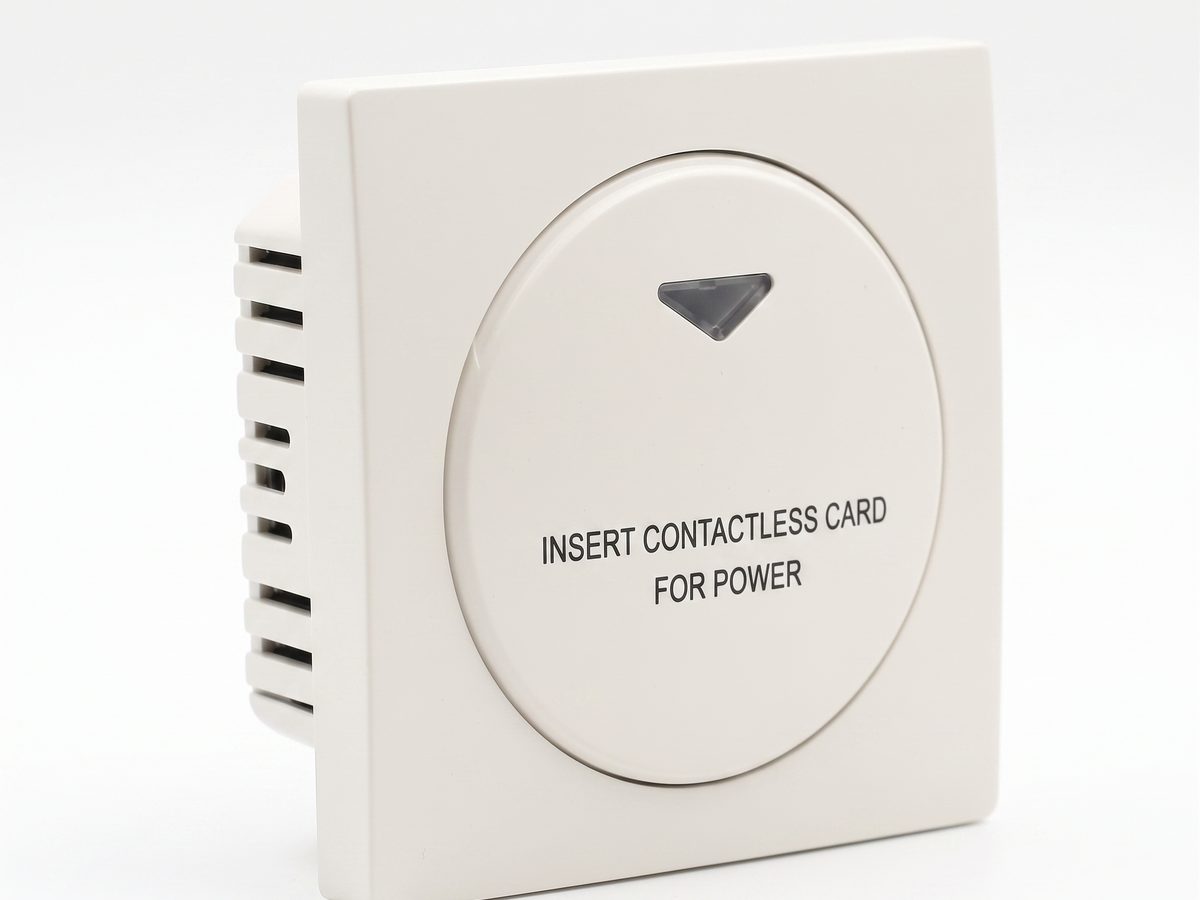
Hotel Key Card Switch — Kontrol Daya Kamar Tamu
Hotel key card switch untuk kontrol daya kamar tamu. Deteksi kartu RFID/IC, masukkan kartu untuk menyalakan daya, penundaan pemadaman saat kartu dilepas. 220V AC, 10A-16A, RS485 atau dry contact. CE RoHS. Pemasok OEM/ODM.
Halaman ini sudah menunjuk ke halaman tersebut sebagai referensi yang direkomendasikan berikutnya.
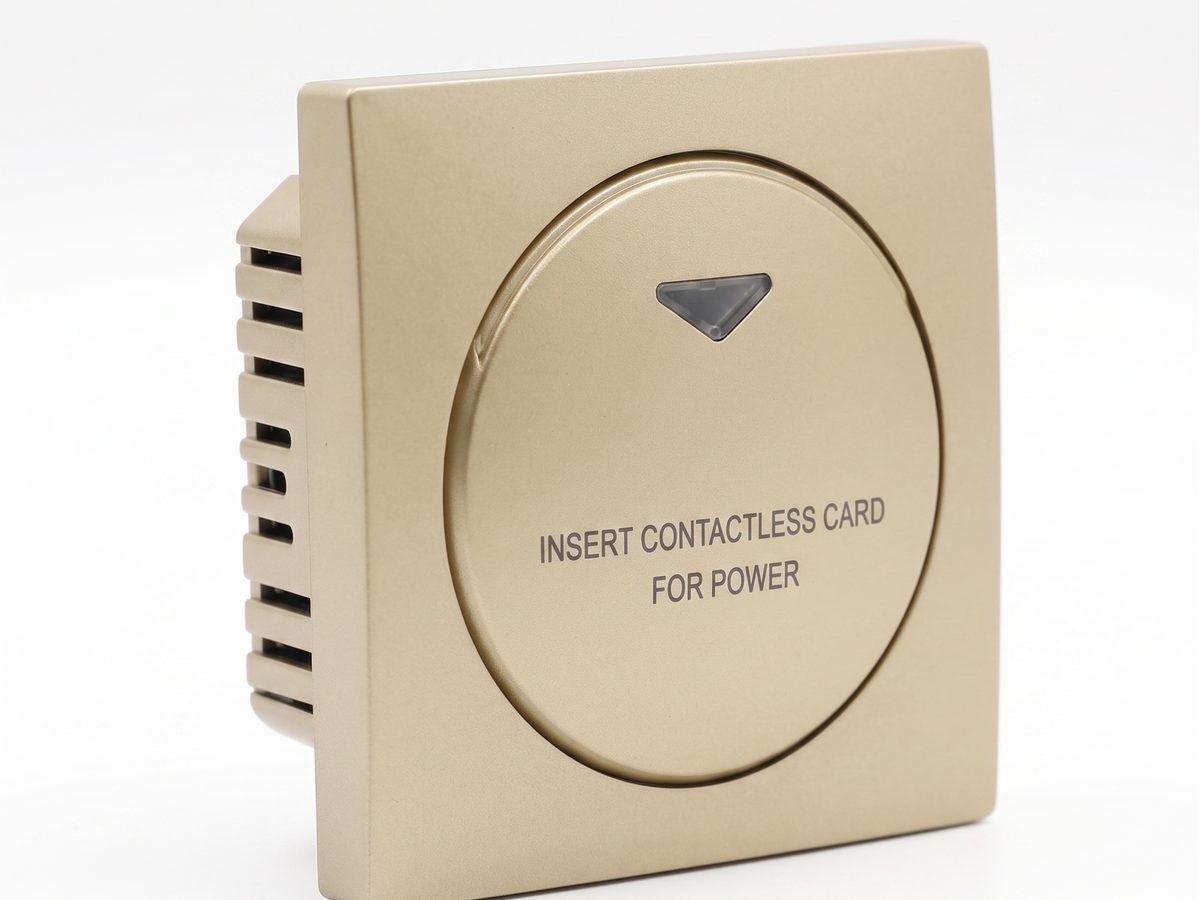
Saklar Hemat Energi Hotel — Kontrol Daya Kamar Masukkan Kartu
Saklar hemat energi hotel: daya nyala saat kartu dimasukkan, mati setelah jeda, integrasi HVAC menghentikan pemborosan kamar kosong. 220V AC, 10A-16A, RS485. CE RoHS.
Halaman ini sudah menunjuk ke halaman tersebut sebagai referensi yang direkomendasikan berikutnya.
Solusi terkait
3Sistem Manajemen Kamar Hotel Berbasis Kartu Listrik
Sistem manajemen kamar hotel praktis untuk mengatur daya listrik kamar melalui saklar kartu kunci, kontaktor, dan aturan operasional yang terdokumentasi.
Halaman tersebut mendukung konteks produk yang sama: Hotel Key Card Switch — Kontrol Daya Kamar Tamu.
Penghematan Energi Hotel dengan Saklar Daya Kamar Tamu
Solusi penghematan energi hotel yang menggunakan daya kamar terkendali kartu untuk mencegah lampu, AC, dan stopkontak terpilih menyala tanpa perlu.
Halaman tersebut mendukung konteks produk yang sama: Hotel Key Card Switch — Kontrol Daya Kamar Tamu.
Kontrol Daya Kamar Hotel dengan Saklar Kartu
Solusi kontrol daya kamar hotel yang praktis untuk mengalihkan pencahayaan, pendingin udara, dan stopkontak kamar tamu dengan kartu kamar resmi.
Halaman tersebut mendukung konteks produk yang sama: Hotel Key Card Switch — Kontrol Daya Kamar Tamu.
Artikel blog terkait
3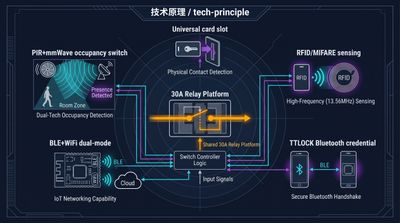
Hotel Key Card Switch: Jenis, Model, dan Cara Memilih
Panduan hotel key card switch mencakup model universal, RFID, TTLOCK, BLE, dan occupancy, serta cara memilih model yang sesuai dengan sistem kartu hotel Anda.
Halaman tersebut mendukung konteks produk yang sama: Hotel Key Card Switch — Kontrol Daya Kamar Tamu.
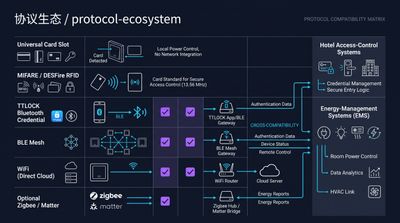
RFID vs NFC untuk Saklar Kartu Kunci Hotel: Pilih Mana?
RFID vs NFC pada saklar kartu kunci hotel berujung pada jangkauan dan penguncian: RFID 125kHz / 13.56MHz (MIFARE, Temic) adalah standar daya kamar hotel…
Halaman tersebut mendukung konteks produk yang sama: Hotel Key Card Switch — Kontrol Daya Kamar Tamu.
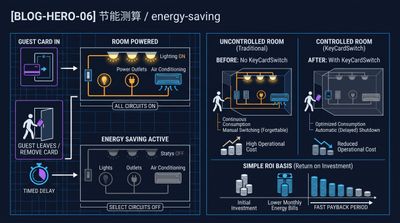
Apa Itu Hotel Key Card Switch dan Cara Hemat Energi Kamar
Hotel key card switch adalah perangkat dinding yang menyalakan listrik kamar saat kartu dimasukkan dan memutusnya saat kartu ditarik, hemat 25–40%…
Halaman tersebut mendukung konteks produk yang sama: Hotel Key Card Switch — Kontrol Daya Kamar Tamu.
Rinci proyek hotel Anda bersama insinyur kami
Kirimkan jumlah kamar, jenis plafon, dan preferensi protokol Anda. Kami akan mengirimkan rencana sampel dan penawaran dalam 24 jam kerja.
- Beralih dari panduan umum ke diskusi produk atau aplikasi.
- Gunakan RFQ saat harga, gambar teknis, MOQ, atau jadwal peluncuran membutuhkan struktur.
- Jaga jalur kontak langsung tetap terlihat untuk klarifikasi cepat dan serah terima.