Kalkulator Hemat Energi Hotel: Estimasi kWh dan Biaya
Kalkulator hemat energi hotel menjelaskan cara mengubah beban kamar dan jam operasi menjadi kilowatt-jam dan biaya dengan rumus serta contoh perhitungan.
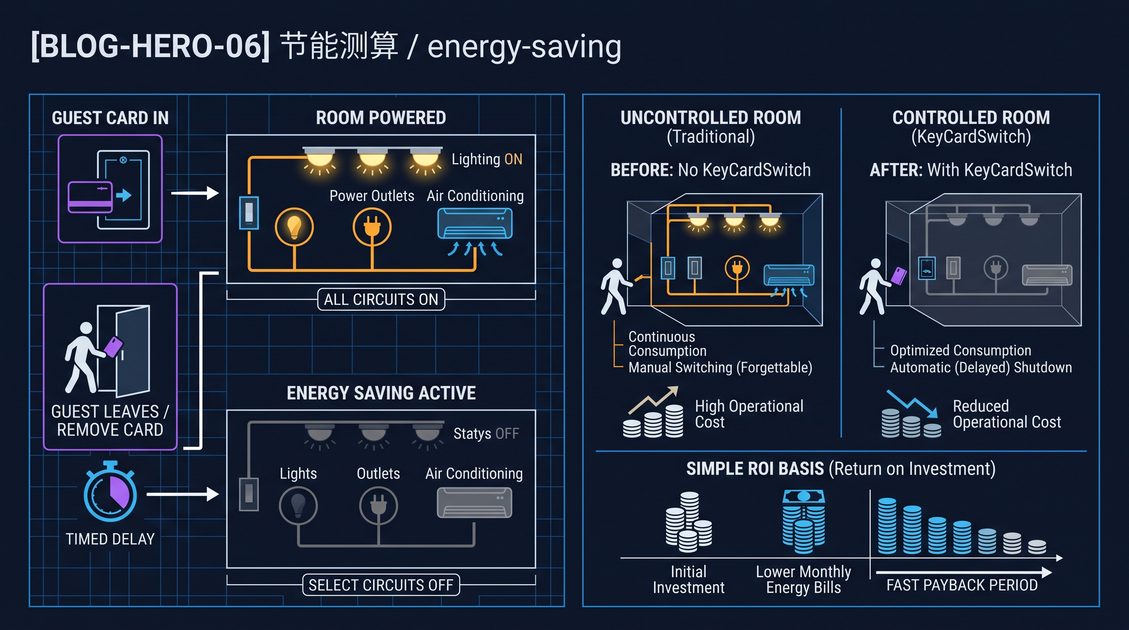
Kalkulator hemat energi hotel adalah metode terstruktur yang biasanya dikerjakan secara manual, mengubah beban peralatan yang diketahui pada kamar tamu beserta waktu operasinya menjadi kilowatt-jam dan biaya operasional, sehingga pemilik dapat memperkirakan berapa banyak energi yang dikonsumsi kamar saat terisi dan berapa banyak saat dibiarkan kosong. Kalkulator ini berpijak pada satu hubungan dasar: energi dalam kilowatt-jam sama dengan daya dalam kilowatt dikalikan waktu dalam jam, ditulis kWh = kW x h, diterapkan pada setiap peralatan yang dialiri kamar. Kalkulator hemat energi hotel berguna karena mengubah intuisi bahwa kamar kosong memboroskan daya menjadi angka yang dapat dibandingkan antarkamar, antarlantai, dan seluruh properti. Karena setiap estimasi bergantung pada beban yang dipasang properti dan jam operasi beban tersebut, kalkulator dibangun di sekitar variabel yang dapat diukur dan disesuaikan oleh hotel, bukan di sekitar aturan tetap. Ini adalah alat perencanaan yang mendukung keputusan pembelian atau retrofit dengan aritmetika, bukan dengan opini.
Apa yang Dilakukan Kalkulator Hemat Energi Hotel
Tugas kalkulator hemat energi hotel adalah menerjemahkan beban fisika sebuah kamar menjadi satu angka yang dapat dibandingkan, yaitu kilowatt-jam yang dikonsumsi kamar per hari. Kalkulator dimulai dari inventaris setiap peralatan yang menarik daya: armatur pencahayaan beserta watt-nya, unit pendingin udara dengan daya terpasang dan daya operasinya, serta colokan dinding dengan televisi, teko listrik, minibar, dan pengisi daya yang terpasang padanya. Untuk setiap item, pengguna menuliskan dua angka, yaitu daya dalam kilowatt dan waktu dalam jam saat item tersebut beroperasi dalam sehari. Mengalikan keduanya menghasilkan energi harian item tersebut, dan menjumlahkan semua item menghasilkan total kamar. Kalkulator ini sengaja dibuat sederhana karena nilainya terletak pada memaksa inventaris yang jelas dan waktu operasi yang jujur, bukan pada matematika yang canggih. Setelah total kamar ada, lembar kerja yang sama dapat dijalankan dua kali, sekali untuk hari terisi dan sekali untuk hari kosong, dan selisih keduanya adalah apa yang dapat dihilangkan dengan mematikan kamar. Kalkulator hemat energi hotel karena itu pada intinya adalah alat pembanding, membandingkan kamar terisi dengan kamar kosong menggunakan daftar peralatan yang sama.
Kalkulator Hemat Energi Hotel: Inventaris Beban
Kolom pertama yang dibutuhkan kalkulator hemat energi hotel adalah inventaris beban yang lengkap, karena peralatan apa pun yang tertinggal membuat hasilnya meremehkan kamar. Inventaris sebaiknya dilakukan dengan berjalan menyusuri ruangan secara fisik, mencatat setiap lampu beserta watt lampunya, model pendingin udara beserta daya operasinya, dan setiap colokan beserta peralatan yang biasanya terhubung padanya. Trik yang membantu adalah membaca rating daya dari pelat nama setiap peralatan, karena watt pada pelat nama adalah angka nyata, bukan tebakan. Untuk pendingin udara, daya operasi saat kondisi normal biasanya lebih rendah daripada maksimum terpasang karena kompresor bekerja siklis, dan menggunakan angka terpasang akan melebih-lebihkan beban; estimasi praktis adalah daya input terpasang dalam watt yang dikurangi untuk duty tipikal. Tabel inventaris sebaiknya memiliki tiga kolom per baris: item tersebut, dayanya dalam kilowatt, dan perkiraan waktu operasi harian dalam jam. Jumlah kolom daya dan jumlah kolom energi sama-sama berguna, yang pertama untuk menentukan ukuran kabel dan yang kedua untuk memperkirakan pemakaian. Kalkulator hemat energi hotel yang dimulai dengan inventaris akurat menghasilkan angka yang dapat dipertahankan pemilik di hadapan kolega atau pemberi pinjaman.
| Item inventaris | Daya (kW) | Perkiraan waktu operasi (jam/hari) |
|---|---|---|
| Lampu plafon LED | 0.03-0.08 | 4-6 |
| Lampu meja nakas LED | 0.02-0.05 | 2-3 |
| Unit pendingin udara | 0.9-2.5 | 6-12 |
| Televisi | 0.05-0.12 | 3-5 |
| Teko listrik | 1.5-2.2 | 0.1-0.2 |
| Kulkas minibar | 0.04-0.09 | 24 (jika tidak disaklar) |
Kalkulator Hemat Energi Hotel: Rumus Beban Dasar
Beban dasar adalah energi yang dihitung kalkulator hemat energi hotel sebagai energi yang selalu ada meskipun tidak ada yang sengaja digunakan, dan sering kali menjadi kejutan terbesar dalam sebuah kamar. Rumusnya sama, energi sama dengan daya kali waktu, tetapi diterapkan pada tarikan daya kontinu yang tidak pernah berhenti. Kulkas minibar yang tetap tercolok sepanjang malam beroperasi 24 jam, sehingga energi harianya adalah daya operasinya dalam kilowatt dikalikan 24, dan jika kompresornya bekerja siklis, digunakan tarikan rata-rata, bukan puncaknya. Detektor asap, basis telepon, dan panel saklar itu sendiri semuanya menarik arus kontinu kecil yang menambah total harian kecil. Ketika kamar kosong tetapi tetap dialiri, beban dasar tetap mengalir karena colokan dan peralatan tetap terhubung, sehingga kamar kosong jarang berada di nol bahkan sebelum ada tamu datang. Beban dasar adalah bagian dari beban kamar yang harus dipisahkan kalkulator hemat energi hotel dari beban yang disengaja, karena bagian ini memberi tahu pemilik berapa banyak daya yang ditarik kamar saat istirahat. Mengurangi beban dasar, dengan memindahkan minibar keluar dari sirkuit tersaklar atau dengan mensaklar seluruh sirkuit, langsung menurunkan batas bawah kamar kosong.
Kalkulator Hemat Energi Hotel: Waktu Operasi Aktifasi Kartu
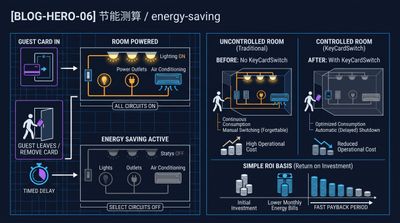
Waktu operasi aktifasi kartu adalah variabel yang digunakan kalkulator hemat energi hotel untuk memisahkan kamar terisi dari kamar kosong, dan inilah alasan saklar masuk ke dalam perhitungan. Pada kamar yang dikendalikan saklar kartu kunci, daya hanya tersedia selama kartu berada di slot, sehingga waktu operasi setiap beban tersaklar dibatasi oleh interval kamar terisi. Kalkulator memodelkan hal ini dengan menetapkan waktu operasi harian pencahayaan, pendingin udara, dan colokan tersaklar sama dengan jam saat tamu benar-benar berada di kamar dengan kartu terpasang. Pada hari terisi, waktu operasi itu mungkin sama dengan seluruh waktu kehadiran tamu, sedangkan pada hari kosong, antara check-out dan kedatangan berikutnya, waktu operasi turun ke nol karena tidak ada kartu. Waktu operasi terisi adalah pilihan perencanaan yang dituliskan pengguna, dan bergantung pada jam check-out properti, jadwal kebersihan, dan jam kebiasaan tamu. Kalkulator hemat energi hotel menggunakan satu angka ini untuk mengalihkan seluruh kamar dari terisi ke kosong, yang persis merupakan perilaku yang diciptakan saklar kartu kunci di dinding.
Kalkulator Hemat Energi Hotel: Contoh Perhitungan kWh
Kalkulator hemat energi hotel paling baik ditunjukkan dengan contoh perhitungan, sehingga bagian ini memandu satu kamar tamu melalui rumus langkah demi langkah. Ambil sebuah kamar dengan tiga lampu plafon LED masing-masing 0.04 kW beroperasi 5 jam, dua lampu meja nakas masing-masing 0.02 kW beroperasi 3 jam, pendingin udara split yang menarik rata-rata 1.5 kW dan beroperasi 8 jam, televisi 0.1 kW beroperasi 4 jam, dan minibar 0.08 kW beroperasi 24 jam jika tetap pada sirkuit tersaklar. Energi pencahayaan adalah tiga lampu kali 0.04 kW kali 5 jam, menghasilkan 0.6 kWh, ditambah dua lampu kali 0.02 kW kali 3 jam, menghasilkan 0.12 kWh, sehingga pencahayaan adalah 0.72 kWh. Pendingin udara adalah 1.5 kW kali 8 jam, menghasilkan 12 kWh. Televisi adalah 0.1 kW kali 4 jam, menghasilkan 0.4 kWh. Minibar adalah 0.08 kW kali 24 jam, menghasilkan 1.92 kWh. Total kamar terisi adalah jumlah 0.72, 12, 0.4, dan 1.92, menghasilkan 15.04 kWh untuk hari itu. Jika minibar dipindah ke depan saklar sehingga tetap dialiri, hari kosong menghilangkan pencahayaan, pendingin udara, dan televisi, yaitu 13.12 kWh beban yang disengaja, menyisakan hanya 1.92 kWh beban dasar. Kalkulator hemat energi hotel membuat aritmetika ini eksplisit sehingga setiap pemilik dapat mereproduksinya.
Kalkulator Hemat Energi Hotel: Biaya per kWh dan Tarif
Langkah berikutnya dalam kalkulator hemat energi hotel adalah mengonversi kilowatt-jam menjadi biaya operasional, karena uang adalah angka yang memicu tindakan pemilik. Konversinya adalah biaya sama dengan energi dalam kilowatt-jam dikalikan tarif dalam mata uang per kilowatt-jam, ditulis biaya = kWh x harga. Hotel sebaiknya membaca tarif riilnya dari tagihan listrik, bukan dari angka umum, karena tarif bervariasi menurut wilayah, waktu, dan kontrak harga. Menggunakan contoh perhitungan, jika kamar terisi di atas menggunakan 15.04 kWh dalam sehari dan tarifnya rata 0.15 satuan mata uang per kilowatt-jam, biaya hari terisi adalah 15.04 kali 0.15, menghasilkan 2.26 satuan. Jika kamar kosong menggunakan 1.92 kWh, biaya hari kosong adalah 1.92 kali 0.15, menghasilkan 0.29 satuan. Selisih antara 2.26 dan 0.29 adalah 1.97 satuan per hari kosong dalam skenario itu. Selisih biaya inilah yang persis dihasilkan kalkulator hemat energi hotel ketika dijalankan untuk hari terisi dan hari kosong, dan angka itu dapat dikalikan dengan jumlah hari-kamar kosong yang dimiliki properti dalam sebulan. Karena tarif adalah pengali sederhana, lembar kerja energi yang sama berubah menjadi lembar kerja biaya tanpa matematika baru.
Kalkulator Hemat Energi Hotel: Beban Pencahayaan
Pencahayaan adalah bagian termudah dari kalkulator hemat energi hotel untuk dihitung karena watt-nya tercetak pada lampu dan waktu operasinya dapat diprediksi. Energi satu armatur adalah watt-nya dibagi seribu untuk menjadi kilowatt, dikalikan jam lampu menyala. Properti yang telah beralih ke LED akan melihat angka kecil per armatur, lampu LED tipikal menarik beberapa watt saja, bukan puluhan watt seperti lampu pijar lama, sehingga total pencahayaan sering kali menjadi porsi yang moderat dari kamar. Waktu operasinya digerakkan oleh tamu: lampu menyala saat tamu berada di kamar, dan pada kamar kosong tanpa kartu, lampu sama sekali tidak dialiri. Karena pencahayaan sepenuhnya berada pada sirkuit tersaklar di hampir semua tata letak, kalkulator hemat energi hotel dapat menganggap seluruh total pencahayaan sebagai beban yang dapat dihilangkan saat kamar kosong. Baris pencahayaan juga menjadi langkah validasi yang baik, karena pemilik dapat membandingkan estimasi energi pencahayaan dengan pembacaan meteran cepat pada kamar yang menyala dan memastikan lembar kerja berada pada urutan besaran yang tepat sebelum mempercayai baris pendingin udara yang lebih besar.
Kalkulator Hemat Energi Hotel: Beban Pendingin Udara
Pendingin udara biasanya merupakan baris terbesar dalam kalkulator hemat energi hotel dan baris yang paling layak diestimasi dengan cermat. Daya input terpasang dalam watt dari pelat nama unit adalah maksimum, tetapi pendingin udara split dalam operasi normal menjalankan kompresor secara siklis, sehingga daya operasi rata-ratanya lebih rendah. Metode yang dapat diterapkan adalah mengestimasi tarikan rata-rata sebagai bagian dari daya input terpasang, atau mengukur arus operasi dengan clamp meter dan mengalikannya dengan tegangan suplai untuk mendapatkan watt. Waktu operasinya ditetapkan oleh tamu dan iklim: di wilayah panas, kamar mungkin beroperasi banyak jam sehari, sedangkan di musim sedang, kamar mungkin hampir tidak beroperasi. Ketika kamar kosong dan kartu ditarik, pendingin udara berhenti sepenuhnya karena berada pada sirkuit tersaklar, yang merupakan beban terbesar yang dapat dihilangkan di sebagian besar kamar. Kalkulator hemat energi hotel sebaiknya memperlakukan pendingin udara baik pada daya rata-rata yang jujur maupun pada waktu operasi yang jujur, karena menggunakan maksimum terpasang dan satu hari penuh akan melebih-lebihkan kamar dan membuat perbandingan apa pun tampak lebih besar dari kenyataan. Pemilik yang ingin yakin pada baris ini sebaiknya mengukur arus operasi, bukan menebak.
Kalkulator Hemat Energi Hotel: Beban Colokan dan Peralatan
Beban colokan dan peralatan adalah blok ketiga yang harus dihitung kalkulator hemat energi hotel, dan blok inilah yang paling bervariasi antarkamar. Televisi, teko listrik, pengisi daya, dan peralatan sesekali semuanya tercolok ke colokan dinding tersaklar, sehingga energi harian masing-masing peralatan adalah watt-nya dibagi seribu kali waktu penggunaan aktualnya. Teko listrik menarik daya tinggi tetapi hanya beroperasi beberapa menit, sehingga energinya kecil meskipun watt-nya besar, dan inilah persis jenis poin yang diperjelas oleh rumus. Kulkas minibar adalah satu-satunya peralatan yang sering dibiarkan di luar sirkuit tersaklar agar stoknya tetap dingin, dan dalam tata letak itu ia masuk ke dalam beban dasar, bukan blok tersaklar. Blok colokan adalah tempat kalkulator hemat energi hotel memungkinkan pemilik menguji keputusan, misalnya apakah mensaklar semua colokan atau mempertahankan colokan kebersihan tetap hidup. Menjumlahkan beban colokan untuk hari terisi dan lagi untuk hari kosong menunjukkan berapa banyak tarikan kamar yang berada di colokan, dan memandu keputusan kabel mengenai colokan mana yang berada pada relai. Inventaris colokan yang lengkap mencegah lembar kerja diam-diam melewatkan beban nyata.
Kalkulator Hemat Energi Hotel: Total Harian per Kamar
Total harian per kamar adalah angka yang menyatukan kalkulator hemat energi hotel, karena itulah satu angka yang dapat digunakan pemilik di mana saja. Angka itu hanyalah jumlah energi pencahayaan, energi pendingin udara, dan energi colokan untuk hari yang dimodelkan. Kalkulator biasanya dijalankan dua kali: sekali dengan waktu operasi terisi dan sekali dengan waktu operasi kosong, dan kedua total itu adalah kilowatt-jam harian kamar terisi dan kilowatt-jam harian kamar kosong. Dalam contoh perhitungan sebelumnya, keduanya adalah 15.04 kWh dan 1.92 kWh, dengan selisih 13.12 kWh sebagai beban yang disengaja yang hilang saat kamar tidak memiliki kartu. Selisih harian per kamar inilah angka yang dapat diskalakan ke satu bulan atau seluruh properti, dan itulah inti jujur dari estimasi karena berasal dari inventaris nyata dan waktu operasi yang dipilih. Kalkulator hemat energi hotel harus selalu menyatakan asumsi yang menghasilkan total tersebut, seperti daya rata-rata pendingin udara dan jam terisi, sehingga angka itu dapat dipertanyakan dan disesuaikan, bukan diterima secara buta.
Kalkulator Hemat Energi Hotel: Penskalaan ke Seluruh Properti
Menskalakan hasil per kamar ke seluruh properti adalah tempat kalkulator hemat energi hotel berubah dari keingintahuan satu kamar menjadi angka bisnis. Selisih harian per kamar dikalikan jumlah hari-kamar yang kosong setiap bulan, yang diperoleh pemilik dari catatan okupansi. Jika properti memiliki sejumlah kamar tertentu dan porsi tertentu dari malam-kamar yang kosong, kilowatt-jam bulanan kamar adalah selisih harian per kamar kali hari-kamar kosong. Energi bulanan itu kemudian dikalikan tarif untuk menghasilkan angka biaya operasional bulanan untuk kamar kosong. Pemilik juga dapat menjalankan kalkulator ke depan, menerapkan hari-kamar kosong yang sama tetapi total hari kosong yang lebih rendah, untuk memodelkan apa yang dilakukan tata letak berbeda atau sebuah saklar terhadap angka tersebut. Penskalaan ini adalah aritmetika murni, sehingga akurasinya sepenuhnya bergantung pada estimasi per kamar dan angka okupansi yang mengalirkannya. Kalkulator hemat energi hotel yang digunakan dalam skala properti memberi manajemen angka bulanan yang dapat dipertahankan dan dapat ditinjau kembali setiap kali tarif, inventaris peralatan, atau okupansi berubah.
Kalkulator Hemat Energi Hotel: Validasi dengan Meteran
Validasi adalah disiplin terakhir yang sebaiknya disertakan kalkulator hemat energi hotel, karena estimasi hanya sebaik bukti di baliknya. Properti dapat mengukur sebuah kamar dengan meteran watt-jam sederhana yang dicolokkan antara colokan dan peralatannya, atau membaca sirkuit kamar di papan distribusi dengan clamp meter untuk membandingkan watt terukur dengan total lembar kerja. Langkah validasinya adalah mengaliri kamar, mencatat meteran, menjalankannya selama jumlah jam yang diketahui, dan memeriksa kilowatt-jam terukur terhadap angka hasil hitung. Diskrepansi biasanya menunjuk pada waktu operasi yang diremehkan atau pelat nama yang salah baca, dan mengoreksi lembar kerja membuat semua angka terskalakan menjadi terpercaya. Setelah satu kamar tervalidasi, inventaris yang sama dapat digunakan kembali untuk tipe kamar yang identik dengan percaya diri. Kalkulator hemat energi hotel yang diakhiri dengan validasi menghasilkan angka yang dapat dipertahankan pemilik dalam rapat, karena setiap baris kini berdiri di atas pengukuran, bukan tebakan. Ini menutup lingkaran dari inventaris ke estimasi ke angka terverifikasi, yang merupakan cara paling andal untuk mengubah daftar peralatan kamar menjadi biaya yang siap untuk pengambilan keputusan.
Kalkulator Hemat Energi Hotel: Asumsi Waktu Operasi
Asumsi waktu operasi adalah angka yang paling tidak terlihat tetapi paling berpengaruh dalam kalkulator hemat energi hotel, sehingga layak mendapat bagiannya sendiri. Setiap baris energi adalah hasil kali daya dan waktu, dan sementara daya berasal dari pelat nama, waktu adalah pilihan yang dituliskan pengguna. Hari terisi dalam lembar kerja ini mengasumsikan sejumlah jam tertentu saat pencahayaan menyala, pendingin udara beroperasi, dan televisi menyala, dan jam-jam itu berasal dari pola check-in, check-out, dan perilaku tamu properti itu sendiri. Hari kosong mengasumsikan kamar yang sama tanpa kartu, sehingga beban tersaklar beroperasi nol jam dan hanya beban dasar yang tersisa. Selisih antara kedua skenario hanyalah asumsi waktu operasi, dan itulah mengapa kalkulator hemat energi hotel sangat sensitif terhadapnya. Pemilik sebaiknya menyatakan setiap asumsi di samping hasil, misalnya pencahayaan lima jam dan pendingin udara delapan jam, sehingga seorang skeptis dapat melihat dengan persis apa yang dimodelkan. Waktu operasi realistis berasal dari mengamati beberapa kamar nyata atau dari survei tamu singkat, dan asumsi itu lebih penting daripada watt yang persis karena waktu mengalikan seluruh baris.
Kalkulator Hemat Energi Hotel: Skenario Musiman
Skenario musiman adalah satu kali jalannya kalkulator hemat energi hotel di bawah kondisi cuaca berbeda, karena total kamar jauh lebih banyak berubah karena musim daripada karena saklar. Di musim panas, pendingin udara beroperasi lebih lama dan pada daya rata-rata lebih tinggi, sehingga total hari terisi naik dan selisih hari kosong tumbuh bersamanya. Di musim sedang, pendingin udara mungkin hanya beroperasi beberapa jam, mengecilkan baik total terisi maupun selisih hari kosong. Cara terbaik memodelkannya adalah menjalankan lembar kerja tiga kali, sekali untuk bulan panas, sekali untuk bulan sedang, dan sekali untuk bulan dingin, hanya mengubah waktu operasi pendingin udara dan daya rata-ratanya. Ketiga hasil itu menunjukkan kepada pemilik berapa banyak angka kamar kosong yang bersifat musiman, bukan konstan, yang penting saat memutuskan apakah sebuah retrofit membayar dirinya pada waktu yang tepat dalam setahun. Kalkulator hemat energi hotel yang digunakan secara musiman juga menghasilkan estimasi tahunan yang lebih baik daripada satu potret tunggal, karena merata-ratakan ketiga jalanan tersebut terhadap okupansi bulanan properti. Musiman adalah alasan utama mengapa estimasi yang jujur adalah sekumpulan kecil skenario, bukan satu angka tetap.
Kalkulator Hemat Energi Hotel: Tipe Kamar dan Variasinya
Tipe kamar memperkenalkan variasi yang harus diakui kalkulator hemat energi hotel, karena kamar standar, suite, dan kamar keluarga jarang membawa beban yang sama. Kamar standar memiliki satu pendingin udara, satu televisi, dan satu set pencahayaan kecil, sehingga totalnya mendekati contoh perhitungan yang sudah ditunjukkan. Suite menambahkan lebih banyak pencahayaan, televisi yang lebih besar atau televisi kedua, pendingin udara kedua pada sebagian tata letak, dan mungkin teko serta kulkas pantry kecil, yang semuanya menaikkan total terisi dan kosong. Kamar keluarga atau aksesibel mungkin membawa televisi tambahan dan minibar yang tetap dialiri, yang mengubah beban dasar sekaligus beban yang disengaja. Cara paling bersih menanganinya adalah membangun satu lembar kerja per tipe kamar, bukan merata-ratakan semua kamar menjadi satu angka, lalu memberi bobot setiap tipe sesuai jumlah kamar jenis itu yang dimiliki properti. Kalkulator hemat energi hotel yang memisahkan tipe kamar memberi pemilik properti angka per tipe yang langsung berguna untuk memutuskan di mana saklar atau perubahan kabel paling membantu. Variasi bukanlah cacat dalam metode; itulah alasan inventaris disusuri kamar demi kamar sejak awal.
Kalkulator Hemat Energi Hotel: Contoh Perhitungan Kedua
Contoh perhitungan kedua dalam kalkulator hemat energi hotel menunjukkan bagaimana metode ini menyesuaikan diri untuk kamar berbeda, sehingga bagian ini memodelkan kamar twin kecil dengan beban lebih ringan. Ambil dua lampu LED masing-masing 0.04 kW beroperasi 4 jam, satu lampu meja nakas 0.02 kW beroperasi 2 jam, pendingin udara split rata-rata 1.2 kW beroperasi 7 jam, televisi 0.09 kW beroperasi 3 jam, dan minibar 0.07 kW beroperasi 24 jam. Energi pencahayaan adalah dua lampu kali 0.04 kW kali 4 jam, menghasilkan 0.32 kWh, ditambah satu lampu kali 0.02 kW kali 2 jam, menghasilkan 0.04 kWh, sehingga total pencahayaan 0.36 kWh. Pendingin udara adalah 1.2 kW kali 7 jam, menghasilkan 8.4 kWh. Televisi adalah 0.09 kW kali 3 jam, menghasilkan 0.27 kWh. Minibar adalah 0.07 kW kali 24 jam, menghasilkan 1.68 kWh. Total kamar twin terisi adalah 10.71 kWh, dan jika minibar dipertahankan teraliri di depan saklar, kamar kosong menyisakan 1.68 kWh sebagai beban dasar. Dibandingkan dengan contoh pertama, kamar yang lebih kecil memiliki total lebih kecil dan selisih hari kosong lebih kecil, yang persis merupakan pola yang diharapkan pemilik dan mengonfirmasi bahwa kalkulator hemat energi hotel berskala mengikuti kamar yang dimasukkan ke dalamnya.
Kalkulator Hemat Energi Hotel: Metode Selisih
Metode selisih adalah cara terbersih untuk menyajikan apa yang sebenarnya diukur kalkulator hemat energi hotel, karena metode ini menyatakan jawaban sebagai satu kontras. Metodenya adalah menjalankan lembar kerja sekali dengan waktu operasi terisi dan sekali dengan waktu operasi kosong, lalu mengurangkan total kosong dari total terisi. Hasilnya adalah kilowatt-jam harian yang hilang saat kamar dibiarkan kosong tanpa kartu di slot. Dalam contoh perhitungan pertama, selisih itu adalah 13.12 kWh, dan dalam contoh twin, 9.03 kWh, keduanya merupakan beban pencahayaan, pendingin udara, dan colokan yang disengaja yang dipotong oleh sebuah saklar. Menyajikan hasil sebagai selisih, bukan sebagai dua total terpisah, menjaga perhatian pada hari-kamar kosong yang benar-benar dimiliki properti. Pemilik kemudian dapat menyatakan bahwa pada satu hari-kamar kosong, sirkuit tersaklar berhenti menarik kira-kira sebanyak itu kilowatt-jam, klaim yang berakar pada inventaris dan waktu operasi yang dipilih. Metode selisih adalah inti kalkulator hemat energi hotel karena langsung menjawab pertanyaan yang diajukan pembeli, yaitu berapa banyak kamar menarik daya saat tidak ada orang di dalamnya.
Kalkulator Hemat Energi Hotel: Menyajikan Hasil kepada Pemilik
Menyajikan hasil adalah lapisan komunikasi dari kalkulator hemat energi hotel, karena angka yang rapi dalam spreadsheet tidak berarti banyak sampai menjadi keputusan. Penyajian paling jelas adalah tabel singkat dengan tiga kolom: total hari terisi, total hari kosong, dan selisih harian, masing-masing dalam kilowatt-jam dan lagi dalam biaya operasional pada tarif properti. Tabel kedua menskalakan angka-angka itu ke satu bulan menggunakan hari-kamar kosong properti, memberikan kilowatt-jam bulanan dan biaya bulanan untuk kamar kosong. Penyajian harus selalu mencantumkan asumsi, daya rata-rata pendingin udara, jam terisi, dan tarif, sehingga pembaca dapat mengikuti perhitungannya. Pemilik yang melihat angka kamar kosong bulanan dalam biaya operasional dapat menimbangnya terhadap biaya dan upaya perubahan kabel atau pemasangan saklar. Kalkulator hemat energi hotel menjadi meyakinkan ketika asumsi terlihat dan aritmetika dapat direproduksi, karena pengambil keputusan kemudian dapat mengubah satu angka dan melihat hasilnya diperbarui, alih-alih mempercayai kotak hitam.
Kalkulator Hemat Energi Hotel: Kesalahan Umum
Kesalahan umum kalkulator hemat energi hotel layak didaftar agar pengguna baru tidak diam-diam melebih-lebihkan atau meremehkan sebuah kamar. Kesalahan pertama adalah menggunakan daya maksimum terpasang pendingin udara alih-alih daya operasi rata-rata, yang dapat kira-kira menggandakan baris terbesar. Kesalahan kedua adalah mengasumsikan hari penuh 24 jam untuk beban tersaklar, padahal tamu jarang berada di kamar sepanjang jam, sehingga waktu operasi sebaiknya mencerminkan kehadiran aktual. Kesalahan ketiga adalah melupakan beban dasar, minibar atau peralatan lain yang selalu menyala, dan menganggap kamar kosong sebagai nol, yang membuat selisih tampak lebih besar dari kenyataan. Kesalahan keempat adalah menerapkan angka satu tipe kamar ke setiap kamar di properti tanpa bobot sesuai jumlah masing-masing tipe. Kesalahan kelima adalah menggunakan tarif tebakan alih-alih tarif nyata dari tagihan listrik, yang memiringkan setiap angka biaya. Setiap kesalahan adalah tempat kalkulator hemat energi hotel dapat menyimpang dari kenyataan, dan masing-masing memiliki penjaga sederhana: ukur pendingin udara, tuliskan waktu operasi yang jujur, pisahkan beban dasar, beri bobot per tipe kamar, dan baca tarifnya. Menamai jebakan sama bergunanya dengan rumus itu sendiri.
Kalkulator Hemat Energi Hotel: Membuat Spreadsheet
Membuat spreadsheet adalah langkah praktis terakhir yang mengubah kalkulator hemat energi hotel dari metode menjadi alat yang dapat diulang. Tata letak sederhana memiliki satu baris per peralatan dan tiga kolom untuk daya, waktu operasi, dan energi harian, dengan energi harian sebagai hasil kali dua kolom pertama. Sheet kedua mengulangi inventaris tetapi dengan waktu operasi kosong ditetapkan nol untuk beban tersaklar, menyisakan hanya beban dasar. Sel ringkasan mengurangkan total kosong dari total terisi untuk memberikan selisih harian, dan sel lain mengalikan selisih itu dengan tarif properti dan dengan hari-kamar kosong bulanan. Rumusnya sederhana untuk diketik langsung, dengan sel energi harian sebagai sama dengan daya kali jam, dan sel bulanan sebagai sama dengan selisih harian kali tarif kali hari. Karena keseluruhannya hanya segelintir sel, pemilik dapat mengubah daya pendingin udara atau jam terisi dan melihat angka bulanan diperbarui seketika. Kalkulator hemat energi hotel yang dibangun dengan cara ini menjadi lembar kerja hidup yang digunakan kembali properti setelah setiap perubahan tarif, pembaruan inventaris, atau pergeseran musiman.
Kalkulator Hemat Energi Hotel: Tabel Biaya Terhitung
Tabel biaya terhitung adalah cara terbersih bagi kalkulator hemat energi hotel untuk menunjukkan energi dan uang dalam satu tampilan, sehingga bagian ini menyatukan kedua contoh sebelumnya secara berdampingan. Kamar pertama, dengan total terisi 15.04 kWh dan total kosong 1.92 kWh, memiliki selisih harian 13.12 kWh. Kamar twin, dengan total terisi 10.71 kWh dan total kosong 1.68 kWh, memiliki selisih harian 9.03 kWh. Pada tarif 0.15 satuan mata uang per kilowatt-jam, selisih kamar pertama bernilai sekitar 1.97 satuan per hari kosong, dan selisih kamar twin bernilai sekitar 1.35 satuan per hari kosong. Membaca tabel itu, pemilik dapat melihat kedua kamar berdampingan dan mengonfirmasi bahwa kamar yang lebih besar membawa angka hari kosong yang lebih besar. Kalkulator hemat energi hotel yang disajikan dengan cara ini memungkinkan pengambil keputusan membandingkan biaya operasional harian dan bulanan kamar kosong antar tipe kamar dalam sekali pandang, yang persis dibutuhkan rapat manajemen sebelum keputusan retrofit diambil.
| Tipe kamar | kWh/hari terisi | kWh/hari kosong | Selisih harian kWh | Biaya harian selisih |
|---|---|---|---|---|
| Kamar standar | 15.04 | 1.92 | 13.12 | 1.97 unit pada 0.15 |
| Kamar twin | 10.71 | 1.68 | 9.03 | 1.35 unit pada 0.15 |
Kalkulator Hemat Energi Hotel: Menurunkan Total Hari Kosong
Menurunkan total hari kosong adalah penggunaan praktis kalkulator hemat energi hotel, karena pemilik menggunakan lembar kerja untuk menguji apa yang menurunkan batas bawah kamar kosong. Tuas pertama adalah mensaklar sirkuit tersaklar sehingga pencahayaan, pendingin udara, dan colokan mati total saat tidak ada kartu, yang menghilangkan seluruh beban yang disengaja dan menyisakan hanya beban dasar. Tuas kedua adalah memindahkan minibar ke depan saklar sehingga tetap teraliri demi stok, yang menukar beban dasar kecil yang selalu menyala dengan beban yang disengaja yang jauh lebih besar yang seharusnya terus berjalan. Tuas ketiga adalah menyetel beban dasar itu sendiri, memilih minibar yang lebih efisien atau mengurangi jumlah colokan yang selalu menyala, karena setiap peralatan yang tidak pernah disaklar menjadi bagian dari batas bawah kamar kosong. Pemilik dapat menjalankan lembar kerja dengan setiap tuas diterapkan dan melihat total hari kosong turun baris demi baris. Kalkulator hemat energi hotel paling bernilai pada langkah ini karena memungkinkan properti menguji perubahan kabel atau pemasangan saklar di atas kertas sebelum mengeluarkan biaya, menunjukkan efek biaya operasional setiap opsi dalam kilowatt-jam dan uang.
Kalkulator Hemat Energi Hotel: Kapan Estimasi Bermanfaat
Mengetahui kapan kalkulator hemat energi hotel bermanfaat, dan kapan ia hanya titik awal, menjaga metode ini tetap jujur. Estimasi paling berguna untuk membandingkan satu tipe kamar dengan tipe lain, untuk menguji keputusan kabel atau saklar sebelum membeli perangkat keras, dan untuk membangun angka bulanan yang dapat dipertahankan dari okupansi nyata. Ini adalah alat perencanaan, bukan meteran, sehingga tidak dapat menggantikan pembacaan meteran watt-jam pada sebuah kamar, dan akurasinya bergantung pada waktu operasi dan daya rata-rata yang dituliskan pengguna. Ketika properti menginginkan kepastian tentang satu kamar, langkah berikutnya yang tepat adalah pengukuran; ketika menginginkan angka yang dapat dibandingkan di seluruh armada, lembar kerja adalah jalur yang lebih cepat. Pemilik sebaiknya memperlakukan angka itu sebagai alat bantu keputusan yang membaik dengan validasi, dan menjalankannya kembali setiap kali tarif, inventaris peralatan, atau pola musiman berubah. Kalkulator hemat energi hotel memperoleh tempatnya justru karena mengubah daftar peralatan kamar menjadi estimasi yang dapat diulang dan ditinjau yang dapat dipertahankan, disetel, dan diskalakan pemilik. Bagi properti yang mengevaluasi proyek hemat energi, menjalankan perhitungan terlebih dahulu menghindari item biaya yang mengejutkan dan memungkinkan pemilik membandingkan retrofit saklar kartu dengan alternatif apa pun pada skala kilowatt-jam dan biaya yang sama.
Sebagian konten artikel ini dihasilkan oleh AI dan dioptimalkan untuk akurasi profesional dan keterbacaan.
A hotel energy saving calculator is a structured method, usually worked by hand, that converts a guest room's known appliance loads and run times into kilowatt-hours and running cost, so an owner can estimate how much energy a room draws while occupied and how much it draws when left empty. The calculator rests on one basic relationship: energy in kilowatt-hours equals power in kilowatts multiplied by time in hours, written kWh = kW x h, applied to each appliance the room powers. A hotel energy saving calculator is useful because it turns the intuition that an empty room wastes power into a number comparable across rooms, floors, and whole properties. Because every estimate depends on the loads a property installs and the hours those loads run, the calculator is built around variables a hotel can measure and tune rather than around fixed rules. It is a planning tool that supports a purchasing or retrofit decision with arithmetic instead of opinion.
What a Hotel Energy Saving Calculator Does
The job of a hotel energy saving calculator is to translate a room's physical loads into a single comparable figure, the kilowatt-hours the room uses per day. The calculator starts with an inventory of every appliance that draws power: the lighting fixtures with their wattages, the air-conditioning unit with its rated and running power, and the wall sockets with the television, kettle, minibar, and chargers that plug into them. For each item the user writes two numbers, the power in kilowatts and the time in hours that the item runs in a day. Multiplying the two gives the daily energy of that item, and adding every item gives the room total. The calculator is deliberately simple because its value is in forcing a clear inventory and honest run times rather than in sophisticated math. Once a room total exists, the same worksheet can be run twice, once for an occupied day and once for an empty day, and the difference between the two is what switching the room off could remove. A hotel energy saving calculator is therefore a comparison tool at heart, comparing an occupied room with an empty one using the same appliance list.
Hotel Energy Saving Calculator: The Load Inventory
The first column a hotel energy saving calculator needs is a complete load inventory, because any appliance left out makes the result understate the room. The inventory should be walked physically, noting each light with its lamp wattage, the air-conditioning model with its running power, and each socket with the appliance normally connected to it. A helpful trick is to read the power rating from the nameplate of each appliance, because nameplate watts are a real number rather than a guess. For the air conditioner, the running power during normal operation is usually lower than the rated maximum because the compressor cycles, and using the rated figure will overstate the load; a practical estimate is the rated input in watts reduced for typical duty. The inventory table should have three columns per row: the item, its power in kilowatts, and its assumed daily run time in hours. The sum of the power column and the sum of the energy column are both useful, the first to size wiring and the second to estimate use. A hotel energy saving calculator that begins with an accurate inventory produces numbers an owner can defend to a colleague or a lender.
| Inventory item | Power (kW) | Assumed run time (h/day) |
|---|---|---|
| LED ceiling lights | 0.03-0.08 | 4-6 |
| LED bedside lamps | 0.02-0.05 | 2-3 |
| Air-conditioning unit | 0.9-2.5 | 6-12 |
| Television | 0.05-0.12 | 3-5 |
| Kettle | 1.5-2.2 | 0.1-0.2 |
| Minibar refrigerator | 0.04-0.09 | 24 (if unswitched) |
Hotel Energy Saving Calculator: The Baseload Formula
The baseload is the energy a hotel energy saving calculator counts as present even when nothing is intentionally in use, and it is often the biggest surprise in a room. The formula is the same energy equals power times time, but applied to the continuous draws that never stop. A minibar refrigerator that stays plugged in through the night runs 24 hours, so its daily energy is its running power in kilowatts multiplied by 24, and if its compressor cycles, the average draw is used rather than the peak. A smoke detector, a telephone base, and the switch panel itself all draw a small continuous current that adds a small daily total. When a room is empty but left powered, the baseload keeps flowing because the sockets and appliances remain connected, so an empty room is rarely at zero even before anyone arrives. The baseload is the part of the room load that a hotel energy saving calculator must separate from the deliberate loads, because it tells an owner how much power a room draws at rest. Reducing the baseload, by moving the minibar off the switched circuit or by switching the whole circuit, directly reduces the empty-room floor.
Hotel Energy Saving Calculator: The Card-Activated Runtime
The card-activated runtime is the variable that a hotel energy saving calculator uses to separate an occupied room from an empty one, and it is the reason the switch enters the calculation at all. In a room controlled by a key card switch, power is available only while a card is in the slot, so the run time of every controlled load is bounded by the interval the room is occupied. The calculator models this by setting the daily run time of the lighting, the air conditioner, and the switched sockets equal to the hours a guest is actually in the room with the card inserted. In an occupied day that runtime might be the full guest present time, while in an empty day, between checkout and the next arrival, the runtime drops to zero because no card is present. The occupied runtime is a planning choice the user writes in, and it depends on the property's checkout time, cleaning schedule, and typical guest hours. A hotel energy saving calculator uses this single number to toggle a whole room from occupied to empty, which is exactly the behavior a key card switch creates in the wall.
Hotel Energy Saving Calculator: kWh Worked Example
A hotel energy saving calculator is best shown by a worked example, so this section walks one guest room through the formula step by step. Take a room with three LED ceiling lights at 0.04 kW each running 5 hours, two bedside lamps at 0.02 kW each running 3 hours, a split air conditioner that draws an average 1.5 kW and runs 8 hours, a television at 0.1 kW running 4 hours, and a minibar at 0.08 kW running 24 hours if it stays on the switched circuit. The lighting energy is three lights times 0.04 kW times 5 hours, giving 0.6 kWh, plus two lamps times 0.02 kW times 3 hours, giving 0.12 kWh, so lighting is 0.72 kWh. The air conditioner is 1.5 kW times 8 hours, giving 12 kWh. The television is 0.1 kW times 4 hours, giving 0.4 kWh. The minibar is 0.08 kW times 24 hours, giving 1.92 kWh. The occupied room total is the sum of 0.72, 12, 0.4, and 1.92, giving 15.04 kWh for the day. If the minibar is moved ahead of the switch so it stays powered, an empty day removes the lighting, the air conditioner, and the television, which is the 13.12 kWh of deliberate load, leaving only the 1.92 kWh baseload. A hotel energy saving calculator makes this arithmetic explicit so any owner can reproduce it.
Hotel Energy Saving Calculator: Cost per kWh and Tariff
The next step in a hotel energy saving calculator is converting kilowatt-hours into running cost, because money is the number owners act on. The conversion is cost equals energy in kilowatt-hours multiplied by the tariff in currency per kilowatt-hour, written cost = kWh x price. A hotel should read its real tariff from the utility bill rather than a general figure, because tariffs vary by region, time of day, and contracted rate. Using a worked example, if the occupied room above uses 15.04 kWh in a day and the tariff is a flat 0.15 currency units per kilowatt-hour, the occupied-day cost is 15.04 times 0.15, giving 2.26 units. If the empty room uses 1.92 kWh, the empty-day cost is 1.92 times 0.15, giving 0.29 units. The difference between 2.26 and 0.29 is 1.97 units per empty day in that scenario. This cost difference is exactly what a hotel energy saving calculator produces when run for both an occupied and an empty day, and it can be multiplied by the number of empty room-days a property has in a month. Because the tariff is a simple multiplier, the same energy worksheet becomes a cost worksheet without any new math.
Hotel Energy Saving Calculator: Lighting Loads
Lighting is the easiest part of a hotel energy saving calculator to count because the wattages are printed on the lamps and the run times are predictable. The energy of one fixture is its wattage divided by one thousand to make kilowatts, multiplied by the hours it is on. A property that has converted to LED will see small numbers per fixture, a typical LED lamp drawing a few watts rather than the tens of watts of an older incandescent, so the lighting total is often a modest share of the room. The run time is guest-driven: lights are on while the guest is in the room, and in an empty room with no card they are simply not powered. Because lighting is fully on the switched circuit in almost every layout, a hotel energy saving calculator can treat the entire lighting total as removable when the room is empty. The lighting rows also make a good validation step, because an owner can compare the estimated lighting energy with a quick meter reading on a lit room and confirm the worksheet is in the right order of magnitude before trusting the larger air-conditioning rows.
Hotel Energy Saving Calculator: Air-Conditioning Loads
Air-conditioning is usually the largest row in a hotel energy saving calculator and the row most worth estimating carefully. The rated input in watts from the unit nameplate is the maximum, but a split air conditioner in normal operation cycles the compressor, so its average running power is lower. A workable method is to estimate the average draw as a share of the rated input, or to measure the running current with a clamp meter and multiply by the supply voltage to get watts. The run time is set by the guest and the climate: in a hot region a room may run for many hours a day, while in a mild season it may barely run at all. When a room is empty and the card is out, the air conditioner stops entirely because it is on the switched circuit, which is the single largest removable load in most rooms. A hotel energy saving calculator should treat air-conditioning both at its honest average power and at its honest run time, because using the rated maximum and a full day will exaggerate the room and make any comparison look larger than reality. An owner who wants confidence in this row should measure the running current rather than guess.
Hotel Energy Saving Calculator: Plug and Appliance Loads
Plug and appliance loads are the third block a hotel energy saving calculator has to count, and they vary the most from room to room. The television, the kettle, chargers, and occasional appliances all plug into the switched wall sockets, so their daily energy is each appliance's wattage over one thousand times its actual use time. A kettle draws high power but runs for only minutes, so its energy is small despite the large wattage, which is exactly the kind of point the formula makes clear. The minibar refrigerator is the one appliance that a property often keeps off the switched circuit so its stock stays cold, and in that layout it belongs in the baseload rather than the switched block. The plug block is where a hotel energy saving calculator lets an owner test decisions, such as whether to switch all sockets or keep a cleaning socket live. Summing the plug loads for the occupied day and again for the empty day shows how much of the room's draw sits in the sockets, and it guides the wiring decision of which sockets belong on the relay. A complete plug inventory prevents a worksheet from quietly missing a real load.
Hotel Energy Saving Calculator: Per-Room Daily Total
The per-room daily total is the figure that brings a hotel energy saving calculator together, because it is a single number an owner can use everywhere. It is simply the sum of the lighting energy, the air-conditioning energy, and the plug energy for the day being modeled. The calculator is usually run twice: once with the occupied run times and once with the empty run times, and the two totals are the occupied-room daily kilowatt-hours and the empty-room daily kilowatt-hours. In the worked example earlier, those two were 15.04 kWh and 1.92 kWh, with the difference of 13.12 kWh being the deliberate load that disappears when the room has no card. This per-room daily difference is the number that scales to a month or a whole property, and it is the honest core of the estimate because it comes from real inventory and chosen run times. A hotel energy saving calculator should always state the assumptions that produced the total, such as the average air-conditioning power and the occupied hours, so the number can be questioned and tuned rather than accepted blindly.
Hotel Energy Saving Calculator: Scaling to the Property
Scaling a per-room result to a whole property is where a hotel energy saving calculator becomes a business figure instead of a single-room curiosity. The daily difference per room is multiplied by the number of room-days that are empty each month, which an owner derives from occupancy records. If a property has a given number of rooms and a given share of room-nights standing empty, the monthly room-kilowatt-hours is the per-room daily difference times the empty room-days. That monthly energy is then multiplied by the tariff to give a monthly running-cost figure for empty rooms. An owner can also run the calculator forward, applying the same empty room-days but a reduced empty-day total, to model what a different layout or a switch might do to the number. The scale-up is pure arithmetic, so its accuracy depends entirely on the per-room estimate and the occupancy figure feeding it. A hotel energy saving calculator used at property scale gives management a defensible monthly number that can be revisited whenever the tariff, the appliance inventory, or the occupancy changes.
Hotel Energy Saving Calculator: Validation with a Meter
Validation is the final discipline a hotel energy saving calculator should include, because an estimate is only as good as the evidence behind it. A property can measure a room with a simple watt-hour meter plugged between a socket and its appliance, or read the room circuit at the distribution board with a clamp meter to compare measured watts with the worksheet total. The validation step is to power the room, note the meter, run it for a known hour count, and check the measured kilowatt-hours against the calculated figure. Discrepancies usually point to an underestimated run time or a misread nameplate, and correcting the worksheet makes all the scaled numbers trustworthy. Once one room validates, the same inventory can be reused for identical room types with confidence. A hotel energy saving calculator that ends with validation produces numbers an owner can defend in a meeting, because every row now stands on a measurement rather than on a guess. This closes the loop from inventory to estimate to verified figure, which is the most reliable way to turn a room's appliance list into a decision-ready cost.
Hotel Energy Saving Calculator: Run-Time Assumptions
The run-time assumptions are the least visible but most influential numbers in a hotel energy saving calculator, so they deserve their own section. Every energy row is the product of a power and a time, and while the power comes from a nameplate, the time is a choice the user writes down. An occupied day in this worksheet assumes a certain number of hours that the lighting is on, that the air conditioner runs, and that the television plays, and those hours come from the property's own pattern of check-in, checkout, and guest behavior. An empty day assumes the same room with no card, so the controlled loads run for zero hours and only the baseload remains. The difference between the two scenarios is only the run-time assumptions, which is why a hotel energy saving calculator is so sensitive to them. An owner should state each assumption next to the result, for example lighting five hours and air-conditioning eight hours, so that a skeptic can see exactly what was modeled. Realistic run times come from observing a few real rooms or from a quick guest survey, and they matter more than the exact wattages because time multiplies the whole row.
Hotel Energy Saving Calculator: Seasonal Scenarios
A seasonal scenario is a run of a hotel energy saving calculator under different weather conditions, because the room total changes far more with the season than with the switch. In a hot season the air conditioner runs longer and at higher average power, so the occupied-day total rises and the empty-day difference grows with it. In a mild season the air conditioner may run only a few hours, shrinking both the occupied total and the empty-day difference. The best way to model this is to run the worksheet three times, once for a hot month, once for a mild month, and once for a cold month, changing only the air-conditioning run time and the average power. The three results show an owner how much of the empty-room figure is seasonal rather than constant, which matters when deciding whether a retrofit pays for itself at the right time of year. A hotel energy saving calculator used seasonally also produces a better annual estimate than a single snapshot, because it averages the three runs against the property's monthly occupancy. Seasonality is the main reason an honest estimate is a small set of scenarios rather than one fixed number.
Hotel Energy Saving Calculator: Room Types and Variations
Room types introduce variation that a hotel energy saving calculator must acknowledge, because a standard room, a suite, and a family room rarely carry the same loads. A standard room has one air conditioner, one television, and a small lighting set, so its total is close to the worked example already shown. A suite adds more lighting, a larger television or a second one, a second air conditioner in some layouts, and perhaps a kitchenette kettle and refrigerator, all of which raise the occupied and empty totals. A family or accessible room may carry an extra television and a minibar that is kept powered, which changes the baseload as well as the deliberate load. The cleanest way to handle this is to build one worksheet per room type rather than averaging all rooms into a single number, then weight each type by how many rooms of that kind the property has. A hotel energy saving calculator that separates room types gives a property owner a per-type number that is directly useful for deciding where a switch or a wiring change helps most. Variation is not a defect in the method; it is the reason the inventory is walked room by room in the first place.
Hotel Energy Saving Calculator: A Second Worked Example
A second worked example in a hotel energy saving calculator shows how the method bends for a different room, so this section models a small twin room with lighter loads. Take two LED lights at 0.04 kW each running 4 hours, one bedside lamp at 0.02 kW running 2 hours, a split air conditioner averaging 1.2 kW running 7 hours, a television at 0.09 kW running 3 hours, and a minibar at 0.07 kW running 24 hours. The lighting energy is two lights times 0.04 kW times 4 hours, giving 0.32 kWh, plus one lamp times 0.02 kW times 2 hours, giving 0.04 kWh, so lighting totals 0.36 kWh. The air conditioner is 1.2 kW times 7 hours, giving 8.4 kWh. The television is 0.09 kW times 3 hours, giving 0.27 kWh. The minibar is 0.07 kW times 24 hours, giving 1.68 kWh. The occupied twin room totals 10.71 kWh, and if the minibar is kept powered ahead of the switch, the empty room leaves 1.68 kWh as baseload. Comparing this with the first example, the smaller room has a smaller total and a smaller empty-day difference, which is exactly the pattern an owner would expect and confirms that a hotel energy saving calculator scales with the room it is fed.
Hotel Energy Saving Calculator: The Difference Method
The difference method is the cleanest way to present what a hotel energy saving calculator is actually measuring, because it states the answer as a single contrast. The method is to run the worksheet once with occupied run times and once with empty run times, then subtract the empty total from the occupied total. The result is the daily kilowatt-hours that disappear when a room sits empty with no card in the slot. In the first worked example that difference was 13.12 kWh, and in the twin example it was 9.03 kWh, both being the deliberate lighting, air-conditioning, and plug loads that a switch cuts. Presenting the result as a difference rather than as two separate totals keeps the attention on the room-days the property actually has standing empty. An owner can then say that on an empty room-day the controlled circuit stops drawing roughly that many kilowatt-hours, which is a claim grounded in the inventory and the chosen run times. The difference method is the core of a hotel energy saving calculator because it directly answers the question a buyer is asking, which is how much the room draws when nobody is in it.
Hotel Energy Saving Calculator: Presenting Results to Owners
Presenting results is the communication layer of a hotel energy saving calculator, because a clean number in a spreadsheet means little until it becomes a decision. The clearest presentation is a short table with three columns: the occupied-day total, the empty-day total, and the daily difference, each in kilowatt-hours and again in running cost at the property tariff. A second table scales those numbers to a month using the property's empty room-days, giving a monthly kilowatt-hours and monthly cost for empty rooms. The presentation should always list the assumptions, the average air-conditioning power, the occupied hours, and the tariff, so the reader can follow the math. An owner who sees the monthly empty-room figure in running cost can weigh it against the cost and effort of a wiring change or a switch install. A hotel energy saving calculator becomes persuasive when the assumptions are visible and the arithmetic is reproducible, because a decision-maker can then change a number and watch the result update rather than trusting a black box.
Hotel Energy Saving Calculator: Common Pitfalls
The common pitfalls of a hotel energy saving calculator are worth listing so a new user does not quietly overstate or understate a room. The first pitfall is using the rated maximum air-conditioning power instead of the average running power, which can roughly double the largest row. The second is assuming a full 24-hour day for a controlled load, when a guest is rarely in the room for every hour, so the run times should reflect actual presence. The third is forgetting the baseload, the minibar or other always-on appliance, and treating an empty room as zero, which makes the difference look larger than reality. The fourth is applying one room type's number to every room in the property without weighting by how many of each type exist. The fifth is using a guessed tariff instead of the real one from the utility bill, which skews every cost figure. Each pitfall is a place where a hotel energy saving calculator can drift from reality, and each has a simple guard: measure the air-conditioning, write honest run times, keep the baseload separate, weight by room type, and read the tariff. Naming the traps is as useful as the formulas themselves.
Hotel Energy Saving Calculator: Building the Spreadsheet
Building the spreadsheet is the practical last step that turns a hotel energy saving calculator from a method into a repeatable tool. A simple layout has one row per appliance and three columns for power, run time, and daily energy, with the daily energy as the product of the first two. A second sheet repeats the inventory but with empty run times set to zero for the controlled loads, keeping only the baseload. A summary cell subtracts the empty total from the occupied total to give the daily difference, and another cell multiplies that difference by the property tariff and by the monthly empty room-days. The formulas are simple enough to type directly, with the daily energy cell as equals power times hours, and the monthly cell as equals daily difference times tariff times days. Because the whole thing is a handful of cells, an owner can change the air-conditioning power or the occupied hours and watch the monthly number update instantly. A hotel energy saving calculator built this way becomes a living worksheet the property reuses after each tariff change, inventory update, or seasonal shift.
Hotel Energy Saving Calculator: A Worked Cost Table
A worked cost table is the cleanest way for a hotel energy saving calculator to show both the energy and the money in one view, so this section brings the two earlier examples together side by side. The first room, with an occupied total of 15.04 kWh and an empty total of 1.92 kWh, has a daily difference of 13.12 kWh. The twin room, with an occupied total of 10.71 kWh and an empty total of 1.68 kWh, has a daily difference of 9.03 kWh. At a tariff of 0.15 currency units per kilowatt-hour, the first room's difference is worth about 1.97 units per empty day, and the twin room's difference is worth about 1.35 units per empty day. Reading the table, an owner can see both rooms side by side and confirm that the larger room carries the larger empty-day figure. A hotel energy saving calculator presented this way lets a decision-maker compare the daily and monthly running cost of empty rooms across room types in a single glance, which is exactly what a management meeting needs before a retrofit decision is made.
| Room type | Occupied kWh/day | Empty kWh/day | Daily difference kWh | Daily cost of difference |
|---|---|---|---|---|
| Standard room | 15.04 | 1.92 | 13.12 | 1.97 units at 0.15 |
| Twin room | 10.71 | 1.68 | 9.03 | 1.35 units at 0.15 |
Hotel Energy Saving Calculator: Reducing the Empty-Day Total
Reducing the empty-day total is the practical use of a hotel energy saving calculator, because an owner uses the worksheet to test what brings the empty-room floor down. The first lever is switching the controlled circuit so the lighting, the air conditioner, and the sockets go dead when no card is present, which removes the entire deliberate load and leaves only the baseload. The second lever is moving the minibar ahead of the switch so it stays powered for stock, which trades a small always-on baseload for the much larger deliberate load that otherwise keeps running. The third lever is tuning the baseload itself, choosing a more efficient minibar or reducing the number of always-on sockets, because any appliance that never switches becomes part of the empty floor. An owner can run the worksheet with each lever applied and watch the empty-day total fall row by row. A hotel energy saving calculator is most valuable at this step because it lets a property test a wiring change or a switch install on paper before spending on it, showing the running-cost effect of each option in kilowatt-hours and money.
Hotel Energy Saving Calculator: When the Estimate Is Useful
Knowing when a hotel energy saving calculator is useful, and when it is only a starting point, keeps the method honest. The estimate is at its most useful for comparing one room type against another, for testing a wiring or switch decision before buying hardware, and for building a defensible monthly figure from real occupancy. It is a planning tool, not a meter, so it cannot replace a watt-hour meter reading on a room, and its accuracy depends on the run times and average power the user writes in. When a property wants certainty about a single room, the right next step is measurement; when it wants a comparable figure across a fleet, the worksheet is the faster path. An owner should treat the number as a decision aid that improves with validation, and re-run it whenever the tariff, the appliance inventory, or the seasonal pattern changes. A hotel energy saving calculator earns its place precisely because it turns a room's appliance list into a repeatable, reviewable estimate that an owner can defend, tune, and scale. For a property evaluating an energy-saving project, running the calculation first avoids surprise line items and lets the owner compare a card switch retrofit against any alternative on the same kilowatt-hour and cost scale.
Part of this article content is generated by AI and optimized for professional accuracy and readability.
blog.inArticleCta.title
blog.inArticleCta.description
contentGraph.title
contentGraph.description
contentGraph.sections.products
2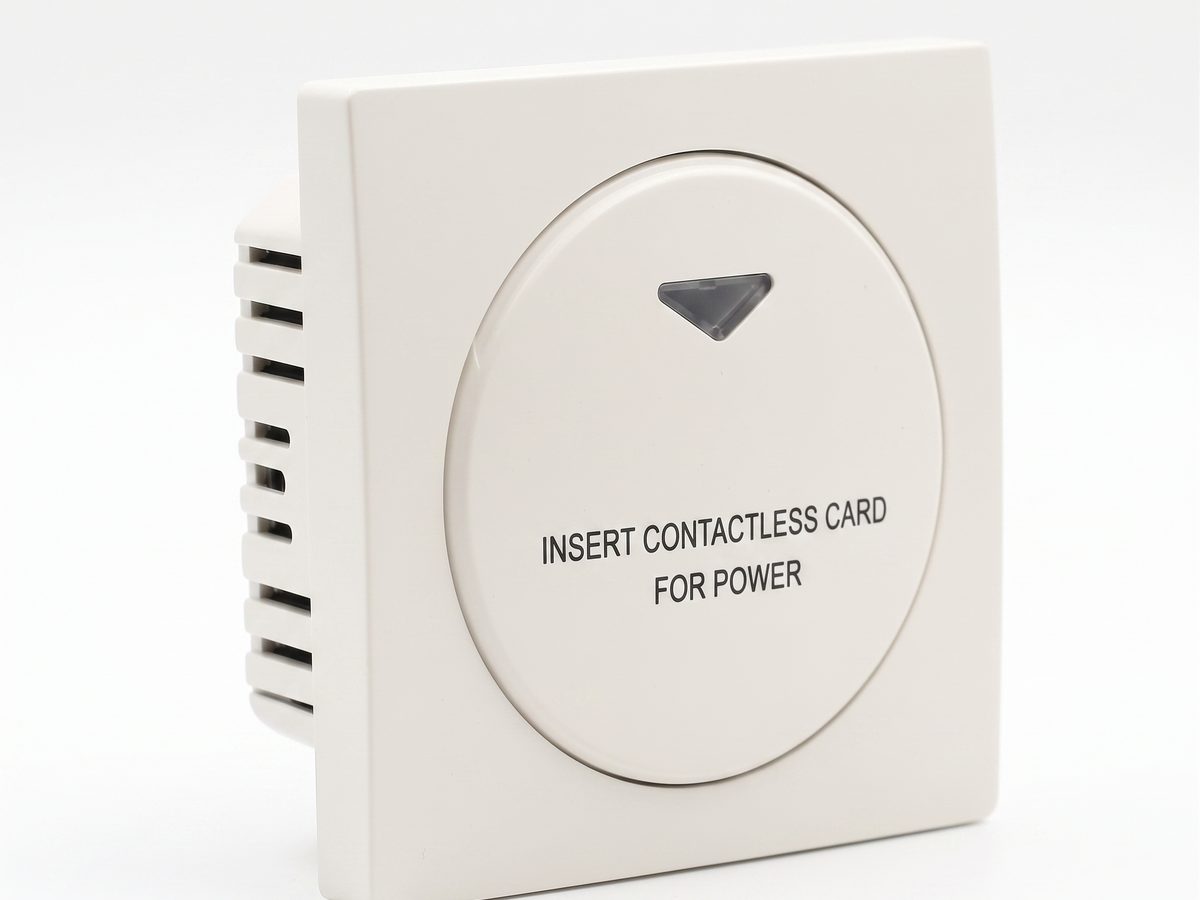
Hotel Key Card Switch — Kontrol Daya Kamar Tamu
Hotel key card switch untuk kontrol daya kamar tamu. Deteksi kartu RFID/IC, masukkan kartu untuk menyalakan daya, penundaan pemadaman saat kartu dilepas. 220V AC, 10A-16A, RS485 atau dry contact. CE RoHS. Pemasok OEM/ODM.
contentGraph.reasons.explicit
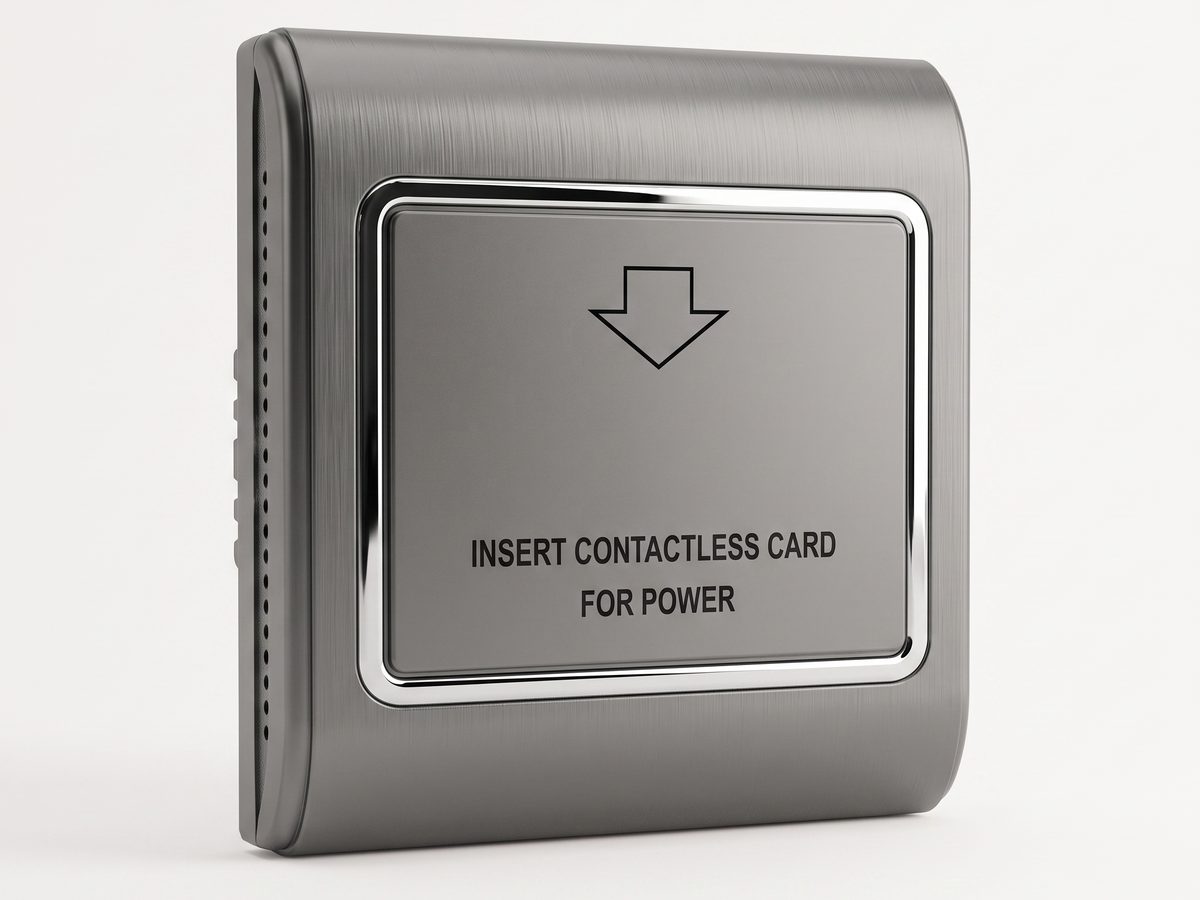
Sakelar Hemat Energi RFID — Kartu MIFARE Ruangan (Tipe B)
Sakelar hemat energi RFID yang mengikat daya ke kartu MIFARE ruangan tertentu. 13.56MHz MIFARE / 125kHz Temic, AC 180–250V, 30A, tunda mati 15 detik.
contentGraph.reasons.explicit
contentGraph.sections.solutions
3Sistem Manajemen Kamar Hotel Berbasis Kartu Listrik
Sistem manajemen kamar hotel praktis untuk mengatur daya listrik kamar melalui saklar kartu kunci, kontaktor, dan aturan operasional yang terdokumentasi.
contentGraph.reasons.productContext
Penghematan Energi Hotel dengan Saklar Daya Kamar Tamu
Solusi penghematan energi hotel yang menggunakan daya kamar terkendali kartu untuk mencegah lampu, AC, dan stopkontak terpilih menyala tanpa perlu.
contentGraph.reasons.productContext
Kontrol Daya Kamar Hotel dengan Saklar Kartu
Solusi kontrol daya kamar hotel yang praktis untuk mengalihkan pencahayaan, pendingin udara, dan stopkontak kamar tamu dengan kartu kamar resmi.
contentGraph.reasons.productContext
contentGraph.sections.blog
3
Hotel Key Card Switch: Jenis, Model, dan Cara Memilih
Panduan hotel key card switch mencakup model universal, RFID, TTLOCK, BLE, dan occupancy, serta cara memilih model yang sesuai dengan sistem kartu hotel Anda.
contentGraph.reasons.productContext
RFID vs NFC untuk Saklar Kartu Kunci Hotel: Pilih Mana?
RFID vs NFC pada saklar kartu kunci hotel berujung pada jangkauan dan penguncian: RFID 125kHz / 13.56MHz (MIFARE, Temic) adalah standar daya kamar hotel…
contentGraph.reasons.productContext
Apa Itu Hotel Key Card Switch dan Cara Hemat Energi Kamar
Hotel key card switch adalah perangkat dinding yang menyalakan listrik kamar saat kartu dimasukkan dan memutusnya saat kartu ditarik, hemat 25–40%…
contentGraph.reasons.productContext
nextStep.blog.title
nextStep.blog.description
- nextStep.blog.points.one
- nextStep.blog.points.two
- nextStep.blog.points.three