RFID vs IC : choisir la bonne technologie de carte pour interrupteur hôtel
Interrupteur RFID vs IC hôtel : comparez cartes 125kHz UID et 13,56MHz MIFARE. Portée, sécurité, chiffrement, coût, compatibilité : guide de sélection complet.
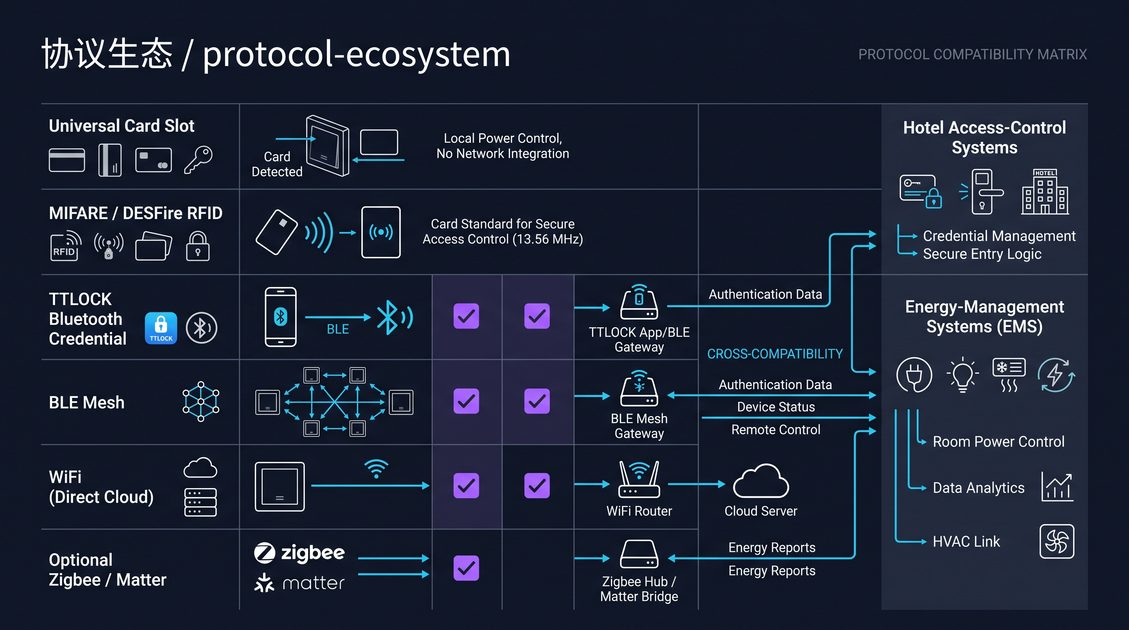
RFID vs IC est la question carte la plus posée par les hôteliers avant d'acheter un interrupteur carte, car les deux termes semblent proches mais désignent des cartes physiques très différentes qui se comportent différemment au niveau de l'interrupteur mural. Dans l'hôtellerie, RFID désigne la carte proximité basse fréquence 125kHz comme EM4100, Temic ou HID, qui ne stocke qu'un numéro d'identification unique gravé en usine. Carte IC signifie carte à circuit intégré, et dans le contexte d'un interrupteur carte hôtel, elle désigne la carte intelligente sans contact 13,56MHz, le plus souvent une MIFARE Classic (M1) sous ISO 14443, qui embarque une vraie puce microcontrôleur avec secteurs mémoire et moteur cryptographique. La différence importe car elle décide comment l'interrupteur valide la carte, s'il peut lier l'alimentation à une chambre, la facilité de clonage, et le coût. Ce guide décompose la comparaison RFID vs IC en portée, sécurité, stockage, coût, compatibilité et rénovation pour choisir le bon interrupteur carte hôtel.
Interrupteur RFID vs IC hôtel : ce que signifient vraiment les deux technologies carte
La sélection interrupteur RFID vs IC hôtel commence par clarifier la terminologie, car "carte RFID" et "carte IC" sont utilisées de façon incohérente dans l'industrie et même dans un même catalogue fournisseur. Une carte RFID dans l'hôtellerie signifie presque toujours une carte proximité 125kHz à puce ID seule, la classique EM4100 (carte ID) ou standard Temic, dont la seule charge utile est un numéro de série fixe écrit en usine ; la carte n'a pas de mémoire inscriptible ni de cryptographie. Une carte IC signifie carte à circuit intégré avec microprocesseur, et le type qui importe pour un interrupteur alimentation carte est la carte intelligente sans contact 13,56MHz, dominée par MIFARE Classic 1K, qui offre 1024 octets EEPROM divisés en 16 secteurs de 4 blocs chacun, un numéro de série 48 bits, et un schéma d'authentification par clé secteur. Quand on demande si un interrupteur lit RFID ou IC, on demande en réalité laquelle de ces deux familles de cartes la bobine lecteur est accordée, car les fréquences 125kHz et 13,56MHz ne sont pas interchangeables sans module lecteur double fréquence.
La confusion terminologique mérite d'être fixée avant tout achat car elle pilote chaque décision compatibilité en aval. Certains fournisseurs utilisent "carte IC" vaguement pour dire toute carte à puce y compris sans contact, et "RFID" pour dire la liaison radio sans contact elle-même, ce qui fait sonner les deux mots comme la même chose. En pratique, pour un interrupteur carte hôtel, la lecture utile est : RFID égale carte proximité 125kHz lecture seule avec UID seulement, tandis que carte IC égale carte intelligente sans contact 13,56MHz avec stockage sur carte et clé d'authentification. Un interrupteur disant lire cartes RFID signifie généralement la famille basse fréquence EM4100 ou Temic. Un interrupteur disant lire cartes IC signifie presque toujours MIFARE Classic ou cartes compatibles 13,56MHz. Si un établissement utilise déjà des cartes porte MIFARE pour ses serrures électroniques, un interrupteur lisant IC est le choix naturel ; s'il utilise des cartes 125kHz bon marché, un interrupteur lisant RFID est l'option économique. Bien définir cela évite l'erreur d'achat la plus courante : acheter un interrupteur qui ne lit pas les cartes que l'hôtel émet déjà.
La différence physique explique aussi la dénomination. Une carte proximité 125kHz est passive, alimentée par le champ lecteur, et se contente de renvoyer son numéro de série ; elle ne contient pas de silicium actif au-delà d'un circuit résonnant et une minuscule puce ID. Une carte IC 13,56MHz contient un circuit intégré plus capable qui peut exécuter des commandes, conserver des données hors alimentation, et répondre à une poignée de main authentification défi-réponse. Parce que la carte IC a une puce qui calcule, elle peut prouver qu'elle connaît une clé secrète au lieu d'annoncer simplement un nombre immuable. Cette unique différence architecturale est la racine de presque toutes les différences sécurité et capacité entre cartes RFID et IC, et la raison pour laquelle un interrupteur carte hôtel conçu pour cartes IC peut faire une validation liée à la chambre qu'un simple interrupteur RFID lisant UID ne peut pas.
Comment un interrupteur RFID vs IC hôtel lit et valide les cartes
Un interrupteur RFID vs IC hôtel lit les cartes via une petite bobine antenne montée derrière la plaque frontale, et la méthode de validation est où les deux types de cartes divergent le plus. Pour une carte proximité RFID 125kHz, l'interrupteur alimente la carte sans fil à la basse fréquence, reçoit le numéro de série fixe de la carte, et compare cet UID à une liste d'autorisation de numéros de carte que l'hôtel a enregistrés pour la chambre. Comme l'UID est la seule donnée, un économiseur RFID accepte généralement la carte si le numéro apparaît en mémoire, ou dans les designs les plus simples il accepte toute carte de la même famille car chaque carte d'un lot 125kHz est traitée comme identique. Pour une carte IC 13,56MHz, l'interrupteur effectue une authentification secteur MIFARE, où la carte prouve la possession de la bonne clé secteur 6 octets via une séquence défi-réponse, et n'expose alors les données stockées dans le secteur. Cela signifie qu'un interrupteur lisant IC peut être programmé pour que seule la carte émise pour cette chambre spécifique alimente l'interrupteur, tandis qu'une carte d'une autre chambre est rejetée même si c'est la même famille de carte.
Le comportement lecture et validation diffère aussi quand deux cartes identiques sont présentées. Avec une carte RFID UID seule, toute carte dont le numéro de série est sur la liste d'autorisation fonctionne, et comme les puces UID 125kHz sont largement clonées, une copie de carte client se comporte exactement comme l'originale. Avec une carte IC utilisant MIFARE, l'interrupteur valide la clé secteur et lit optionnellement des données client comme le numéro de chambre ou l'heure de départ stockées sur la carte, donc l'interrupteur peut imposer la liaison chambre et même rejeter une carte expirée. Dans la configuration liée chambre la plus simple, l'interrupteur carte écrit le numéro de chambre dans le secteur données de la carte à l'arrivée du client, et l'interrupteur mural lit ce secteur à l'insertion ; si le numéro correspond, l'alimentation s'active. Cela donne à l'hôtel un interrupteur carte vraiment par chambre plutôt que par famille de carte. Pour des établissements passant d'un économiseur purement mécanique ou à plaque, comprendre cette étape lecture-validation sépare un interrupteur qui détecte juste toute carte d'un qui identifie vraiment la chambre du client.
Le comportement d'insertion à l'interrupteur est une autre distinction pratique. Un interrupteur carte clé RFID 125kHz réagit généralement à la simple présence de la carte et fonctionne souvent par insertion ou tap, car le lecteur n'a qu'à détecter qu'une carte est dans la fente. Un interrupteur carte clé IC effectue un cycle d'authentification complet à chaque fois, ce qui prend quelques centaines de millisecondes, et nécessite généralement que la carte soit insérée et maintenue dans la fente pour que le champ sans contact reste engagé. Certains interrupteurs double usage combinent les deux, laissant le lecteur détecter toute carte pour commuter la charge mais utilisant les données secteur IC seulement pour la liaison chambre. Le câblage et le comportement électrique au relais sont identiques pour les deux types, car le côté commutation d'un interrupteur carte est juste un relais qui ferme pour connecter l'alimentation secteur aux éclairages et prises de la chambre. La différence est entièrement côté lecture. Quand vous comparez options interrupteur RFID vs IC hôtel, la logique validation, pas le relais, est ce que vous payez vraiment.
Interrupteur RFID vs IC hôtel : tableau comparatif paramètres techniques
Une carte IC et une carte RFID diffèrent sur fréquence fonctionnement, mémoire, cryptographie, résistance clonage, et coût unitaire, et le tableau ci-dessous résume les paramètres qui importent le plus quand vous comparez compatibilité interrupteur RFID vs IC hôtel. Les deux familles ne sont pas interchangeables au lecteur, donc ces nombres se traduisent directement en quel interrupteur vous pouvez installer.
| Paramètre | Carte Proximité RFID | Carte IC (MIFARE Classic 1K) |
|---|---|---|
| Fréquence fonctionnement | 125kHz (EM4100, Temic, HID) | 13,56MHz (ISO 14443) |
| Standard lecture | ISO 11784 / ISO 11785 | ISO 14443A |
| Portée lecture typique | 3 à 10 cm | 2 à 5 cm |
| Mémoire sur carte | Aucune, UID seulement | 1024 octets, 16 secteurs de 4 blocs |
| Charge utile carte | Numéro série 40 à 64 bits | UID 48 bits plus secteurs données inscriptibles |
| Authentification | Aucune, comparaison UID seulement | Clé secteur 6 octets, défi-réponse |
| Données inscriptibles hôtel | Non | Oui, numéro chambre, expiration, données client |
| Résistance clonage | Faible, UID facilement copié | Moyenne, clés protègent données |
| Chiffrement | Pas de moteur cryptographique | Chiffrement flux Crypto-1, vérification clé matériel |
| Capacité liaison chambre | Limitée à liste UID | Complète, lit secteur données par chambre |
| Coût unitaire carte typique | Très bas, prix gros | Bas à modéré, cartes marquées plus |
| Module lecteur requis | Bobine 125kHz | Bobine 13,56MHz |
| Cas usage courant | Économiseur budget, interrupteurs basiques | Serrures portes, alimentation liée chambre, POS |
La comparaison paramètres montre pourquoi le choix n'est pas cosmétique. La portée lecture diffère car fréquence plus basse pénètre mieux, donc un interrupteur RFID 125kHz peut parfois détecter une carte à travers une plaque frontale légèrement plus épaisse ou au tap, tandis que lecture IC 13,56MHz exige contact plus proche. La colonne mémoire explique l'histoire liaison chambre : une carte RFID ne peut simplement pas stocker le numéro chambre, donc l'interrupteur doit garder une liste d'autorisation d'UID, alors qu'une carte IC porte les données chambre sur la carte elle-même. La colonne cryptographie explique l'histoire sécurité : une carte IC peut prouver qu'elle connaît une clé, tandis qu'une carte RFID ne peut que répéter un nombre. Quand vous lisez le tableau de haut en bas, chaque ligne raconte la même histoire : la carte IC échange portée légèrement plus courte pour beaucoup plus de stockage, sécurité, et contrôle par chambre, et la carte RFID échange tout cela pour le coût le plus bas possible et un lecteur plus simple.
Choisir un interrupteur RFID vs IC hôtel pour votre établissement
Choisir un interrupteur RFID vs IC hôtel se résume aux cartes que votre établissement émet déjà, car l'interrupteur doit lire la même famille de carte que vos serrures portes si vous voulez une carte pour les deux jobs. Si votre hôtel utilise serrures électroniques porte clés MIFARE ou autres cartes IC 13,56MHz, alors le choix évident est un interrupteur lisant IC, car il valide la même carte qui ouvre la porte chambre et peut lier l'alimentation à cette chambre spécifique. Si votre établissement utilise encore des cartes proximité 125kHz EM4100 ou Temic, ou si vous gérez un petit hôtel budget voulant le coût par carte le plus bas, alors un interrupteur lisant RFID est l'option économique. Commencez votre décision en listant le type carte que vos serrures acceptent, car forcer une famille carte différente juste pour l'interrupteur alimentation signifie porter deux cartes client différentes, ce qui est confus pour le personnel réception et les clients. L'interrupteur doit suivre votre écosystème carte, pas l'inverse.
Au-delà de la famille carte, le second facteur décisif est le niveau de sécurité et contrôle par chambre dont vous avez besoin. Un établissement voulant juste couper l'électricité gaspillée quand les clients partent peut utiliser un interrupteur RFID détectant la présence de toute carte enregistrée, car l'objectif principal est contrôle charge plutôt qu'identité. Un établissement voulant empêcher le partage cartes, empêcher le personnel d'alimenter des chambres où ils ne sont pas, ou facturer l'énergie supplémentaire aux clients doit choisir un interrupteur IC avec liaison chambre, car il rejette une carte de la mauvaise chambre. Le coût opérationnel importe aussi sur la durée de vie carte : une carte IC est légèrement plus chère par unité mais porte données client et peut être réécrite et réutilisée maintes fois, tandis qu'une carte RFID est moins chère mais n'offre rien au-delà de son numéro fixe. Pour un hôtel qui réémet cartes à chaque séjour, la réinscriptibilité carte IC tend à gagner sur coût total possession, tandis que la carte RFID gagne sur coût pur initial.
Le troisième facteur est le chemin rénovation. Si vous avez déjà un système carte fonctionnel et voulez juste améliorer l'interrupteur mural, la voie la moins disruptive est un interrupteur correspondant à votre famille carte existante. Si vous passez des vieilles clés 125kHz à un système serrure MIFARE moderne en même temps, alors acheter un interrupteur IC correspondant dans le même projet évite un stock cartes abandonné. Beaucoup de fournisseurs proposent maintenant modèles interrupteurs dans les deux versions depuis le même boîtier, donc la plaque frontale et le câblage sont identiques et seul le module lecteur diffère. Cela fait de la décision interrupteur RFID vs IC hôtel un choix propre, faible risque une fois que vous avez confirmé votre standard carte. Le guide achat sur ce site détaille les paliers prix et MOQ, mais la règle courte est : suivez la serrure, suivez la carte, et laissez les exigences sécurité décider entre interrupteur RFID lisant UID et interrupteur IC liant chambre.
Différences sécurité : cartes RFID UID seule vs cartes IC chiffrées
Les différences sécurité entre carte RFID et carte IC sont la partie la plus conséquente d'une comparaison interrupteur RFID vs IC hôtel, car elles déterminent la facilité pour un client de copier une carte ou alimenter une chambre non payée. Une carte RFID 125kHz expose son identité complète comme numéro de série fixe lisible par un cloneur portable bon marché vendu ouvertement en ligne, et copier ce numéro sur une puce 125kHz vierge produit une carte fonctionnellement identique à l'originale pour un interrupteur UID seul. Il n'y a pas de clé, pas de cryptographie, et pas de liaison chambre sauf si l'interrupteur maintient sa propre liste d'autorisation UID. Une carte IC comme MIFARE Classic se défend avec une clé secteur 6 octets vérifiée par poignée de main défi-réponse, et bien que Crypto-1 ait des faiblesses académiques connues, un interrupteur clé MIFARE correctement configuré bloque encore le clonage occasionnel et empêche une carte d'une autre chambre de fonctionner. Pour la plupart applications hôtelières, la différence est la différence entre n'importe qui avec une carte copieuse qui fonctionne et seule la vraie carte chambre qui fonctionne.
La liaison chambre est où les cartes IC prennent l'avantage décisif en sécurité. Quand l'hôtel écrit le numéro chambre et données départ dans le secteur carte, l'interrupteur carte clé peut rejeter une carte dont le numéro chambre ne correspond pas, même si la carte porte une clé valide. Cela ferme un abus courant où les clients échangent cartes ou utilisent une carte zone commune pour garder leur propre chambre alimentée. Un interrupteur RFID avec seulement UID ne peut pas distinguer la chambre à laquelle appartient la carte, donc il accepte soit toutes les cartes de la famille, soit repose sur la réception pour programmer une liste d'autorisation fastidieuse à maintenir au fil des émissions et retours cartes. La capacité stockage données de la carte IC est la fonctionnalité sécurité, pas juste une commodité, car elle déplace la décision accès sur la carte elle-même plutôt qu'une comparaison nombre statique. Pour un hôtel soucieux d'empêcher l'alimentation gratuite, la voie IC est le choix plus robuste.
Il y a des mises en garde pratiques à dire honnêtement plutôt que surpromettre. Le chiffrement flux Crypto-1 de MIFARE Classic a été rétro-ingénierie publiquement, donc une carte IC avec clé connue ou par défaut n'est pas cryptographiquement incassable, et un attaquant sérieux avec le bon matériel et connaissances peut lire un secteur MIFARE mal protégé. Cependant, la barrière est bien plus haute que cloner un UID 125kHz, et pour le modèle menace de clients hôtel essayant d'économiser quelques dollars électricité, l'approche secteur-clé IC est plus que suffisante. Les cartes IC plus récentes basées sur MIFARE Plus ou DESFire utilisent chiffrement AES-128 et ferment l'écart théorique entièrement, à un coût carte plus élevé que seuls certains hôtels justifient. Si vous pesez sécurité interrupteur RFID vs IC hôtel, le résumé honnête est qu'un interrupteur IC arrête le clonage occasionnel et impose contrôle par chambre, tandis qu'un interrupteur RFID est acceptable seulement quand économie énergie est l'unique but et l'identité n'importe pas.
Interrupteur RFID vs IC hôtel : coût, compatibilité, et rénovation
Le côté coût et compatibilité d'une décision interrupteur RFID vs IC hôtel est où beaucoup d'hôtels se décident vraiment, car l'écosystème carte qu'ils possèdent déjà est un actif investi qu'il est cher de changer. L'interrupteur lui-même est prix similaire entre les deux types lecteurs pour qualité construction comparable, car le coût principal est la plaque frontale métal, le relais, et la carte contrôle, le module lecteur n'étant qu'une portion modeste du total. Les plus grandes différences coût vivent dans les cartes et le système serrure environnant. Une carte proximité RFID 125kHz est parmi les consommables les moins chers qu'un hôtel achète, coûtant quelques centimes par vierge en gros, tandis qu'une carte IC MIFARE Classic coûte un peu plus par unité mais peut être réécrite sur des centaines de séjours. Si vos serrures acceptent déjà MIFARE, le coût carte IC est déjà investi dans votre système existant, donc le coût incrémental d'un interrupteur IC est faible. Si vous partez de zéro, l'économie par carte RFID peut importer pour un très grand établissement émettant des milliers de cartes.
La compatibilité est la contrainte qui l'emporte sur le prix. Un interrupteur carte clé doit lire la même fréquence et standard carte que la carte client, donc vérifiez trois choses avant d'acheter : la fréquence carte (125kHz vs 13,56MHz), le standard carte (EM4100, Temic, HID vs MIFARE Classic, Plus, ou DESFire), et si le système serrure écrit des données chambre sur la carte que l'interrupteur pourrait réutiliser. Certains systèmes serrure porte stockent l'information chambre dans un secteur MIFARE spécifique, et un interrupteur lisant ce même secteur peut lier l'alimentation à la chambre sans programmation séparée. D'autres utilisent une disposition secteur propriétaire, auquel cas vous pouvez avoir besoin de la coopération du fournisseur serrure ou d'un interrupteur lisant l'UID seulement. C'est pourquoi la question compatibilité doit être posée à votre fournisseur serrure et votre fournisseur interrupteur ensemble, avant de vous engager sur une famille carte. Une incompatibilité ici est l'erreur la plus chère dans toute la décision RFID vs IC, car elle abandonne à la fois les cartes et les interrupteurs.
Rénovation et installation sont la préoccupation pratique finale. La plupart interrupteurs carte clé utilisent un format mural standard avec deux bornes pour phase et neutre et une sortie relais, donc passer d'un interrupteur RFID à un interrupteur IC dans le même projet est un remplacement identique avec câblage identique. Si vous installez dans des chambres clients existantes, confirmez que l'interrupteur gère la tension chambre, typiquement 220V dans la plupart marchés hôteliers, et qu'il s'adapte à la boîte de jonction déjà dans le mur. Si vous améliorez tout le système carte d'un coup, commandez serrures, cartes, et interrupteurs dans le même standard pour garder l'écosystème cohérent. La matrice compatibilité dans la section ci-dessus donne les paramètres exacts à confirmer avec votre fournisseur. Que vous choisissiez interrupteur RFID ou IC, l'installation mécanique et électrique est la même, donc la décision se réduit vraiment au standard carte et au niveau sécurité voulu, pas à une différence câblage.
Interrupteur RFID vs IC hôtel : familles cartes compatibles
Le choix interrupteur RFID vs IC hôtel se réduit vite une fois qu'on mappe les vraies familles cartes, car le marché se stabilise en une poignée de standards de facto que les fournisseurs conçoivent leurs lecteurs autour. Côté RFID 125kHz, les familles dominantes sont EM4100, Temic (aussi écrit Temic 5577), et HID Prox, toutes présentant un numéro de série gravé usine et n'offrant pas de mémoire inscriptible ; un lecteur interrupteur accordé à l'une de ces familles lit l'UID carte et le compare à une liste d'autorisation. Côté IC 13,56MHz, MIFARE Classic 1K est de loin le plus courant, avec MIFARE Plus et MIFARE DESFire servant les niveaux sécurité supérieurs, et la couverture ISO 14443A dans le lecteur étant ce qui rend les trois lisibles par le même module. Quand un fournisseur dit qu'un interrupteur lit "MIFARE", il signifie presque toujours MIFARE Classic, donc confirmez si le lecteur gère aussi MIFARE Plus et DESFire si vous prévoyez migrer vers cartes AES-128 plus tard. Mapper votre famille carte à l'un de ces standards est le moyen le plus rapide de filtrer quels modèles interrupteurs peuvent marcher pour votre établissement.
Deux règles pratiques en découlent. Premièrement, n'assumez jamais que deux cartes même fréquence sont interchangeables : une carte 125kHz EM4100 et une carte 125kHz Temic sont toutes deux "RFID", mais un lecteur interrupteur peut être construit pour l'une et rejeter l'autre, donc spécifiez la famille puce exacte, pas juste la fréquence, quand vous commandez. Deuxièmement, côté IC, un lecteur 13,56MHz gérant MIFARE Classic lira aussi la plupart autres cartes ISO 14443A, ce qui donne plus flexibilité si vous changez fournisseur carte, alors qu'un lecteur 125kHz est étroitement couplé à la puce basse fréquence spécifique. Les différences sécurité et mémoire se répètent ici : les familles 125kHz ne stockent rien et n'authentifient rien, tandis que les familles 13,56MHz stockent secteurs et peuvent authentifier, avec DESFire offrant la protection AES-128 la plus forte. C'est pourquoi un établissement prévoyant évoluer vers cartes haute sécurité devrait favoriser un interrupteur IC maintenant plutôt que rénover plus tard.
| Famille Carte | Fréquence | Mémoire | Auth | Usage Typique avec Interrupteur |
|---|---|---|---|---|
| EM4100 | 125kHz | Aucune, UID | Aucune | Économiseur RFID budget |
| Temic (5577) | 125kHz | Aucune, UID | Aucune | Économiseur RFID budget |
| HID Prox | 125kHz | Aucune, UID | Aucune | Systèmes proximité legacy |
| MIFARE Classic 1K | 13,56MHz | 1024 octets | Clé secteur | Interrupteur IC lié chambre |
| MIFARE Plus | 13,56MHz | Secteur configurable | AES-128 | Interrupteur IC haute sécurité |
| MIFARE DESFire | 13,56MHz | Jusqu'à 8KB | AES-128 | Contrôle accès, sécurité forte |
Comment un interrupteur carte clé économise l'énergie, et pourquoi le type carte change le calcul
Comprendre comment un interrupteur carte clé hôtel économise l'énergie explique pourquoi le choix interrupteur RFID vs IC hôtel affecte non juste la compatibilité mais la fiabilité de votre garantie économie énergie. Un interrupteur carte clé est un relais en série avec l'alimentation principale chambre ; quand le client retire la carte en partant, le relais s'ouvre et coupe l'alimentation aux éclairages, prises, et appareils forte charge de la chambre, tout en laissant les circuits câblés dur comme réfrigérateur et autres circuits toujours actifs fonctionner. Cela élimine la plus grande source énergie gaspillée hôtel, qui est chambres laissées alimentées et climatisées après départ ou pendant que le client est dehors. Le type carte ne change pas le mécanisme commutation, car interrupteurs RFID et IC coupent l'alimentation pareil quand aucune carte valide n'est présente. Ce que le type carte change, c'est la confiance avec laquelle l'interrupteur peut décider que la personne partant ne va pas revenir, et si une carte égarée laissée dans la fente peut maintenir l'alimentation par accident.
La capacité liaison chambre d'un interrupteur IC rend le comportement économie énergie plus précis. Avec un interrupteur RFID UID seul, toute carte de la bonne famille laissée dans la fente maintient la chambre alimentée, donc un client qui oublie une carte dans la fente défait le but, et une carte valide pour une chambre peut en alimenter une autre si l'interrupteur accepte toute la famille. Avec un interrupteur IC lisant un secteur par chambre, seule la carte de la bonne chambre maintient l'alimentation de cette chambre, ce qui resserre le contrôle énergie et empêche une carte d'une chambre d'en alimenter une autre. C'est une différence subtile mais réelle dans combien de l'économie théorique est réellement atteinte en opération quotidienne. Nous ne publions pas de pourcentage économie énergie spécifique, car les vraies économies dépendent occupation, habitudes clients, consignes CVC, et climat, qui varient trop entre établissements pour donner un chiffre universel.
Ce qui est sûr à dire est le mécanisme : couper l'alimentation principale quand aucune carte valide n'est présente élimine les charges veille et fantômes sur toute la chambre, ce qui est l'économie la plus grande et prévisible. Le système CVC est la charge dominante habituelle, et bien que beaucoup contrôles CVC aient besoin de leurs propres capteurs pour répondre vite, retirer l'alimentation d'une chambre totalement inoccupée empêche un client de laisser chauffage ou climatisation tourner toute la journée. Pour la décision comptabilité énergie, le type carte importe moins que la discipline câbler l'interrupteur pour que les circuits vous voulez vraiment contrôlés soient derrière le relais. Que vous choisissiez interrupteur RFID ou IC, le comportement énergie est gouverné par le relais et le plan câblage, pas par le lecteur. Choisissez donc le type carte pour compatibilité et sécurité, et concevez le câblage pour le résultat énergie vous voulez.
Il vaut aussi noter comment les deux types cartes se comportent dans le scénario qui importe le plus pour l'énergie, qui est le client partant pour la journée. Avec un interrupteur RFID UID seul, le champ est large et l'interrupteur peut enregistrer une carte comme présente même si elle repose juste près du lecteur, et une carte valide pour la famille chambre maintient l'alimentation jusqu'à retrait physique. Avec un interrupteur IC authentifiant et lisant un secteur par chambre, l'interrupteur décide sur une transaction valide complète, donc le même risque carte oubliée est plus petit. Aucune approche ne remplace une bonne gouvernante ou une routine départ sensée, et l'interrupteur ne doit jamais être traité comme substitut de la réception confirmant le départ client. Mais la logique décision plus serrée de l'interrupteur IC réduit le scénario toujours-allumé accidentel qui érode silencieusement les économies énergie sur un grand portefeuille. Quand vous fixez les attentes pour un propriétaire établissement, présentez l'interrupteur comme dispositif contrôle charge fiable dont le type carte détermine principalement compatibilité et sécurité, et dont la contribution énergie est réelle mais dépend comportement occupation et plan câblage vous implémentez.
Interrupteur RFID vs IC hôtel : installation, câblage, et format
L'installation et le câblage d'un interrupteur RFID vs IC hôtel est identique pour les deux types lecteurs, car la différence est confinée au lecteur frontal et la logique contrôle, tandis que le relais arrière et le bloc bornes sont les mêmes. Un interrupteur carte clé typique expédié comme unité murale avec plaque frontale, fente carte ou zone détection sur le devant, et soit bornes vis soit connecteur enfichable au dos. L'installateur connecte phase et neutre pour alimenter l'interrupteur lui-même, connecte les bornes relais commun et normalement ouvert en série avec les circuits contrôlés chambre, et optionnellement connecte un fil pour sonnette ou contrôle maître sur certains modèles. Le schéma câblage sur ce site montre la disposition bornes exacte pour version 220V. Comme la charge relais est dimensionnée pour la tension et courant chambre, vous devez confirmer que la charge nominale interrupteur correspond aux circuits vous placez derrière, et que les circuits toujours actifs comme réfrigérateur sont câblés en amont du relais plutôt qu'à travers.
Les différences format entre versions RFID et IC sont surtout sur la surface lecture. Un interrupteur proximité RFID lit souvent une carte par tap ou insertion brève car le champ 125kHz est large, tandis qu'un interrupteur IC a généralement besoin carte insérée et maintenue dans la fente pour que le lecteur 13,56MHz complète l'authentification. Certains interrupteurs modernes combinent lecteur proximité et fente pour lire cartes RFID style tap et cartes IC style insertion, ce qui est l'option la plus flexible pour un établissement en transition. Quel que soit le format choisi, confirmez la profondeur montage s'adapte à votre boîte jonction, car une bobine lecteur plus profonde ou un PCB plus grand peut nécessiter boîte plus profonde. Sur rénovation où la boîte existante est peu profonde, un interrupteur IC compact est parfois plus facile à installer qu'un modèle double fréquence plus volumineux.
Avant d'installer un lot dans vos chambres, installez une unité unique dans une chambre représentative et testez-la contre les vraies cartes clients, incluant une carte d'une autre chambre pour vérifier liaison chambre, une carte expirée si votre système écrit données expiration, et une carte vierge pour confirmer rejet. Ce test pré-installation attrape problèmes compatibilité quand une unité est facile à corriger plutôt qu'après déploiement complet. Gardez les détails standard carte de la section compatibilité sous la main quand vous commandez, pour que le module lecteur corresponde aux cartes vous émettez vraiment. Une fois l'interrupteur câblé et testé, l'opération courante ne demande pas maintenance au-delà nettoyage occasionnel plaque frontale, car interrupteurs RFID et IC sont lecteurs passifs sans contact sans pièces mobiles sur surface lecture. L'installation interrupteur RFID vs IC hôtel est donc un travail électrique standard, et le choix entre les deux est décidé en amont par votre écosystème carte.
Questions fréquentes sur interrupteurs RFID vs IC hôtel
Les questions les plus courantes sur un interrupteur RFID vs IC hôtel répètent les mêmes quelques préoccupations, donc cette section y répond directement avant achat. Une question fréquente est si un interrupteur peut lire cartes RFID et IC, et la réponse honnête est qu'un interrupteur standard est accordé à une fréquence, mais modèles double fréquence existent incluant lecteurs 125kHz et 13,56MHz, donc ils acceptent les deux familles cartes, généralement avec réserve que liaison chambre ne marche que côté IC. Une autre question est si clients peuvent utiliser carte IC hôtel dans leur téléphone, et la réponse est que bien qu'une carte 13,56MHz puisse être émulée par téléphone NFC dans certains montages, l'interrupteur alimentation lié chambre est conçu autour de la carte physique, donc vous ne devriez pas compter sur émulation téléphone pour l'interrupteur mural sauf si le fournisseur le supporte explicitement. Une troisième question courante est si ça vaut le coup de passer d'un interrupteur RFID existant à un interrupteur IC, ce qui dépend si vos serrures et cartes tournent déjà sur 13,56MHz et si vous avez besoin liaison chambre.
Clients et équipes achat demandent aussi coût et quantité cartes, et le conseil pratique est commander des réserves de la famille carte vous utilisez déjà, acheter un petit lot test interrupteur d'abord, et confirmer le lecteur correspond à votre carte avant déploiement complet. Une autre question fréquente est si un interrupteur carte IC marchera avec une carte qu'un système hôtel précédent a écrite sur un secteur différent, et la réponse est que vous devrez peut-être lire la carte avec un programmeur pour confirmer quel secteur tient données chambre, ou utiliser un interrupteur lisant UID qui ne dépend pas disposition secteur. Propriétaires demandent aussi si l'interrupteur marche marchés haute tension, et la réponse est que la plupart interrupteurs carte clé supportent tension chambre standard 220V, mais vous devriez confirmer charge nominale pour votre marché. Enfin, certains demandent si cartes RFID peuvent être mises à niveau IC plus tard, et la réponse pratique est que l'interrupteur et la carte doivent changer ensemble, donc planifiez le standard carte avant de standardiser l'interrupteur sur votre établissement.
Le thème récurrent dans chaque question est que la décision interrupteur RFID vs IC hôtel est décidée en amont par votre écosystème carte et serrure existant, et en aval par le niveau sécurité et contrôle par chambre vous voulez. Commencez par lister les cartes vos serrures portes émettent, confirmez fréquence et standard, décidez si vous avez besoin liaison chambre ou simplement contrôle charge, et choisissez un interrupteur dont le module lecteur correspond à cette carte. Pour un établissement budget émettant cartes proximité 125kHz et voulant juste arrêter électricité gaspillée, un interrupteur RFID est le choix économique et correct. Pour un établissement tournant serrures portes MIFARE et voulant empêcher partage cartes et imposer alimentation par chambre, un interrupteur IC est le bon choix. Dans les deux cas l'installation est identique, le câblage standard, et l'interrupteur coupera fiablement l'alimentation quand aucune carte valide n'est présente, qui est le travail cœur de tout interrupteur carte clé hôtel.
Une partie de cet article est générée par IA et optimisée pour exactitude professionnelle et lisibilité. RFID vs IC is the single most asked card question we get from hoteliers who are about to buy a key card switch, because the two terms look similar but describe very different physical cards that behave differently at the wall switch. In the hotel industry, RFID refers to the low-frequency 125kHz proximity card such as EM4100, Temic, or HID, which stores only a factory-burned unique ID number and nothing else. IC card is short for integrated circuit card, and in a hotel key card switch context it refers to the 13.56MHz contactless smart card, most commonly a MIFARE Classic (M1) running ISO 14443, which carries a real microcontroller chip with memory sectors and a cryptographic engine. The difference matters because it decides how a hotel key card switch validates the card, whether it can bind power to one room, how easy the card is to clone, and what it costs. This guide breaks the RFID vs IC comparison into read range, security, storage, cost, compatibility, and retrofit so you can choose the right hotel key card switch.
RFID vs IC Hotel Key Card Switch: What the Two Card Technologies Actually Mean
RFID vs IC hotel key card switch selection starts with clearing up the terminology, because "RFID card" and "IC card" are used inconsistently across the industry and even within a single supplier's catalog. An RFID card in the hotel trade almost always means a 125kHz proximity card with an ID-only chip, the classic EM4100 (ID card) or Temic standard, whose only payload is a fixed serial number written at the factory; the card carries no writable memory and no cryptography. An IC card means an integrated circuit card with a microprocessor, and the type that matters for a key card power switch is the 13.56MHz contactless smart card, dominated by MIFARE Classic 1K, which offers 1024 bytes of EEPROM divided into 16 sectors of 4 blocks each, a 48-bit serial number, and a sector-key authentication scheme. When someone asks whether a switch reads RFID or IC, they are really asking which of these two card families the reader coil is tuned for, because the operating frequencies of 125kHz and 13.56MHz are not interchangeable without a dual-frequency reader module.
The terminology confusion is worth pinning down before any purchase because it drives every compatibility decision downstream. Some suppliers use "IC card" loosely to mean any chip card including contactless, and "RFID" to mean the contactless radio link itself, which makes the two words sound like they are the same thing. In practice, for a hotel key card switch, the useful reading is: RFID equals a read-only 125kHz proximity card with only a UID, while IC card equals a 13.56MHz contactless smart card with on-card storage and an authentication key. A hotel key card switch that says it reads RFID cards typically means the low-frequency EM4100 or Temic family. A switch that says it reads IC cards almost always means MIFARE Classic or compatible 13.56MHz cards. If a property already uses MIFARE door cards for its electronic locks, then an IC-reading switch is the natural match; if it uses low-cost 125kHz cards, an RFID-reading switch is the cheaper fit. Getting this one definition right avoids the most common purchasing error, which is buying a switch that cannot read the cards the hotel already issues.
The physical difference also explains the naming. A 125kHz proximity card is passive, powered by the reader's field, and simply echoes its serial number; it contains no active silicon beyond a resonant circuit and a tiny ID chip. A 13.56MHz IC card contains a more capable integrated circuit that can execute commands, hold data across power cycles, and respond to a challenge-response authentication handshake. Because the IC card has a chip that can compute, it can prove it knows a secret key rather than merely announcing an unchangeable number. That single architectural difference is the root of nearly every security and capability difference between RFID and IC cards, and it is the reason a hotel key card switch designed for IC cards can do room-bound validation that a simple UID-reading RFID switch cannot.
How an RFID vs IC Hotel Key Card Switch Reads and Validates Cards
An RFID vs IC hotel key card switch reads cards through a small antenna coil mounted behind the faceplate, and the validation method is where the two card types diverge most sharply. For a 125kHz RFID proximity card, the switch powers the card wirelessly at the low frequency, receives the card's fixed serial number, and compares that UID against an allowlist of card numbers that the hotel has registered to the room. Because the UID is the only datum, an RFID energy saver typically accepts the card if the number appears in its memory, or in the simplest designs it accepts any card from the same family because every card in a 125kHz batch is treated as identical. For a 13.56MHz IC card, the switch performs a MIFARE sector authentication, where the card proves possession of the correct 6-byte sector key through a challenge-response sequence, and only then exposes the data stored in the sector. This means an IC-reading switch can be programmed so that only the card issued for that specific room powers the switch, while a card from another room is rejected even though it is the same card family.
The read and validate behavior also differs in what happens when two identical-looking cards are presented. With a UID-only RFID card, any card whose serial number is on the allowlist works, and because 125kHz UID chips are widely cloned, a copy of a guest card behaves exactly like the original. With an IC card using MIFARE, the switch validates the sector key and optionally reads guest data such as the room number or checkout time stored on the card, so the switch can enforce room binding and can even reject an expired card. In the simplest room-bound setup, the key card switch writes the room number into the card's data sector when the guest checks in, and the wall switch reads that sector on insertion; if the room number matches, power turns on. This gives the hotel a card switch that is genuinely per-room rather than per-card-family. For properties upgrading from a purely mechanical or switch-plate energy saver, understanding this read-and-validate step is what separates a switch that just detects any card from one that truly identifies the guest's room.
The insertion behavior at the switch is another practical distinction. A 125kHz RFID key card switch usually reacts to the mere presence of the card and often works with either insertion or a tap, because the reader only needs to detect that a card is in the slot. An IC key card switch performs a full authentication cycle each time, which takes a few hundred milliseconds, and typically requires the card to be inserted and held in the slot for the contactless field to remain engaged. Some dual-purpose switches combine both, letting the reader detect any card to switch the load but using the IC sector data only for room binding. The wiring and electrical behavior at the relay is identical for both types, since the switching side of a key card switch is just a relay that closes to connect live power to the room's lighting and outlets. The difference is entirely on the read side. When you compare RFID vs IC hotel key card switch options, the validation logic, not the relay, is what you are really paying for.
RFID vs IC Hotel Key Card Switch: Technical Parameter Comparison Table
An IC card and an RFID card differ on operating frequency, memory, cryptography, cloning resistance, and unit cost, and the table below summarizes the parameters that matter most when you compare RFID vs IC hotel key card switch compatibility. The two families are not interchangeable at the reader, so these numbers translate directly into which switch you can install.
| Parameter | RFID Proximity Card | IC Card (MIFARE Classic 1K) |
|---|---|---|
| Operating frequency | 125kHz (EM4100, Temic, HID) | 13.56MHz (ISO 14443) |
| Read standard | ISO 11784 / ISO 11785 | ISO 14443A |
| Typical read range | 3 to 10 cm | 2 to 5 cm |
| On-card memory | None, UID only | 1024 bytes, 16 sectors of 4 blocks |
| Card payload | 40-bit to 64-bit serial number | 48-bit UID plus writable data sectors |
| Authentication | None, UID compare only | 6-byte sector key, challenge-response |
| Data writable by hotel | No | Yes, room number, expiry, guest data |
| Cloning resistance | Low, UID easily copied | Medium, keys protect data |
| Encryption | No cryptographic engine | Crypto-1 stream cipher, hardware key check |
| Room-bound capability | Limited to UID allowlist | Full, reads per-room data sector |
| Typical card unit cost | Very low, bulk pricing | Low to moderate, branded cards more |
| Reader module needed | 125kHz coil | 13.56MHz coil |
| Common use case | Budget energy saver, basic switches | Door locks, room-bound power, POS |
The parameter comparison shows why the choice is not cosmetic. The read range differs because lower frequency penetrates better, so a 125kHz RFID switch can sometimes detect a card through a slightly thicker faceplate or at a tap, while 13.56MHz IC reading demands closer contact. The memory column explains the room-binding story: an RFID card simply cannot store the room number, so the switch must keep an allowlist of UIDs, whereas an IC card carries the room data on the card itself. The cryptography column explains the security story: an IC card can prove it knows a key, while an RFID card can only repeat a number. When you read the table from top to bottom, every row tells the same story, which is that the IC card trades slightly shorter range for a great deal more storage, security, and per-room control, and the RFID card trades all of that for the lowest possible cost and a simpler reader.
Choosing an RFID vs IC Hotel Key Card Switch for Your Property
Choosing an RFID vs IC hotel key card switch comes down to the cards your property already issues, because the switch must read the same card family as your door locks if you want one card to do both jobs. If your hotel uses electronic door locks keyed to MIFARE or other 13.56MHz IC cards, then the obvious choice is an IC-reading key card switch, because it validates the same card that opens the room door and can bind power to that specific room. If your property still uses 125kHz EM4100 or Temic proximity cards, or if you operate a small budget hotel that wants the lowest possible per-card cost, then an RFID-reading switch is the economical fit. Start your decision by listing the card type your locks accept, because forcing a different card family just for the power switch means carrying two different guest cards, which is confusing for front desk staff and guests alike. The switch should be the follower of your card ecosystem, not the other way around.
Beyond the card family, the second deciding factor is how much per-room security and control you need. A property that simply wants to cut wasted electricity when guests leave can use an RFID switch that detects the presence of any registered card, because the main goal is load control rather than identity. A property that wants to prevent guests from sharing cards, stop staff from powering rooms they are not in, or charge guests for extra energy should choose an IC switch with room binding, because it rejects a card from the wrong room. The operational cost also matters over the card lifetime: an IC card is slightly more expensive per unit but carries guest data and can be rewritten and reused many times, while an RFID card is cheaper but offers nothing beyond its fixed number. For a hotel that reissues cards every stay, the IC card's rewriteability tends to win on total cost of ownership, while the RFID card wins on pure upfront cost.
The third factor is the retrofit path. If you already have a working card system and simply want to upgrade the wall switch, the least disruptive route is a switch that matches your existing card family. If you are upgrading from the old 125kHz keys to a modern MIFARE lock system at the same time, then buying a matching IC switch in the same project avoids a stranded inventory of cards. Many suppliers now offer switch models in both versions from the same housing, so the faceplate and wiring are identical and only the reader module differs. This makes the RFID vs IC hotel key card switch decision a clean, low-risk choice once you have confirmed your card standard. The buying guide on this site walks through pricing tiers and MOQ in more detail, but the short rule is: match the lock, match the card, and let security requirements decide between a UID-reading RFID switch and a room-binding IC switch.
Security Differences: UID-Only RFID Cards vs Encrypted IC Cards
The security differences between an RFID card and an IC card are the most consequential part of an RFID vs IC hotel key card switch comparison, because they determine how easily a guest can copy a card or power a room they have not paid for. A 125kHz RFID card exposes its full identity as a fixed serial number that can be read by a cheap handheld cloner sold openly online, and copying that number onto a blank 125kHz chip produces a card that is functionally identical to the original for a UID-only switch. There is no key, no cryptography, and no per-room binding unless the switch maintains its own UID allowlist. An IC card such as MIFARE Classic defends itself with a 6-byte sector key verified through a challenge-response handshake, and while Crypto-1 has known academic weaknesses, a properly configured MIFARE key switch still blocks casual cloning and prevents a card from another room from working. For most hotel applications, the difference is the difference between anyone with a copier card working and only the genuine room card working.
Room binding is where IC cards pull decisively ahead in security. When the hotel writes the room number and checkout data into the card's sector, the key card switch can reject a card whose room number does not match, even if the card carries a valid key. This closes a common abuse where guests swap cards or use a card from a common area to keep their own room powered. An RFID switch with only a UID cannot distinguish the room the card belongs to, so it either accepts all cards in the family or relies on the front desk to program an allowlist that is cumbersome to maintain as cards are issued and returned. The data-storage capability of the IC card is the security feature, not just a convenience, because it moves the access decision onto the card itself rather than a static number comparison. For a hotel that cares about preventing free power, the IC route is the more robust choice.
There are practical caveats to state honestly rather than overclaim. MIFARE Classic's Crypto-1 stream cipher has been publicly reverse-engineered, so an IC card with a known or default key is not cryptographically unbreakable, and a serious attacker with the right hardware and knowledge can read a poorly protected MIFARE sector. However, the barrier is far higher than cloning a 125kHz UID, and for the threat model of hotel guests trying to save a few dollars on electricity, the sector-key IC approach is more than sufficient. Newer IC cards based on MIFARE Plus or DESFire use AES-128 encryption and close the theoretical gap entirely, at a higher card cost that only some hotels justify. If you are weighing RFID vs IC hotel key card switch security, the honest summary is that an IC switch stops casual cloning and enforces per-room control, while an RFID switch is acceptable only when energy saving is the sole goal and identity does not matter.
RFID vs IC Hotel Key Card Switch: Cost, Compatibility, and Retrofit
The cost and compatibility side of an RFID vs IC hotel key card switch decision is where many hotels actually make up their mind, because the card ecosystem they already own is a sunk asset that is expensive to change. The switch itself is priced similarly between the two reader types for comparable build quality, since the main cost is the metal faceplate, the relay, and the control board, with the reader module being only a modest portion of the total. The larger cost differences live in the cards and in the surrounding lock system. A 125kHz RFID proximity card is among the cheapest consumables a hotel buys, costing a few cents per blank in bulk, while a MIFARE Classic IC card costs somewhat more per unit but can be rewritten across hundreds of stays. If your locks already accept MIFARE, the IC card cost is already sunk into your existing system, so the incremental cost of an IC switch is small. If you are starting from zero, the per-card saving of RFID can matter for a very large property issuing thousands of cards.
Compatibility is the constraint that overrides price. A key card switch must read the same frequency and card standard as the guest card, so check three things before buying: the card frequency (125kHz vs 13.56MHz), the card standard (EM4100, Temic, HID vs MIFARE Classic, Plus, or DESFire), and whether the lock system writes any room data onto the card that the switch could reuse. Some door lock systems store room information in a specific MIFARE sector, and a switch that reads that same sector can bind power to the room without any separate programming. Others use a proprietary sector layout, in which case you may need the lock vendor's cooperation or a switch that reads the UID only. This is why the compatibility question should be asked of your lock supplier and your switch supplier together, before you commit to a card family. A mismatch here is the most expensive mistake in the whole RFID vs IC decision, because it strands both the cards and the switches.
Retrofit and installation are the final practical concern. Most key card switches use a standard wall-mount form factor with two terminals for live and neutral and a relay output, so swapping from an RFID to an IC switch in the same project is a like-for-like replacement with identical wiring. If you are installing into existing guest rooms, confirm the switch can handle the room's voltage, typically 220V in most hotel markets, and that it fits the junction box already in the wall. If you are upgrading the entire card system at once, order the locks, cards, and switches in the same standard to keep the whole ecosystem consistent. The compatibility matrix in the section above gives you the exact parameters to confirm with your supplier. Whether you choose an RFID or an IC switch, the mechanical and electrical installation is the same, so the decision truly reduces to the card standard and the level of security you want, not to any wiring difference.
RFID vs IC Hotel Key Card Switch: Compatible Card Families
The RFID vs IC hotel key card switch choice narrows quickly once you map the actual card families, because the market settles into a handful of de-facto standards that suppliers design their readers around. On the 125kHz RFID side, the dominant families are EM4100, Temic (also written as Temic 5577), and HID Prox, all of which present a factory-burned serial number and offer no writable memory; a switch reader tuned to any of these reads the card UID and matches it against an allowlist. On the 13.56MHz IC side, MIFARE Classic 1K is by far the most common, with MIFARE Plus and MIFARE DESFire serving the higher-security tiers, and ISO 14443A coverage in the reader being what makes all three readable by the same module. When a supplier says a switch reads "MIFARE," it almost always means MIFARE Classic, so confirm whether the reader also handles MIFARE Plus and DESFire if you plan to migrate to AES-128 cards later. Mapping your card family to one of these standards is the fastest way to filter which switch models can possibly work for your property.
Two practical rules come out of this family map. First, never assume two cards with the same frequency are interchangeable: a 125kHz EM4100 card and a 125kHz Temic card are both "RFID," but a switch reader may be built for one and reject the other, so specify the exact chip family, not just the frequency, when you order. Second, on the IC side, a 13.56MHz reader that handles MIFARE Classic will also read most other ISO 14443A cards, which gives you more flexibility if you change card suppliers, whereas a 125kHz reader is tightly coupled to the specific low-frequency chip. The security and memory differences repeat here: the 125kHz families store nothing and authenticate nothing, while the 13.56MHz families store sectors and can authenticate, with DESFire offering the strongest AES-128 protection. This is why a property that plans to grow into higher-security cards should favor an IC switch now rather than retrofit later.
| Card Family | Frequency | Memory | Auth | Typical Use with Switch |
|---|---|---|---|---|
| EM4100 | 125kHz | None, UID | None | Budget RFID energy saver |
| Temic (5577) | 125kHz | None, UID | None | Budget RFID energy saver |
| HID Prox | 125kHz | None, UID | None | Legacy proximity systems |
| MIFARE Classic 1K | 13.56MHz | 1024 bytes | Sector key | Room-bound IC switch |
| MIFARE Plus | 13.56MHz | Sector configurable | AES-128 | Higher-security IC switch |
| MIFARE DESFire | 13.56MHz | Up to 8KB | AES-128 | Access control, strong security |
How a Key Card Switch Saves Energy, and Why Card Type Changes the Math
Understanding how a hotel key card switch saves energy explains why the RFID vs IC hotel key card switch choice affects not just compatibility but the reliability of your energy-saving guarantee. A key card switch is a relay in series with the room's main power feed; when the guest removes the card on leaving, the relay opens and cuts power to the room's lighting, outlets, and high-load appliances, while leaving the hard-wired refrigerator and other always-on circuits running. This removes the biggest source of wasted hotel energy, which is rooms left powered and air-conditioned after checkout or while the guest is out. The card type does not change the switching mechanism, because both RFID and IC switches cut power the same way when no valid card is present. What the card type changes is how confidently the switch can decide that the person leaving is not about to return, and whether a stray card left in the slot can keep power on by accident.
The room-binding capability of an IC switch makes the energy-saving behavior more precise. With a UID-only RFID switch, any card from the right family that is left in the slot keeps the room powered, so a guest who forgets a card in the slot defeats the purpose, and a card that is valid for one room can power another if the switch accepts the whole family. With an IC switch that reads a per-room sector, only the correct room's card keeps that room's power on, which tightens the energy control and prevents a card from one room powering another. This is a subtle but real difference in how much of the theoretical saving is actually achieved in daily operation. We do not publish a specific energy-saving percentage, because real savings depend on occupancy, guest habits, HVAC setpoints, and climate, all of which vary far too much between properties to state a universal figure.
What is safe to state is the mechanism: cutting the main power when no valid card is present eliminates standby and phantom loads across the whole room, which is the largest and most predictable saving. The HVAC system is the usual dominant load, and while many HVAC controls need their own sensors to respond quickly, removing power to a room that is fully unoccupied prevents a guest from leaving heating or cooling running all day. For the energy-accounting decision, the card type matters less than the discipline of wiring the switch so that the circuits you actually want controlled are behind the relay. Whether you pick an RFID or an IC switch, the energy behavior is governed by the relay and the wiring plan, not by the reader. So choose the card type for compatibility and security, and design the wiring for the energy outcome you want.
It is also worth noting how the two card types behave in the one scenario that matters most for energy, which is the guest leaving for the day. With a UID-only RFID switch, the field is broad and the switch may register a card as present even if it is only resting near the reader, and a card that is valid for the room family keeps power flowing until it is physically removed. With an IC switch that authenticates and reads a per-room sector, the switch decides on a full valid transaction, so the same forgot-the-card risk is smaller. Neither approach replaces good housekeeping or a sensible checkout routine, and the switch should never be treated as a substitute for the front desk confirming the guest has departed. But the tighter decision logic of the IC switch reduces the accidental always-on scenario that quietly erodes energy savings across a large portfolio. When you set the expectations for a property owner, frame the switch as a reliable load-control device whose card type primarily determines compatibility and security, and whose energy contribution is real but dependent on occupancy behavior and the wiring plan you implement.
RFID vs IC Hotel Key Card Switch: Installation, Wiring, and Form Factor
The installation and wiring of an RFID vs IC hotel key card switch is identical for both reader types, because the difference is confined to the front-end reader and the control logic, while the back-end relay and terminal block are the same. A typical key card switch ships as a wall-mounted unit with a faceplate, a card slot or sensing pad on the front, and either screw terminals or a plug-in connector on the back. The installer connects live and neutral to power the switch itself, connects the relay common and normally-open terminals in series with the room's controlled circuits, and optionally connects a wire for a doorbell or master control in some models. The wiring diagram on this site shows the exact terminal layout for the 220V version. Because the relay load is rated for the room's voltage and current, you must confirm the switch's rated load matches the circuits you place behind it, and that the always-on circuits such as the refrigerator are wired ahead of the relay rather than through it.
The form factor differences between RFID and IC versions are mostly about the reading surface. An RFID proximity switch often reads a card by a tap or a brief insertion because the 125kHz field is broad, while an IC switch usually needs the card inserted and held in the slot for the 13.56MHz reader to complete authentication. Some modern switches combine a proximity reader and a slot so they can read both tap-style RFID cards and insert-style IC cards, which is the most flexible option for a property mid-transition. Whichever form you choose, confirm the mounting depth fits your junction box, because a deeper reader coil or a larger PCB can require a deeper box. On a retrofit where the existing box is shallow, a compact IC switch is sometimes easier to fit than a bulkier dual-frequency model.
Before installing a batch across your rooms, install a single unit in a representative room and test it against the actual guest cards, including a card from another room to verify room binding, an expired card if your system writes expiry data, and a blank card to confirm rejection. This pre-install test catches compatibility problems when one unit is easy to correct rather than after a full rollout. Keep the card-standard details from the compatibility section handy when you order, so the reader module matches the cards you actually issue. Once the switch is wired and tested, routine operation requires no maintenance beyond occasional faceplate cleaning, because both RFID and IC switches are passive, contactless readers with no moving parts in the reading surface. The RFID vs IC hotel key card switch installation is therefore a standard electrical job, and the choice between the two is decided upstream by your card ecosystem.
Frequently Asked Questions about RFID vs IC Hotel Key Card Switches
The most common questions we receive about an RFID vs IC hotel key card switch repeat the same few concerns, so this section answers them directly before you buy. One frequent question is whether a switch can read both RFID and IC cards, and the honest answer is that a standard switch is tuned to one frequency, but dual-frequency models exist that include both a 125kHz and a 13.56MHz reader, so they can accept either card family, usually with a caveat that room binding only works on the IC side. Another question is whether guests can use a hotel IC card in their phone, and the answer is that while a 13.56MHz card can be emulated by an NFC phone in some setups, the room-bound power switch is designed around the physical card, so you should not rely on phone emulation for the wall switch unless the supplier explicitly supports it. A third common question is whether it is worth upgrading an existing RFID switch to an IC switch, which depends on whether your locks and cards already run on 13.56MHz and whether you need per-room binding.
Guests and procurement teams also ask about card cost and quantity, and the practical guidance is to order spares of the card family you already use, buy a small test batch of the switch first, and confirm the reader matches your card before a full rollout. Another frequent question is whether an IC card switch will work with a card that a previous hotel system wrote to a different sector, and the answer is that you may need to read the card with a programmer to confirm which sector holds room data, or use a UID-reading switch that does not depend on sector layout. Property owners also ask whether the switch works with high-voltage markets, and the answer is that most key card switches support the standard 220V room voltage, but you should confirm the rated load for your market. Finally, some ask whether RFID cards can be upgraded to IC later, and the practical answer is that the switch and the card must change together, so plan the card standard before you standardize the switch across your property.
The recurring theme in every question is that the RFID vs IC hotel key card switch decision is decided upstream by your existing card and lock ecosystem, and downstream by the level of security and per-room control you want. Start by listing the cards your door locks issue, confirm the frequency and standard, decide whether you need room binding or simply load control, and then choose a switch whose reader module matches that card. For a budget property issuing 125kHz proximity cards and wanting only to stop wasted electricity, an RFID switch is the economical and correct choice. For a property running MIFARE door locks and wanting to prevent card sharing and enforce per-room power, an IC switch is the right fit. In both cases the installation is identical, the wiring is standard, and the switch will reliably cut power when no valid card is present, which is the core job of any hotel key card switch.
Part of this article content is generated by AI and optimized for professional accuracy and readability.
Vous ne savez pas quel capteur choisir ?
Parlez à nos ingénieurs d’application mmWave pour une consultation gratuite.
Trouvez le capteur de présence adapté à votre projet hôtelier
Comparez les 3 protocoles, consultez des études de cas hôteliers et téléchargez le guide d'installation
Produits associés
2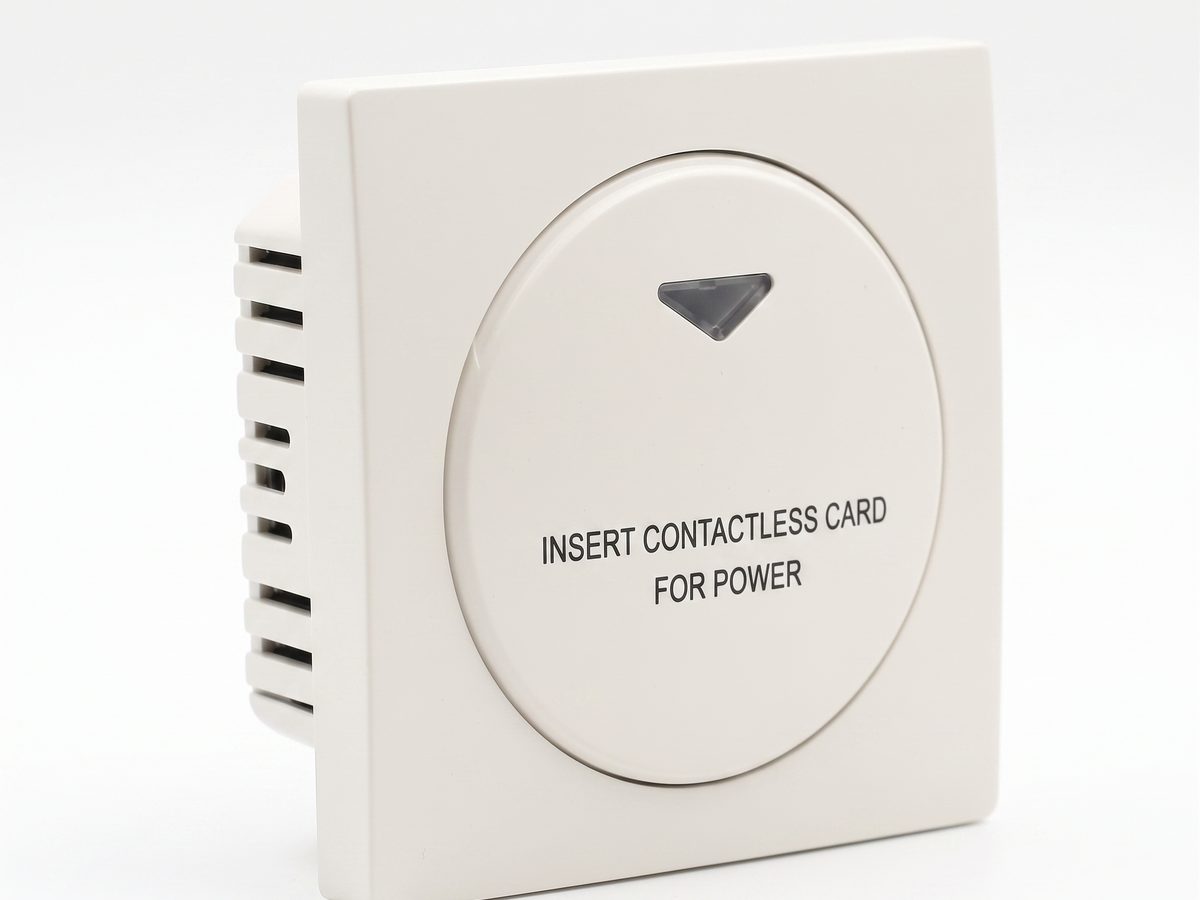
Interrupteur Carte Clé Hôtel — Contrôle Énergie Chambre
Interrupteur carte clé hôtel pour contrôle énergie chambre. Détection RFID/IC, insertion=alimentation, retrait=délai coupure. 220V CA, 10A-16A, RS485 ou contact sec. CE RoHS. Fournisseur OEM/ODM.
Cette page le désigne déjà comme prochaine référence recommandée.
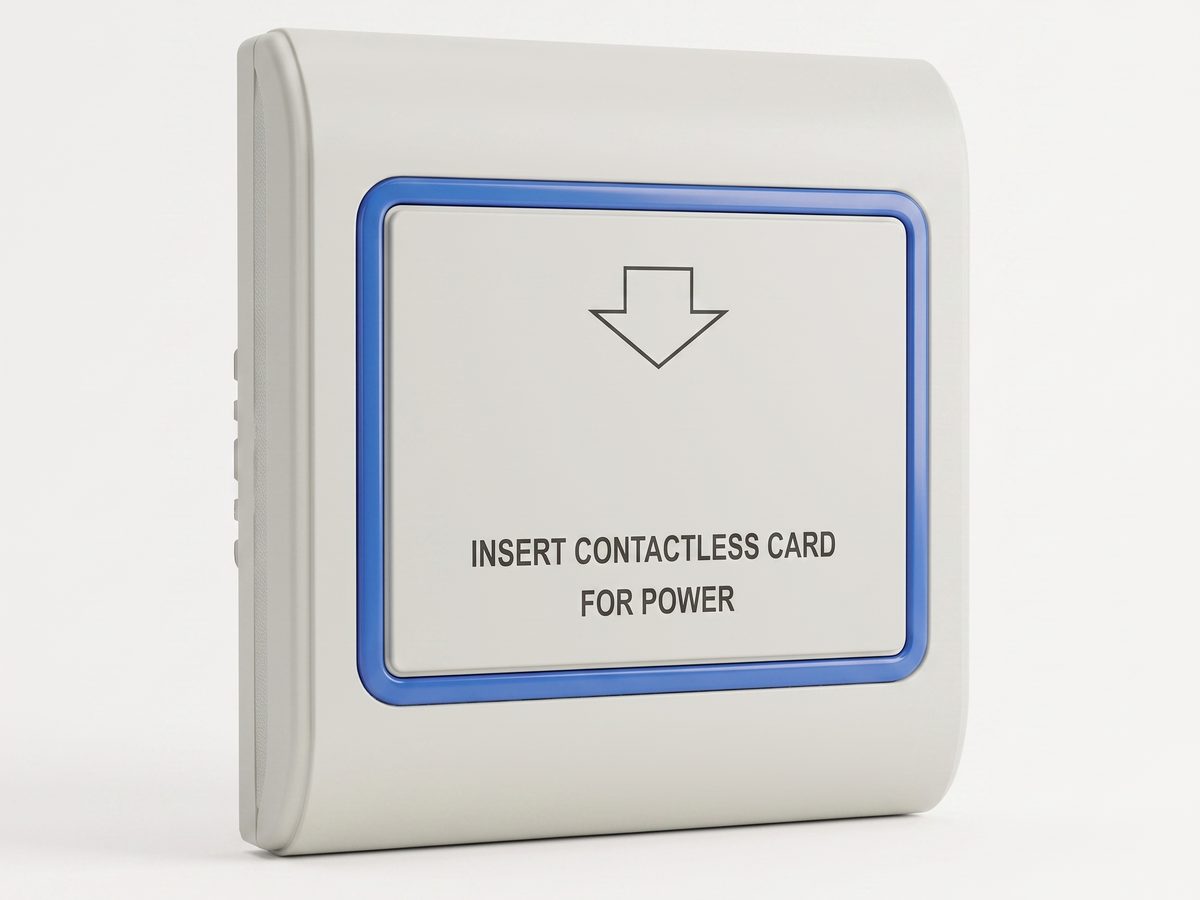
Interrupteur RFID Carte Clé — Contrôle Puissance Chambre 13,56MHz Sans Contact
Interrupteur RFID carte clé avec détection 13,56MHz sans contact. Le client pose simplement la carte sur la zone de lecture pour alimenter la chambre, sans fente d'insertion. Fonctionne avec les serrures d'hôtel. CE RoHS. Fournisseur OEM/ODM.
Cette page le désigne déjà comme prochaine référence recommandée.
Solutions associées
3Système de gestion des chambres par prise carte
Un système pratique de gestion des chambres pour contrôler l'alimentation via des prises carte, contacteurs et règles d'exploitation claires.
Il couvre le même contexte produit : Interrupteur Carte Clé Hôtel — Contrôle Énergie Chambre.
Économie d'énergie hôtel : commutation d'alimentation en chambre
Solution d'économie d'énergie hôtel utilisant la commutation d'alimentation par carte pour éviter le fonctionnement inutile des éclairages, climatisations et prises sélectionnées.
Il couvre le même contexte produit : Interrupteur Carte Clé Hôtel — Contrôle Énergie Chambre.
Contrôle d'alimentation chambre hôtel par cartes-clés
Solution pratique de contrôle d'alimentation pour éclairage, climatisation et prises de chambre via carte de chambre autorisée.
Il couvre le même contexte produit : Interrupteur Carte Clé Hôtel — Contrôle Énergie Chambre.
Articles de blog associés
3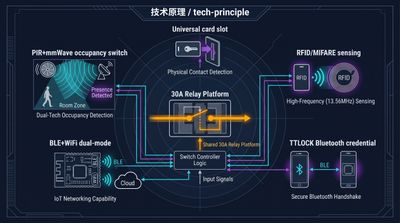
Commutateur carte-clé hôtel : types, modèles, spécification
Le commutateur à carte-clé d'hôtel existe en modèles universel, RFID, TTLOCK, BLE et à présence. Ce guide couvre les termes clés et le choix du modèle.
Il couvre le même contexte produit : Interrupteur Carte Clé Hôtel — Contrôle Énergie Chambre.
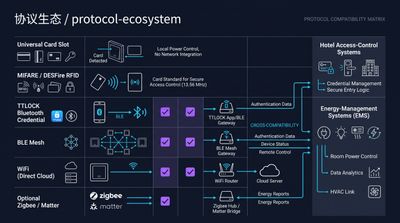
RFID vs NFC pour commutateurs carte clé hôtel : quel choix ?
RFID vs NFC pour commutateurs carte clé hôtel : RFID (125kHz, 13,56MHz MIFARE/Temic) standard alimentation chambre ; NFC protocole téléphone. Comparer portée, verrouillage.
Il couvre le même contexte produit : Interrupteur Carte Clé Hôtel — Contrôle Énergie Chambre.
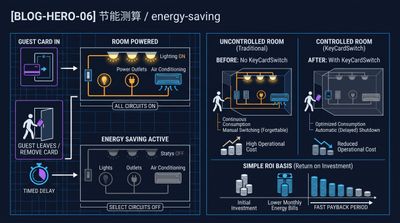
Interrupteur carte-clé hôtel : fonctionnement et économies d'énergie
L'interrupteur à carte-clé d'hôtel active l'électricité à l'insertion de la carte et la coupe au retrait, réduisant de 25 à 40 % la consommation de la chambre. Comparez modèles universels, RFID, TTLOCK et BLE.
Il couvre le même contexte produit : Interrupteur Carte Clé Hôtel — Contrôle Énergie Chambre.
Spécifiez votre projet hôtelier avec nos ingénieurs
Indiquez le nombre de chambres, le type de plafond et votre préférence de protocole. Nous renverrons un plan d'échantillon et un devis sous 24 heures ouvrées.
- Passez d'une guidance générale à une discussion produit ou application.
- Utilisez la RFQ quand le prix, les plans, le MOQ ou le calendrier de lancement nécessitent de la structure.
- Gardez une voie de contact direct visible pour les clarifications rapides et le transfert.