Guide d'achat d'interrupteur à carte hôtel : Comment choisir le bon modèle pour les chambres
Guide d'achat d'interrupteur à carte hôtel pour installateurs et acheteurs : protocole carte, tension, charge, relais, temporisation, format panneau, compatibilité.
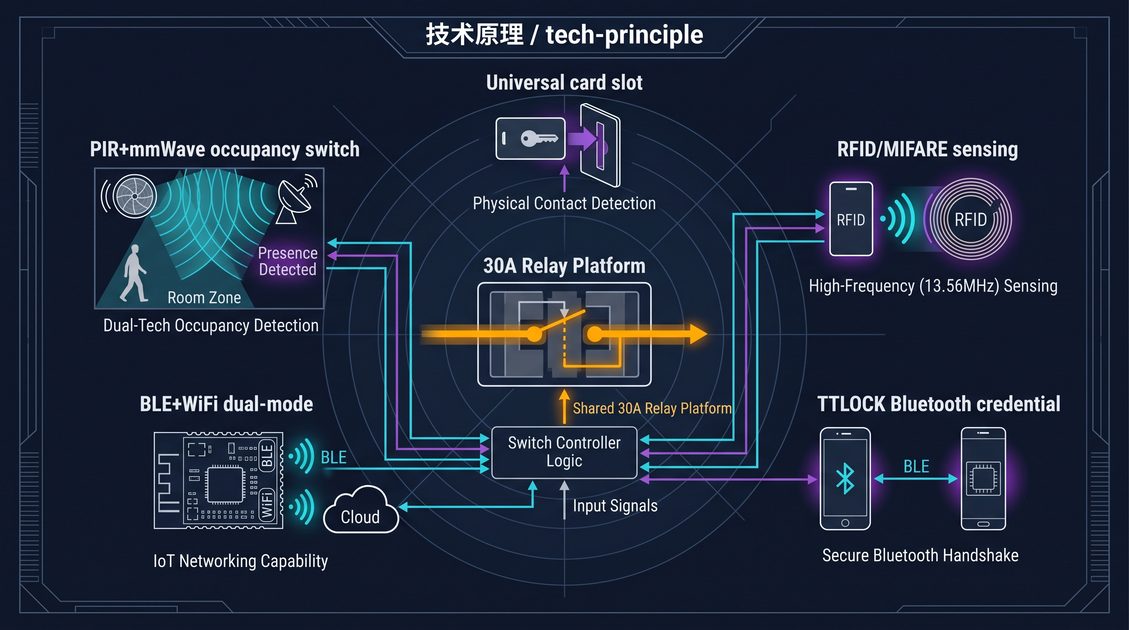
Un guide d'achat d'interrupteur à carte hôtel est une méthode structurée pour sélectionner un interrupteur de puissance commandé par carte qui alimente le circuit de la chambre uniquement lorsqu'une carte valide est insérée, couvrant la technologie du lecteur, la tension d'alimentation, la charge admissible, la logique du relais et le format de montage. Un guide d'achat d'interrupteur à carte hôtel aide l'acheteur à confirmer d'abord le protocole carte, car le lecteur doit correspondre aux cartes déjà délivrées à la réception — un lecteur bande magnétique 125 kHz ne peut pas lire une carte RFID 13,56 MHz et inversement. Un guide d'achat d'interrupteur à carte hôtel passe ensuite en revue la tension AC (110 V ou 180–250 V), la charge de pointe que le relais doit supporter, la temporisation après retrait de la carte, et si le relais est intégré au panneau ou monté en externe. Un guide d'achat d'interrupteur à carte hôtel s'adresse aux responsables achats, ingénieurs maintenance et intégrateurs système qui souhaitent une liste de contrôle reproductible pour l'ensemble d'un parc hôtelier.
Guide d\'achat d\'interrupteur à carte hôtel : Ce que fait l\'appareil dans le circuit chambre
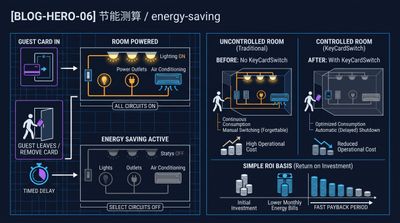
Un guide d'achat d'interrupteur à carte hôtel commence par le rôle de l'appareil dans le circuit de puissance de la chambre. L'interrupteur est un contrôleur de relais commandé par carte, monté au point d'entrée, généralement près de la porte ou sur le mur à l'entrée, qui détecte la présence d'une carte valide et ferme un relais pour alimenter les éclairages, le thermostat de climatisation et les prises. Lorsque le client retire la carte en partant, le relais s'ouvre après une temporisation prédéfinie, coupant l'alimentation de la chambre inoccupée. L'objectif de tout guide d'achat d'interrupteur à carte hôtel est de traduire cette fonction simple en spécifications concrètes que l'acheteur peut comparer entre fournisseurs. Comprendre l'architecture de base aide l'acheteur à reconnaître que l'interrupteur lui-même ne porte presque aucune charge, car un relais intégré ou externe porte le courant de la chambre, et que le panneau est donc un dispositif de contrôle à faible courant. Cette séparation est le concept le plus important dans un guide d'achat d'interrupteur à carte hôtel, car elle détermine si l'établissement a besoin d'un interrupteur avec relais intégré, d'un relais externe 30 A, ou d'un contacteur sur rail DIN pour de très grosses charges.
La séquence de fonctionnement de base est cohérente sur presque tous les modèles. Une carte est insérée dans la fente ou présentée devant la zone de lecture. Le lecteur vérifie la carte selon son propre format accepté, et non contre une base de données distante, car l'interrupteur fonctionne uniquement sur la présence physique de la carte et la reconnaissance de son format. Lorsqu'une carte valide est détectée, le relais s'active en environ une seconde et le circuit de la chambre est sous tension. Lorsque la carte est retirée, un minuteur interne démarre, et après un délai d'usine — couramment 15 secondes mais réglable sur de nombreux modèles — le relais se désactive et le circuit s'ouvre. Un guide d'achat d'interrupteur à carte hôtel doit clarifier qu'il n'y a pas de mémorisation de l'identité du client ni de suivi d'activité ; l'appareil répond seulement à la question « une carte valide est-elle insérée ». Ce comportement physique, hors ligne, explique pourquoi ces dispositifs sont si largement rénovés dans les chambres existantes : ils remplacent l'interrupteur manuel ou se placent devant lui et ajoutent l'exigence de la carte sans ajouter de réseau.
Le dispositif typique s'adapte à une boîte électrique simple standard. Le format le plus courant est un panneau encastré d'environ 86 mm sur 86 mm avec une profondeur de 48 mm, dont environ 29 mm sont encastrés dans le mur. Il existe aussi une variante en saillie qui se fixe sur la face du mur lorsqu'une boîte encastrée n'est pas disponible. La face avant comporte la fente à carte ou la zone de lecture RFID, parfois un petit voyant indiquant l'état du relais, et occasionnellement une commande manuelle. Un guide d'achat d'interrupteur à carte hôtel doit traiter le format de montage comme une décision de premier ordre, car encastrer une boîte dans du plâtre fini est bien plus perturbant que de remplacer une plaque encastrée existante. Les acheteurs doivent confirmer la taille de la boîte et l'empreinte du panneau avant commande, et vérifier si les boîtes simple existantes de l'établissement sont des unités standard 86 mm ou un autre standard régional, car la géométrie du panneau n'est pas universelle selon les marchés.
La gestion de la charge est le second pilier de la décision d'achat. Le relais doit porter la charge combinée de la chambre, qui pour une chambre d'hôtel typique inclut le circuit d'éclairage, les prises et l'alimentation de la climatisation. La fiche technique de l'interrupteur indique normalement le courant maximal des contacts du relais, et l'acheteur doit comparer cette valeur à la somme des circuits de la chambre. Une valeur courante est 30 A pour l'alimentation complète de la chambre, avec des unités plus petites à 16 A ou 20 A utilisées lorsque l'interrupteur ne contrôle qu'une partie de la chambre. Un guide d'achat d'interrupteur à carte hôtel doit alerter l'acheteur de ne jamais supposer que le corps de l'interrupteur porte la charge, car l'électronique du panneau n'est dimensionnée que pour quelques ampères ; le relais fait le travail lourd. Pour les chambres dont la climatisation est un circuit dédié important, l'acheteur peut avoir besoin d'un modèle avec contact de relais séparé ou d'un contacteur externe, ce qui est une spécification à noter sur la commande.
Le troisième pilier est le comportement de temporisation. Lorsque la carte est retirée, l'interrupteur ne coupe pas l'alimentation instantanément ; il attend un intervalle d'usine pour que le client ne soit pas plongé dans le noir en rangeant sa carte, et pour que les électroniques de contrôle comme un contrôleur de climatisation puissent s'arrêter proprement. Les valeurs de délai vont de quelques secondes à une minute, 15 secondes étant un défaut très courant. Certains modèles permettent à l'installateur de sélectionner le délai par cavalier ou petit commutateur embarqué, tandis que d'autres sont fixes. Un guide d'achat d'interrupteur à carte hôtel doit demander à l'acheteur de choisir le délai qui correspond aux habitudes de l'entretien et au profil d'arrêt de la climatisation, car un délai trop court peut laisser la chambre sombre en plein mouvement et un délai trop long gaspille de l'énergie après le départ réel du client.
Guide d\'achat d\'interrupteur à carte hôtel : Protocole carte et compatibilité lecteur
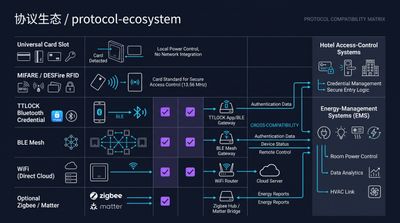
Un guide d'achat d'interrupteur à carte hôtel aborde ensuite le protocole carte, qui est la source la plus fréquente d'erreurs de commande. Le lecteur à l'intérieur de l'interrupteur doit reconnaître la même technologie de carte que l'établissement délivre déjà, et les deux familles dominantes sont la bande magnétique 125 kHz (souvent appelée piste magnétique ou swipe) et le RFID 13,56 MHz (identification par radiofréquence). Une carte à bande magnétique a une piste brune ou noire au dos qui stocke les données sur trois pistes parallèles, et l'interrupteur lit la carte en la faisant glisser ou en l'insérant dans une fente qui déplace la tête de lecture sur la piste. Une carte RFID est une carte plastique avec antenne et puce intégrées, lue sans contact physique en approchant la carte de la zone de lecture. Les deux ne sont pas interchangeables : un lecteur 125 kHz ignore une carte 13,56 MHz, et un lecteur RFID ne peut pas lire une bande magnétique. L'acheteur doit donc demander à la réception quelle technologie est en service avant de commander tout modèle.
Au sein du RFID, il y a une distinction supplémentaire sur l'utilisation de la carte. Certains systèmes RFID fonctionnent avec une puce basse fréquence 125 kHz ne contenant qu'un numéro d'identification, et l'interrupteur doit seulement détecter une carte de la bonne fréquence. D'autres systèmes utilisent 13,56 MHz et peuvent embarquer des données d'application dans des secteurs mémoire supplémentaires. Pour un guide d'achat d'interrupteur à carte hôtel, la question pratique est plus simple : l'établissement a-t-il besoin que l'interrupteur accepte toute carte d'une fréquence donnée, ou doit-il vérifier un bloc de données spécifique sur la carte ? La plupart des interrupteurs à carte sont basés sur la présence et acceptent toute carte de la fréquence correspondante, car l'encodage à la réception détermine déjà qui est client. Un guide d'achat d'interrupteur à carte hôtel doit recommander de clarifier si l'interrupteur doit être un lecteur générique détectant toute carte 13,56 MHz ou un lecteur configuré pour un encodage particulier, et noter que les lecteurs basés sur la présence sont l'option la plus simple et la plus largement disponible.
Le format de la fente à carte importe aussi pour les cartes magnétiques. Un interrupteur à bande magnétique peut être un lecteur swipe, où le client fait glisser la carte dans une fente verticale ou horizontale, ou un lecteur à fente, où la carte est insérée entièrement et retirée manuellement. Les lecteurs swipe sont rapides mais exigent un sens et une vitesse de glissement corrects, tandis que les lecteurs à fente sont plus tolérants car la carte reste dans la fente pendant que le client est dans la chambre. Un guide d'achat d'interrupteur à carte hôtel doit demander si l'établissement préfère que le client laisse la carte dans la fente, ce qui est courant pour les systèmes magnétiques, ou qu'il l'emporte, ce qui est courant pour le RFID. Ce choix affecte l'ergonomie du panneau et l'expérience client, et c'est une véritable décision d'achat plutôt qu'un détail mineur, car il change toute la disposition de la face et la mécanique du lecteur.
La durabilité du lecteur est un facteur d'achat connexe. Le lecteur de carte est la pièce la plus exposée à l'usure, car il voit chaque entrée de chaque client. Un lecteur swipe magnétique contient une tête de lecture mobile et une fente qui collecte poussière et débris de cartes, tandis qu'un lecteur RFID n'a pas de pièces mobiles et est scellé derrière la face, ce qui explique pourquoi les interrupteurs RFID tendent à être plus fiables sur le long terme. Un guide d'achat d'interrupteur à carte hôtel doit mettre en balance le coût d'un lecteur magnétique contre la maintenance de nettoyage de la fente et le remplacement occasionnel de la tête de lecture, versus le coût initial plus élevé d'un lecteur RFID qui nécessite rarement de maintenance. Pour les établissements prévoyant une longue durée de service, le RFID est souvent le choix au coût total inférieur malgré le prix initial plus élevé.
L'acceptation du format carte interagit aussi avec les cartes de remplacement. Si un établissement délivre des cartes magnétiques aujourd'hui mais prévoit de migrer vers le RFID plus tard, le choix de l'interrupteur affecte cette migration. Un guide d'achat d'interrupteur à carte hôtel doit conseiller d'acheter des modèles correspondant à la technologie de carte actuelle tout en confirmant que le corps et l'empreinte du panneau sont neutres technologiquement, de sorte qu'un échange ultérieur d'une face lecteur magnétique vers une face lecteur RFID ne nécessite pas de changer la boîte relais ni le câblage. Certains fabricants vendent une base commune avec têtes de lecture interchangeables pour cette raison. Vérifier si la tête de lecture est remplaçable sur site est un moyen peu coûteux de pérenniser l'achat.
Guide d\'achat d\'interrupteur à carte hôtel : Tension d\'alimentation et charge admissible
Un guide d'achat d'interrupteur à carte hôtel se tourne maintenant vers l'alimentation électrique, en commençant par la tension AC. Les deux alimentations régionales courantes sont 110 V, utilisée en Amérique du Nord et dans certaines parties de l'Asie et de l'Amérique latine, et 220 V à 240 V, utilisées en Europe, dans une grande partie de l'Asie, au Moyen-Orient et en Afrique. La plupart des interrupteurs à carte sont spécifiés pour une plage, généralement 180–250 V AC pour la famille 220 V ou environ 110 V AC pour la famille basse tension, bien que de nombreux modèles modernes acceptent les deux plages avec une alimentation universelle interne. Un guide d'achat d'interrupteur à carte hôtel doit insister pour que l'acheteur confirme la tension nominale de l'établissement et la plage mesurée, car un interrupteur prévu pour 220 V installé sur une alimentation 110 V ne fonctionnera pas correctement, et une unité 110 V sur du 220 V risque d'être endommagée. La tension est indiquée sur l'étiquette ou la fiche technique, et l'acheteur doit la faire correspondre au système de distribution avant commande.
La charge admissible est la spécification électrique suivante. Le relais doit porter la charge de pointe simultanée de tout ce que l'interrupteur contrôle, et l'acheteur doit calculer cette charge plutôt que la deviner. Pour une chambre dont l'éclairage, les prises et la climatisation sont tous commutés, la demande combinée peut être substantielle. Une valeur courante du relais est 30 A à la tension nominale, qui couvre confortablement une chambre standard, tandis que des unités plus petites sont dimensionnées à 16 A ou 20 A pour les chambres où l'interrupteur ne contrôle que l'éclairage ou un sous-circuit limité. Un guide d'achat d'interrupteur à carte hôtel doit présenter le calcul de charge comme une tâche arithmétique simple : lister chaque circuit contrôlé, noter son disjoncteur ou sa charge estimée, les additionner, et appliquer une marge de sécurité pour que le relais ne fonctionne pas à son maximum absolu. Choisir un relais avec de la marge au-dessus de la charge calculée est une assurance peu coûteuse contre les déclenchements intempestifs et l'usure prématurée des contacts.
La distinction entre la propre intensité de l'interrupteur et la charge des contacts du relais mérite d'être répétée dans tout guide d'achat d'interrupteur à carte hôtel. L'électronique du panneau, le lecteur et la bobine du relais ne consomment que quelques watts, généralement 1 W à 3 W en veille. Les contacts du relais, qu'ils soient à l'intérieur de l'interrupteur ou dans une unité externe, portent la charge de la chambre. Les acheteurs lisent parfois mal une fiche technique et croient que l'interrupteur lui-même est dimensionné pour 30 A, alors que seuls les contacts du relais le sont. La lecture correcte est que l'interrupteur commande un relais, et la charge des contacts du relais définit la charge maximale. Si la charge de la chambre dépasse la capacité du relais interne, l'acheteur doit choisir un modèle qui pilote un relais ou contacteur externe, et la sortie de commande de bobine de l'interrupteur doit être compatible avec cet appareil externe.
Le courant d'appel est un facteur subtil mais important dans la charge admissible. L'éclairage incandescent et certains moteurs tirent une surtension momentanée plusieurs fois leur courant nominal à la mise sous tension, et le relais doit survivre à ces surtensions à chaque mise sous tension de la chambre. Les charges résistives comme le chauffage n'ont pas d'appel significatif, mais les moteurs, transformateurs et de nombreux drivers LED en ont. Un guide d'achat d'interrupteur à carte hôtel doit conseiller de vérifier la capacité du relais aux contacts pour le courant permanent et la capacité de coupure à l'appel, et de préférer un relais avec une charge de contact généreuse lorsque la chambre contient des moteurs ou des bancs de drivers LED importants. Sous-dimensionner pour l'appel est une cause majeure de piqûre des contacts et de défaillance prématurée.
Le calibre du câblage connecté aux contacts du relais doit aussi correspondre à la charge. Les conducteurs d'alimentation de la chambre doivent être dimensionnés pour le courant du relais à la tension d'alimentation, et l'acheteur doit confirmer la taille de câble existante de l'établissement par
A hotel key card switch buying guide is a structured method for selecting a card-controlled power switch that energizes the guest-room circuit only while a valid card is inserted, covering the reader technology, the supply voltage, the load rating, the relay logic, and the mounting format. A hotel key card switch buying guide helps the buyer confirm the card protocol first, because the reader must match the cards already issued at the front desk — a 125 kHz magnetic strip card reader cannot read a 13.56 MHz RFID card and vice versa. A hotel key card switch buying guide then walks through the AC voltage (110V or 180–250V), the peak room load the relay must carry, the delay-off timing after card removal, and whether the relay is built into the panel or mounted externally. A hotel key card switch buying guide is intended for purchasing staff, maintenance engineers, and system integrators who want one repeatable checklist that works across every property in a portfolio.
Hotel Key Card Switch Buying Guide: What the Device Does in the Room Circuit
A hotel key card switch buying guide begins with the role the device plays in the guest-room power circuit. The switch is a card-operated relay controller mounted at the entry point, typically beside the door or on the wall near the entrance, that reads the presence of a valid key card and closes a relay to feed power to the lights, the air-conditioning thermostat, and the socket outlets. When the guest removes the card on leaving, the relay opens after a preset delay, cutting the unoccupied room's power. The purpose of any hotel key card switch buying guide is to translate that simple function into concrete specifications the buyer can compare across suppliers. Understanding the basic architecture helps the buyer recognize that the switch itself carries almost no load, because a built-in or external relay carries the room current, and that the panel is therefore a low-current control device. This separation is the single most important concept in a hotel key card switch buying guide, because it determines whether a property needs a switch with a built-in relay, an external 30A relay, or a DIN-rail-mounted contactor for very large loads.
The core working sequence is consistent across nearly all units. A card is inserted into the slot or held against the reader face. The reader verifies the card against its own accepted format, not against any remote database, because the switch works entirely on physical card presence and format recognition. When a valid card is detected, the relay energizes within about one second and the room circuit is live. When the card is removed, an internal timer starts, and after a factory-set delay — commonly 15 seconds but adjustable on many models — the relay de-energizes and the circuit opens. A hotel key card switch buying guide should make clear that there is no memory of who the guest is and no tracking of activity; the unit only answers the question "is a valid card inserted." That physical, offline behavior is why these devices are so widely retrofitted into existing rooms: they replace the manual switch or sit in front of it and add the card requirement without adding networking.
The typical device fits a standard single-gang electrical box. The most common format is a flush panel measuring about 86mm by 86mm with a depth of 48mm, of which about 29mm is embedded in the wall. There is also a surface-mount variant that fixes to the wall face when a recessed box is not available. The front face carries the card slot or the RFID read zone, sometimes a small indicator lamp showing relay state, and occasionally a manual override. A hotel key card switch buying guide should treat the mounting format as a first-order decision, because retrofitting a recessed box in finished plaster is far more disruptive than replacing an existing flush plate. Buyers should confirm the box size and the panel footprint before ordering, and should check whether the property's existing single-gang boxes are standard 86mm units or a different regional standard, since panel geometry is not universal across markets.
Load handling is the second pillar of the buying decision. The relay must carry the combined load of the room, which for a typical hotel room includes the lighting circuit, the socket outlets, and the air-conditioning supply. The switch's datasheet normally states the maximum current rating of the relay contacts, and the buyer should compare that rating against the sum of the room's circuits. A common rating is 30A for a whole-room feed, with smaller units at 16A or 20A used when the switch controls only part of the room. A hotel key card switch buying guide should warn the buyer never to assume the switch body carries the load, because the panel's own electronics are rated for only a few amps; the relay does the heavy work. For rooms whose air-conditioning is a large dedicated circuit, the buyer may need a unit with a separate relay contact or an external contactor, which is a specification worth noting on the order.
The third pillar is the delay-off behavior. When the card is removed, the switch does not cut power instantly; it waits a factory-set interval so the guest is not plunged into darkness while putting the card away, and so that control electronics such as an air-conditioning controller can shut down cleanly. Delay values range from a few seconds to a minute, with 15 seconds being a very common default. Some models allow the installer to select the delay with a jumper or a small onboard switch, while others are fixed. A hotel key card switch buying guide should ask the buyer to choose the delay that matches housekeeping habits and the air-conditioning shutdown profile, because too short a delay can leave the room dark mid-motion and too long a delay wastes power after the guest has truly left.
Hotel Key Card Switch Buying Guide: Card Protocol and Reader Compatibility
A hotel key card switch buying guide next addresses the card protocol, which is the single most common source of ordering mistakes. The reader inside the switch must recognize the same card technology the property already issues, and the two dominant families are 125 kHz magnetic strip (often called swipe or magnetic track) and 13.56 MHz RFID (radio-frequency identification). A magnetic-strip card has a brown or black stripe on the back that stores data in three parallel tracks, and the switch reads the card by swiping or inserting it into a slot that moves the reader head across the stripe. An RFID card is a plastic card with an embedded antenna and chip, read without physical contact by holding the card near the read zone. The two are not interchangeable: a 125 kHz reader ignores a 13.56 MHz card, and an RFID reader cannot read a magnetic stripe. The buyer must therefore ask the front desk which technology is in use before ordering any unit.
Within RFID, there is a further distinction in how the card is used. Some RFID systems work with a low-frequency 125 kHz chip that contains only an identification number, and the switch merely needs to detect a card of the right frequency. Other systems use 13.56 MHz and may embed application data in additional memory sectors. For the purposes of a hotel key card switch buying guide, the practical question is simpler: does the property need the switch to accept any card of a given frequency, or does it need the switch to check a specific data block on the card? Most key card switches are presence-based and accept any card of the matching frequency, because the front desk encoding already determines who is a guest. A hotel key card switch buying guide should recommend clarifying whether the switch must be a generic reader that detects any 13.56 MHz card or a reader configured for a particular encoding, and should note that presence-based readers are the simplest and most widely available option.
The card slot format also matters for magnetic cards. A magnetic-strip switch can be a swipe reader, where the guest slides the card through a vertical or horizontal slot, or a slot reader, where the card is inserted fully and removed manually. Swipe readers are quick but require correct swipe direction and speed, while slot readers are more forgiving because the card sits in the slot while the guest is inside the room. A hotel key card switch buying guide should ask whether the property prefers the guest to leave the card in the slot, which is common for magnetic systems, or to take the card with them, which is common for RFID. This choice affects the ergonomics of the panel and the guest experience, and it is a genuine buying decision rather than a minor detail, because it changes the entire face layout and the reader mechanics.
Reader durability is a related buying factor. The card reader is the part most exposed to wear, because it sees every entry by every guest. A magnetic swipe reader contains a moving read head and a slot that collects dust and card debris, while an RFID reader has no moving parts and is sealed behind the face, which is why RFID switches tend to be more reliable over the long term. A hotel key card switch buying guide should weigh the cost of a magnetic reader against the maintenance of cleaning the slot and occasionally replacing the read head, versus the higher initial cost of an RFID reader that rarely needs servicing. For properties planning a long service life, RFID is often the lower total-cost choice despite the higher upfront price.
Card format acceptance also interacts with replacement cards. If a property issues magnetic cards today but plans to migrate to RFID later, the switch choice affects that migration. A hotel key card switch buying guide should advise buying units that match the current card technology while confirming that the switch body and panel footprint are technology-neutral, so that a later swap from a magnetic reader face to an RFID reader face does not require changing the relay box or rewiring. Some manufacturers sell a common base with interchangeable reader heads for exactly this reason. Checking whether the reader head is replaceable in the field is a low-cost way to future-proof the purchase.
Hotel Key Card Switch Buying Guide: Supply Voltage and Load Rating
A hotel key card switch buying guide now turns to the electrical supply, starting with the AC voltage. The two common regional supplies are 110V, used in North America and parts of Asia and Latin America, and 220V to 240V, used across Europe, much of Asia, the Middle East, and Africa. Most key card switches are specified for one range, typically 180–250V AC for the 220V family or around 110V AC for the low-voltage family, though many modern units accept both ranges with an internal universal power supply. A hotel key card switch buying guide should insist that the buyer confirm the property's nominal supply voltage and the measured range, because a switch rated for 220V installed on a 110V feed will not operate correctly, and a 110V-rated unit on a 220V feed may be damaged. The voltage is printed on the label or datasheet, and the buyer should match it to the distribution system before ordering.
The load rating is the next electrical specification. The relay must carry the peak simultaneous load of everything the switch controls, and the buyer should calculate that load rather than guess it. For a room whose lighting, sockets, and air-conditioning are all switched, the combined demand can be substantial. A common relay rating is 30A at the rated voltage, which comfortably covers a standard guest room, while smaller units are rated at 16A or 20A for rooms where the switch controls only lighting or a limited sub-circuit. A hotel key card switch buying guide should present the load calculation as a simple arithmetic task: list each controlled circuit, note its breaker rating or estimated load, sum them, and apply a safety margin so the relay is not run at its absolute maximum. Choosing a relay with headroom above the calculated load is inexpensive insurance against nuisance tripping and premature contact wear.
The distinction between the switch's own current rating and the relay's contact rating is worth repeating in any hotel key card switch buying guide. The panel electronics, the reader, and the relay coil draw only a few watts, typically in the range of 1W to 3W in standby. The relay contacts, whether inside the switch or in an external unit, carry the room load. Buyers sometimes misread a datasheet and believe the switch itself is rated for 30A, when in fact only the relay contacts are. The correct reading is that the switch controls a relay, and the relay's contact rating defines the maximum load. If the room load exceeds the internal relay rating, the buyer must select a model that drives an external relay or contactor, and the switch's coil drive output must be compatible with that external device.
Inrush current is a subtle but important factor in the load rating. Incandescent lighting and certain motors draw a momentary surge several times their steady-state current when switched on, and the relay must survive these surges every time the room is energized. Resistive loads such as heating draw no significant inrush, but motors, transformers, and many LED drivers do. A hotel key card switch buying guide should advise checking the relay's contact rating for both the steady-state current and the switching-inrush capability, and preferring a relay with a generous contact rating when the room contains motors or large LED driver banks. Under-specifying for inrush is a leading cause of relay contact pitting and premature failure.
The wiring gauge connected to the relay contacts must also match the load. The room feed conductors must be sized for the relay current at the supply voltage, and the buyer should confirm the property's existing cable size against the relay rating. A hotel key card switch buying guide should remind the buyer that a relay rated for 30A is only as good as the conductor feeding it, and that undersized wiring defeats the relay's capability and creates a fire risk. If the existing room wiring is thinner than the new relay's rating, the buyer should either choose a relay matched to the existing conductor size or upgrade the cable, and should note this in the order to avoid an installation that passes inspection only by a narrow margin.
Hotel Key Card Switch Buying Guide: Relay Type and Switching Logic
A hotel key card switch buying guide must cover the relay configuration, because it determines the whole installation. The two broad options are a built-in relay, where the switching contacts are inside the flush panel and the room feed is brought to the box, and an external relay, where the switch carries only a control pair to a separately mounted relay or contactor. A built-in relay is the simplest to install, because the installer lands the room feed on the panel's load terminals and everything is in one box, but it is limited by the physical space and current capacity of the flush panel. An external relay or DIN-rail contactor can switch much larger loads and is easier to service, because the relay can be replaced without touching the panel, at the cost of a second enclosure and more wiring. A hotel key card switch buying guide should map the property's load and service preference to one of these two architectures early in the selection.
Relay logic describes whether the relay is normally open or normally closed and how the switch drives it. In a normally-open arrangement, the contacts are open when the relay is de-energized, so no power flows until the card closes the circuit, which is the desired fail-safe behavior for energy saving. Some designs add a fail-safe priority such that a power failure always leaves the room de-energized on the switched circuit, which is safer and is the recommended default. A hotel key card switch buying guide should confirm that the unit's logic is normally-open with fail-safe off, and should treat any normally-closed variant as a special case only, because a normally-closed relay would leave the room powered when the card is absent, defeating the entire purpose.
The number of relay channels matters for rooms with split circuits. A single-channel switch controls one combined feed, while a two-channel switch can control lighting and air-conditioning separately, so that, for example, removing the card cuts the AC immediately but keeps a low-power socket live for device charging. A hotel key card switch buying guide should ask whether the property wants one unified room circuit or separate control of lighting and power, because a two-channel unit costs more but gives finer energy control and can keep essential sockets energized. If the property's rooms have air-conditioning on a dedicated circuit that must stay powered independently, the buyer needs a unit with at least two independent relay channels or a bypass arrangement.
The relay coil drive output is relevant when choosing an external relay. If the switch drives an external relay, the output is a low-voltage control signal, and the external relay must be compatible with that signal, typically accepting a 110V or 220V coil or a low-voltage DC coil depending on the model. A hotel key card switch buying guide should have the buyer confirm the external relay's coil voltage and contact rating match the switch's drive output and the room load, and should treat the switch and external relay as a matched pair rather than separately ordered items. Ordering them together as a kit reduces the risk of a mismatch discovered at installation.
Switching behavior under a manual override is another logic consideration. Many switches include a bypass or manual-on mode so that housekeeping can energize the room without a card, for cleaning or maintenance. The override is usually a switch on the face or an internal jumper, and it typically bypasses the card requirement until reset. A hotel key card switch buying guide should confirm that the override exists and that it returns to card-controlled operation when the card is removed or the override is reset, so the energy-saving behavior is not left disabled permanently. The override is a small feature but one that maintenance staff rely on daily, so its presence and reset behavior belong in the specification.
Hotel Key Card Switch Buying Guide: Delay-Off and Timing Behavior
A hotel key card switch buying guide should dedicate attention to the delay-off timer, because it directly affects both guest comfort and energy savings. When the card is removed, the switch holds the relay closed for a factory-set interval before opening the circuit. The delay serves several purposes: it gives the guest a few seconds of light while they gather belongings or step back in to retrieve something, it allows control electronics such as an air-conditioning thermostat to complete a clean shutdown, and it prevents the relay from chattering if a card is briefly removed and reinserted. A hotel key card switch buying guide should explain that the delay is a deliberate compromise between instant power removal and momentary comfort, and that the right value depends on the property's rooms and housekeeping habits.
Common delay values range from about 5 seconds to 60 seconds, with 15 seconds being a frequent factory default. Shorter delays cut power sooner and save slightly more energy, but can leave a guest in the dark if they step out and immediately realize they left something. Longer delays give more comfort but keep the empty room powered for longer. A hotel key card switch buying guide should present this as a tunable decision and ask whether the model allows the delay to be adjusted, either by a jumper, a small rotary switch, or a dip switch on the panel, rather than being fixed at the factory. An adjustable delay lets the property tune each room type to its own habits and makes one stock item cover the whole property.
The delay also interacts with the air-conditioning shutdown sequence. If the room's air-conditioning controller needs time to write its final state or to cycle the compressor down gradually, an extremely short delay can interrupt that sequence. Conversely, if the air-conditioning runs on a separate always-on circuit not controlled by the card switch, the delay is irrelevant to it. A hotel key card switch buying guide should have the buyer map which circuits the card switch actually controls and then choose the delay accordingly, so that the timer is long enough for the controlled electronics to shut down cleanly and short enough to avoid wasted power. Matching the delay to the real shutdown profile prevents both discomfort and wasted run time.
Repeat-entry behavior is another timing detail. When the guest reinserts the card during the delay window, the switch should recognize the card and hold the relay closed, resetting the timer rather than double-tripping the relay. A hotel key card switch buying guide should confirm that the unit handles a card reinsertion during the delay gracefully, because a switch that toggles on a second insertion is confusing and can leave the room unexpectedly powered or dark. A well-designed unit treats the card's presence as the single controlling input, so the relay stays closed as long as a valid card is in the reader, regardless of how many times the guest enters and leaves.
Indicator behavior during the delay is a final timing feature worth specifying. Most switches show a small lamp that indicates whether the relay is energized, and some show a different state during the delay-off period, so the guest and staff can tell at a glance whether the room is live or powering down. A hotel key card switch buying guide should confirm the indicator meanings and their visibility, because a clear lamp reduces guest confusion about whether the card is working and helps housekeeping identify which rooms are powered. The indicator is a minor component, but its clarity has an outsized effect on perceived reliability.
Hotel Key Card Switch Buying Guide: Mounting, Panel Size, and Box Compatibility
A hotel key card switch buying guide must cover physical mounting before ordering, because it determines how disruptive the install will be. The dominant format is a flush panel that fits a standard single-gang electrical box, with the common metric footprint at roughly 86mm by 86mm and a depth near 48mm, of which about 29mm sits inside the wall. This size is sometimes referred to by its regional standard, and the buyer should confirm that the property's existing boxes match the switch's back-body footprint. A hotel key card switch buying guide should treat box compatibility as a pre-order verification step, because a panel that does not fit the existing box means either a new box, a surface-mount adapter, or a larger recess, all of which add labor and cost to a retrofit.
Where no recessed box exists, a surface-mount variant is the practical answer. A surface-mount key card switch fixes to the wall face with screws or adhesive, housing the reader and relay in a self-contained enclosure, and is ideal for concrete, masonry, or drywall where cutting a box is undesirable. A hotel key card switch buying guide should note that surface-mount units are slightly more prominent on the wall but avoid the dust, debris, and patching work of cutting a recess, which often makes them the faster choice for a large retrofit. The buyer should confirm which variant each supplier offers, because not every model is available in both flush and surface-mount forms.
The panel material and finish affect durability and appearance. Key card switches face constant handling at the entrance, so the front plate should resist scratches, yellowing, and cleaning agents. Common materials are flame-retardant thermoplastics and sometimes a metal or metal-framed face for higher-traffic lobbies and premium room types. A hotel key card switch buying guide should ask about the face material, the color options, and whether the plate is replaceable independently of the electronics, because a scratched face on an otherwise working switch should not force a full replacement. A replaceable face also lets the property standardize one electronics module across different room finishes.
The depth of the back body is a less obvious but critical dimension. Flush panels need enough cavity depth behind the wall surface to house the reader electronics, the relay, and the wiring connections. Standard single-gang boxes vary in depth, and a very shallow box may not accept a deep back body. A hotel key card switch buying guide should have the buyer measure the existing box depth and compare it to the switch's required mounting depth before ordering, and should flag that the common 48mm body needs a box deep enough to leave clearance. Where the box is too shallow, the installer may need a box extender or a surface-mount solution.
Accessory and knockout positions also matter for clean wiring. The back body should offer knockouts or entry points on multiple faces so the installer can route the incoming feed and the control pair without sharp bends or crowding. A hotel key card switch buying guide should note that generous, well-placed wiring entries make the install faster and reduce strain on the terminals, and that a cramped back body with a single small entry point complicates an otherwise simple job. Reviewing the mounting depth, the wiring entries, and the terminal layout together gives the buyer confidence that the unit installs cleanly in the property's real boxes.
Hotel Key Card Switch Buying Guide: Standby Power and Operating Environment
A hotel key card switch buying guide should consider the standby consumption, because these devices sit powered 24 hours a day across hundreds of rooms. The panel's reader and relay coil draw a small standby current even when no card is inserted, because the switch must remain ready to detect a card. Typical standby draw is modest, in the range of a couple of watts, though the exact figure varies by design and by whether a lamp stays lit. A hotel key card switch buying guide should have the buyer compare standby figures across models, because across a large property the difference between a 1W and a 3W standby per room adds up across hundreds of rooms over a year. Lower standby is a legitimate differentiator when all other specifications are equal.
The operating environment includes temperature, humidity, and pollution. The switch mounts at room height near the entrance, exposed to the room's ambient conditions and occasional cleaning, but not to outdoor weather in most cases. Still, the rated operating temperature and humidity should comfortably cover the property's climate, and the face should tolerate the cleaning products used. A hotel key card switch buying guide should confirm the unit's rated temperature range and that it operates without degradation in the property's climate, and should note that units sold for indoor room use are not rated for outdoor corridors or unsealed areas where moisture could intrude.
Moisture and dust ingress is worth a specific check. A card slot in a magnetic reader is a natural collection point for dust, lint, and card debris, so the slot design and the seal around the reader affect long-term reliability. RFID readers, being sealed, are more resistant. A hotel key card switch buying guide should ask about the ingress protection of the face and the card slot, and should prefer a unit whose slot is easy to clean and whose electronics are sealed from the front so that spills near the door do not reach the circuit board. Simple design choices here avoid a disproportionate share of field failures.
Mechanical durability includes the card slot and any exposed switches. The card slot and any manual override button or rotary control see daily use, so their construction should be robust enough to survive years of insertion and removal. A hotel key card switch buying guide should check that the slot guides the card smoothly, that the override control is solid, and that the whole face is secured firmly to the back body, because a loose or wobbly face reads as cheap and fails faster under constant handling. The buyer should weigh the panel's build quality just as heavily as its electrical rating, since the electrical spec is irrelevant if the physical device wears out quickly.
Vibration and mounting stability are minor but relevant. The panel is fixed to the wall, so it sees little vibration in normal service, but a firmly secured back body and a stable relay mount reduce internal stress and extend relay life. A hotel key card switch buying guide should confirm the unit is assembled with adequate strain relief on the incoming wires and that the relay is held in place, because loose internal components are a common early-failure symptom in low-cost units. Reviewing the mechanical assembly along with the electrical spec produces a more reliable purchase decision.
Hotel Key Card Switch Buying Guide: Durability, Materials, and Expected Service Life
A hotel key card switch buying guide should evaluate the materials and the expected service life, because these devices operate continuously and are replaced rarely. The relay contacts are the component most subject to wear, since they make and break the room load on every card insertion and removal. Contact life is often stated as a number of switching operations, and the buyer should compare this figure across models. A hotel key card switch buying guide should note that a relay rated for tens of thousands of operations will outlast the property's renovation cycle at typical occupancy, and that a generously rated relay plus adequate load headroom gives the longest trouble-free service.
The relay contact material influences durability under the room's load profile. Silver-alloy contacts are common and suit most resistive and lightly inductive loads, while larger or motor-heavy loads may benefit from a contact alloy rated for higher switching currents. A hotel key card switch buying guide should not overcomplicate this, but should advise the buyer to match the relay to the actual load type, preferring a relay with a clear rating for the connected load rather than the cheapest generic part. Where the room load is inductive, such as a fan coil unit or a transformer, the contact rating for that load class matters more than the pure current figure.
The plastic housing should be flame-retardant and mechanically rigid. The back body and face are typically molded thermoplastics chosen for their flame-retardant properties and their resistance to impact and cleaning chemicals. A hotel key card switch buying guide should confirm the housing material and that the face resists the yellowing and cracking that cheap plastics develop under heat and light. A rigid housing that holds its color and shape over years of use protects the internal electronics and keeps the panel looking clean in the room.
Terminal quality affects both safety and maintenance. The wiring terminals must accept the appropriate conductor size and grip it firmly without loosening under thermal cycling, because a loose terminal generates heat and can fail intermittently. A hotel key card switch buying guide should check the terminal type and the acceptable conductor range, and should prefer captive, well-marked terminals that are easy to land with a standard screwdriver. Clear terminal marking — line, load, and control — reduces installer error and speeds service, so a clear wiring diagram on the label or in the manual is a real buying criterion.
Spare-part availability is the final durability consideration. The most likely field service is replacing a reader face, an override control, or a relay, and the buyer should confirm that these parts are available for the specific model rather than requiring a whole-switch replacement. A hotel key card switch buying guide should ask the supplier which components are field-replaceable and keep a small spares stock of the most common parts for each property. Confirming spare availability before ordering prevents a single failed reader face from taking a room out of service for an extended period.
Hotel Key Card Switch Buying Guide: Compatibility With an Existing Card System
A hotel key card switch buying guide should treat compatibility with the property's existing card issuance as a make-or-break requirement. The front desk already issues cards in a specific technology, and the switch must accept exactly those cards. The first compatibility question is the frequency and medium: magnetic 125 kHz, RFID 125 kHz, or RFID 13.56 MHz. A hotel key card switch buying guide should have the buyer identify the card type from the front desk or from a sample card, because ordering a switch that reads the wrong medium renders it useless in the room even though it powers up fine.
The second compatibility question is whether the switch must validate the card's encoded data or only its presence. In most properties the front desk encodes the card, and the switch needs only to recognize a card of the right type and hold it present. This presence-based model is simple and works with any correctly encoded card of the matching frequency. In a minority of cases a property wants the switch to check a specific data block, for example to ensure only active cards are accepted, and then the switch must be configured to read that block. A hotel key card switch buying guide should clarify this requirement up front, because a presence-based reader cannot be upgraded to a data-checking reader without replacing its electronics.
The third question is the relationship between the card switch and the door lock. In some hotels the same card opens the door and is then inserted into the card switch, while in others the two systems use different cards. The card switch does not need to share any data with the door lock; it works independently by detecting the card's presence. A hotel key card switch buying guide should reassure the buyer that the switch and the door lock are independent, so a property can retrofit the card switch without touching the lock system, as long as the switch's reader matches the card's medium. There is no handshake or shared encoding required for the basic function.
The fourth question is whether the reader head is interchangeable for future card changes. If a property currently uses magnetic cards but may move to RFID, buying a switch with a replaceable reader head lets the property change the reader face later without replacing the relay box and wiring. A hotel key card switch buying guide should ask whether the model supports reader-head interchangeability, because it is a low-cost hedge against a future card-technology migration. Confirming this now avoids a full re-installation when the front desk upgrades its cards.
The fifth question is replacement and duplicate card behavior. The switch treats any card of the accepted medium as valid for presence, so a duplicate card or a second issued card works exactly like the original. There is no per-card authorization and no blacklist, which keeps the switch simple and compatible with any card the front desk issues. A hotel key card switch buying guide should note that this simplicity is a feature for compatibility, and that properties requiring per-card access control should look to the door lock system rather than the energy switch, because the card switch is deliberately a presence device.
Hotel Key Card Switch Buying Guide: Ordering, Spares, and Bulk Planning
A hotel key card switch buying guide closes with the practicalities of ordering at scale, because most properties retrofit hundreds of rooms. The first ordering decision is the unit count and the mix of flush and surface-mount variants, plus spares for the reader heads, relays, and faces that will need replacement over the service life. A hotel key card switch buying guide should recommend ordering a small stock of spare units above the installed count, typically enough to cover failures during the retrofit and the first months of operation, so the project is not blocked by a single failed unit.
The second decision is confirming the electrical and mechanical spec on the order in writing. The order should state the card medium, the supply voltage, the relay rating, the delay-off value, the mounting format, and the panel footprint, because these are the fields most likely to be mis-specified. A hotel key card switch buying guide should have the buyer attach a completed specification sheet to the order and ask the supplier to confirm the model matches before shipment, catching a wrong card medium or wrong voltage before it reaches the property.
The third decision is testing a sample before committing to the full quantity. Ordering a small number of units for a pilot install in a few rooms lets the property verify the card medium, the fit in the existing boxes, the relay behavior under the real room load, and the delay timing before scaling to the whole portfolio. A hotel key card switch buying guide should treat the pilot as a mandatory step rather than an optional courtesy, because it exposes mismatches that no datasheet reveals and de-risks the entire retrofit.
The fourth decision is documentation and training. The buyer should obtain a clear wiring diagram, an installation sheet, and a specification sheet for each model, and should confirm the units ship with the necessary mounting hardware. A hotel key card switch buying guide should advise asking the supplier for installer documentation in a format the local electrician can follow, because well-documented units install faster and with fewer errors. Good documentation also reduces the support burden during the rollout.
The fifth decision is packaging and delivery for a large project. Units for a big retrofit are shipped in quantity, and the buyer should confirm the packaging protects the panels and that the delivery is split sensibly across buildings or phases. A hotel key card switch buying guide should note that consistent batch and model markings make inventory tracking easier across a multi-building property, and that standardizing one model across the property simplifies spares and service. A single standardized spec is easier to maintain than a mix of slightly different units bought over time.
Hotel Key Card Switch Buying Guide: A Final Specification Checklist
A hotel key card switch buying guide ends with a consolidated checklist the buyer can carry into any purchase. The checklist begins with the card medium, confirmed against the cards issued at the front desk. It then confirms the supply voltage and the calculated room load, and verifies the relay rating covers the load with headroom for inrush. It confirms the relay logic is normally-open and fail-safe, and whether one or two relay channels are needed for the room's circuits. It sets the delay-off value and confirms whether the delay is adjustable. It specifies the mounting format, the panel footprint, and the back-body depth against the existing boxes. It checks the standby power, the materials, the contact life, the spare parts, and the reader-head interchangeability. And it confirms a pilot install before the full order.
Running the checklist in order prevents the classic ordering mistakes: a switch that reads the wrong card, a relay too small for the room load, a panel that does not fit the existing box, or a delay that does not match housekeeping. A hotel key card switch buying guide is most valuable when it is treated as a live document, updated as the property's card technology, load profile, and room designs change, so the next purchase starts from a correct baseline rather than from the last guess. Keeping one checklist per property and reviewing it before every order is the simplest way to make card switch procurement repeatable and reliable across an entire portfolio.
Part of this article content is generated by AI and optimized for professional accuracy and readability.
Vous ne savez pas quel capteur choisir ?
Parlez à nos ingénieurs d’application mmWave pour une consultation gratuite.
Trouvez le capteur de présence adapté à votre projet hôtelier
Comparez les 3 protocoles, consultez des études de cas hôteliers et téléchargez le guide d'installation
Produits associés
3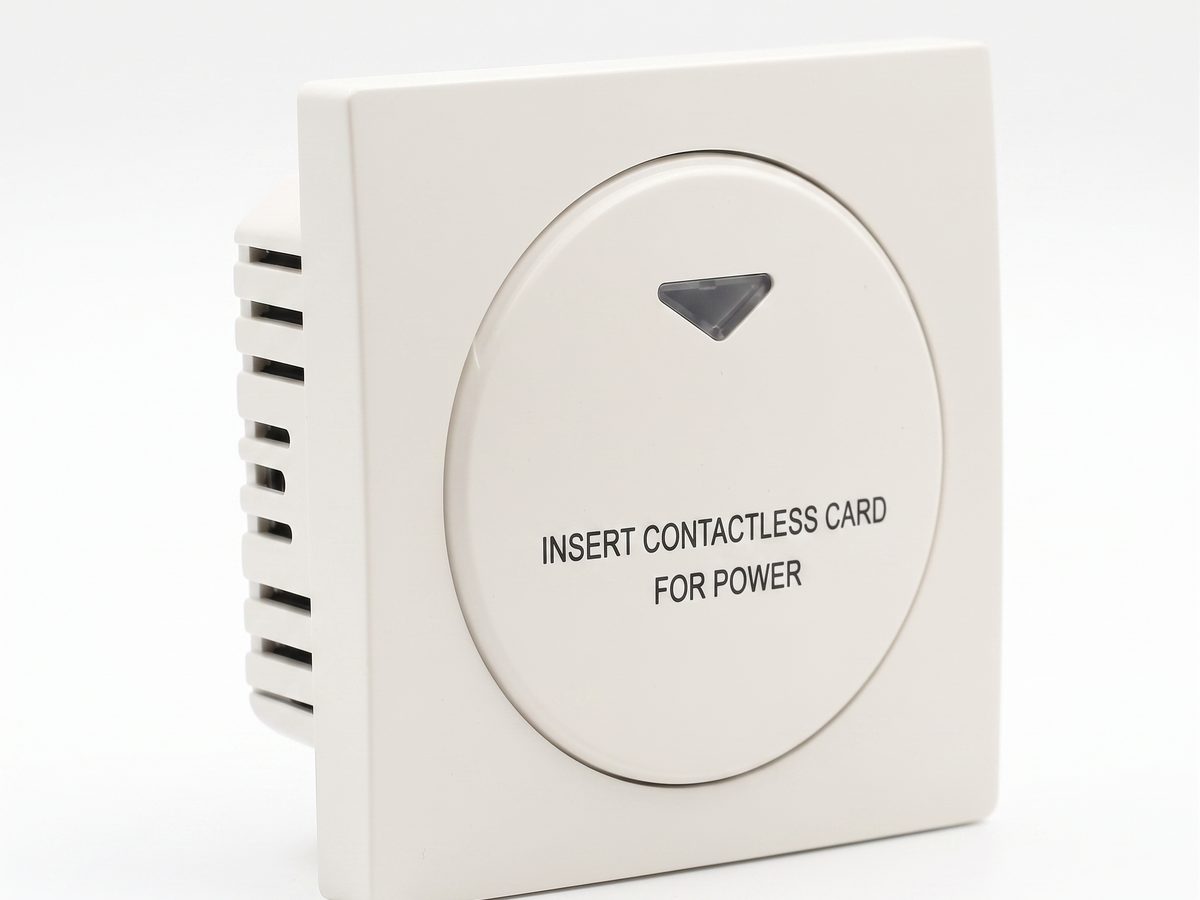
Interrupteur Carte Clé Hôtel — Contrôle Énergie Chambre
Interrupteur carte clé hôtel pour contrôle énergie chambre. Détection RFID/IC, insertion=alimentation, retrait=délai coupure. 220V CA, 10A-16A, RS485 ou contact sec. CE RoHS. Fournisseur OEM/ODM.
Cette page le désigne déjà comme prochaine référence recommandée.
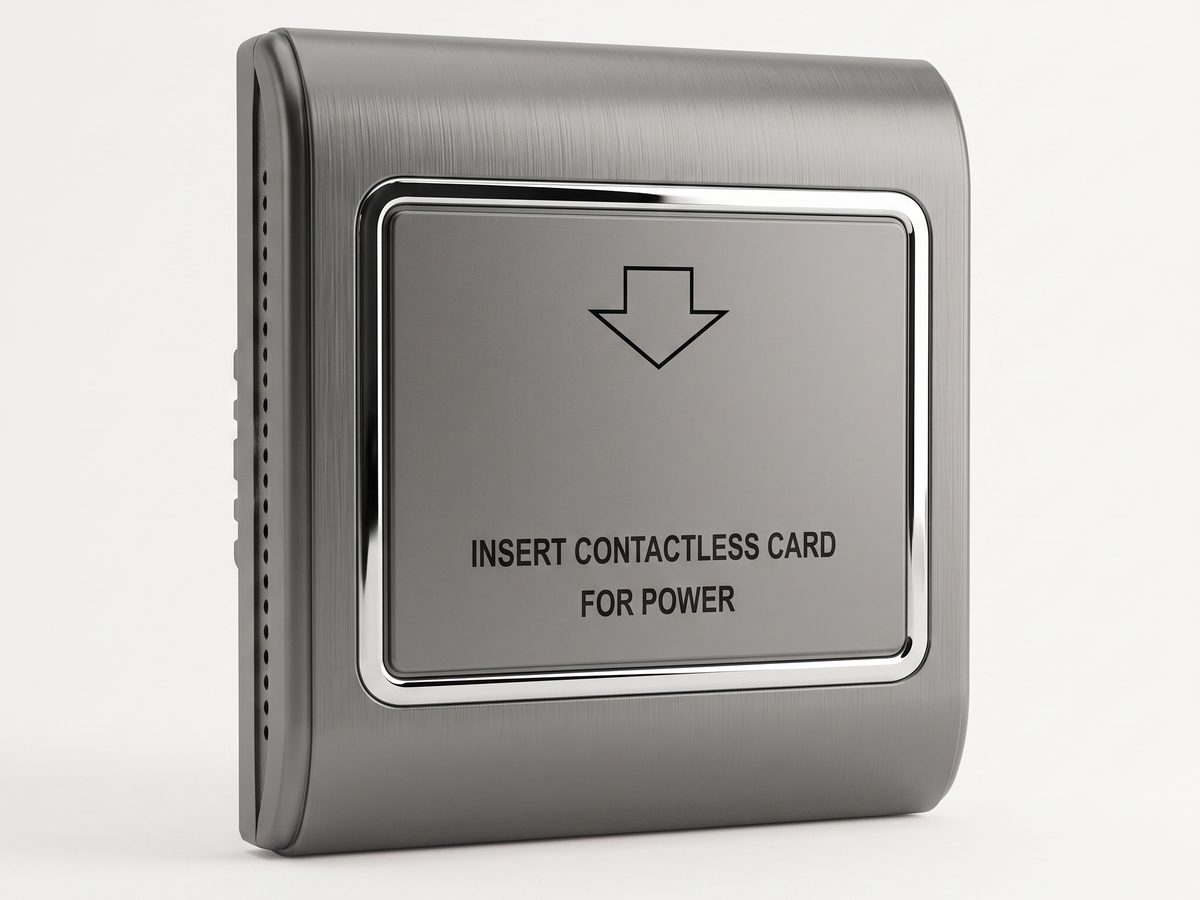
Interrupteur Économiseur RFID — Interrupteur Carte MIFARE Liée à la Chambre (Type B)
Interrupteur économiseur RFID liant l'alimentation à une carte MIFARE de chambre spécifique. 13,56 MHz MIFARE / 125 kHz Temic, CA 180–250 V, 30 A, délai 15 s. Un interrupteur hôtel RFID qui empêche le partage de cartes entre chambres et réduit l'énergie de 25 à 40 %.
Cette page le désigne déjà comme prochaine référence recommandée.
Interrupteur Énergie Compatible TTLOCK — Chambre + Temps (Type C)
Interrupteur énergie compatible TTLOCK avec ID chambre et limite temps. Fonctionne cartes MIFARE TTLOCK/TTHotel via auth clé secteur, AC 180–250V, 30A. Interrupteur carte chiffré et switch énergie TTLOCK ES2 pour rétrofit hôtels écosystème-verrouillé.
Cette page le désigne déjà comme prochaine référence recommandée.
Solutions associées
3 Guide d'achat 2026 : commutateur d'économie d'énergie hôtelier
Guide d'achat complet pour commutateurs d'économie d'énergie hôteliers : carte universelle, RFID/MIFARE, compatible TTLOCK, BLE intelligent et capteur d'occupation. Choisissez le bon commutateur à clé, à insertion de carte ou d'économie d'énergie pour vos chambres.
Cette page le désigne déjà comme prochaine référence recommandée.
Système de gestion énergétique hôtelière — Contrôle de l'électricité en chambre rentable
Un système de gestion énergétique hôtelière basé sur commutateurs à carte, économiseurs RFID et capteurs d'occupation réduisant de 25 à 40 % l'électricité des chambres. Guide du contrôleur d'énergie pour hôtels rénovant l'alimentation des chambres.
Cette page le désigne déjà comme prochaine référence recommandée.
Système de gestion des chambres par prise carte
Un système pratique de gestion des chambres pour contrôler l'alimentation via des prises carte, contacteurs et règles d'exploitation claires.
Il couvre le même contexte produit : Interrupteur Carte Clé Hôtel — Contrôle Énergie Chambre, Interrupteur Économiseur RFID — Interrupteur Carte MIFARE Liée à la Chambre (Type B).
Articles de blog associés
3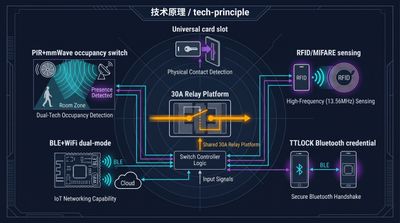
Commutateur carte-clé hôtel : types, modèles, spécification
Le commutateur à carte-clé d'hôtel existe en modèles universel, RFID, TTLOCK, BLE et à présence. Ce guide couvre les termes clés et le choix du modèle.
Il couvre le même contexte produit : Interrupteur Carte Clé Hôtel — Contrôle Énergie Chambre, Interrupteur Économiseur RFID — Interrupteur Carte MIFARE Liée à la Chambre (Type B), Interrupteur Énergie Compatible TTLOCK — Chambre + Temps (Type C).
RFID vs NFC pour commutateurs carte clé hôtel : quel choix ?
RFID vs NFC pour commutateurs carte clé hôtel : RFID (125kHz, 13,56MHz MIFARE/Temic) standard alimentation chambre ; NFC protocole téléphone. Comparer portée, verrouillage.
Il couvre le même contexte produit : Interrupteur Économiseur RFID — Interrupteur Carte MIFARE Liée à la Chambre (Type B), Interrupteur Carte Clé Hôtel — Contrôle Énergie Chambre, Interrupteur Énergie Compatible TTLOCK — Chambre + Temps (Type C).
Interrupteur carte-clé hôtel : fonctionnement et économies d'énergie
L'interrupteur à carte-clé d'hôtel active l'électricité à l'insertion de la carte et la coupe au retrait, réduisant de 25 à 40 % la consommation de la chambre. Comparez modèles universels, RFID, TTLOCK et BLE.
Il couvre le même contexte produit : Interrupteur Carte Clé Hôtel — Contrôle Énergie Chambre, Interrupteur Économiseur RFID — Interrupteur Carte MIFARE Liée à la Chambre (Type B), Interrupteur Énergie Compatible TTLOCK — Chambre + Temps (Type C).
Spécifiez votre projet hôtelier avec nos ingénieurs
Indiquez le nombre de chambres, le type de plafond et votre préférence de protocole. Nous renverrons un plan d'échantillon et un devis sous 24 heures ouvrées.
- Passez d'une guidance générale à une discussion produit ou application.
- Utilisez la RFQ quand le prix, les plans, le MOQ ou le calendrier de lancement nécessitent de la structure.
- Gardez une voie de contact direct visible pour les clarifications rapides et le transfert.