Interruptor de Tarjeta vs Sensor de Presencia mmWave para Hoteles: ¿Cuál Ahorra Más Energía
Compare interruptor de tarjeta vs sensor de presencia mmWave para hoteles en lógica de control, coste, instalación, precisión de ocupación y diseño de respaldo tarjeta-más-radar.
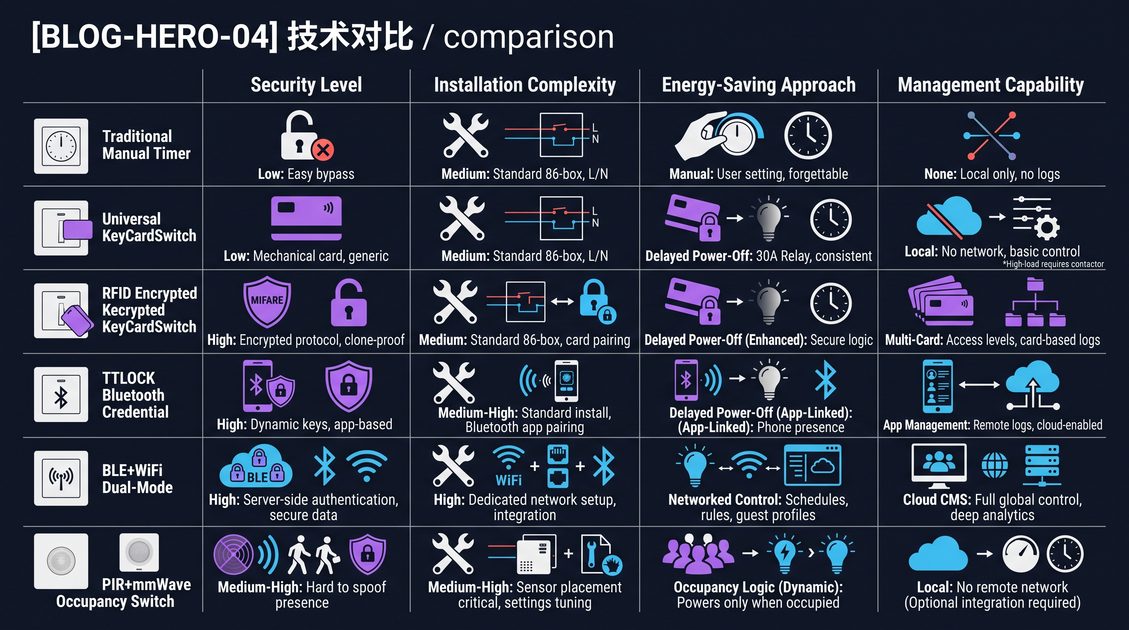
Un interruptor de tarjeta vs sensor de presencia mmWave para hoteles no es una contienda entre dos productos similares, sino una decisión entre dos filosofías opuestas de control de energía en habitaciones. Un interruptor de tarjeta es un dispositivo determinista: enciende la habitación cuando una tarjeta válida está en la ranura y corta el circuito en el momento en que la tarjeta sale, sin juzgar si realmente hay una persona dentro. Un sensor de presencia mmWave es un dispositivo inductivo: usa radar de 24–60 GHz para detectar un humano estacionario, incluyendo micro-movimientos como la respiración, y mantiene la habitación energizada solo mientras se confirma la presencia. Donde el interruptor de tarjeta pregunta "¿hay una tarjeta presente?", el sensor de presencia pregunta "¿hay un cuerpo presente?", y esa única diferencia impulsa cada decisión posterior sobre coste, cableado, esfuerzo de reforma y comportamiento del huésped. Entender la disyuntiva interruptor de tarjeta vs sensor de presencia mmWave importa porque la mayoría de hoteles deciden entre un estándar probado de dos décadas y una tecnología de sensado más nueva que puede, en la distribución adecuada, eliminar el problema de la entrega de la tarjeta por completo.
Interruptor de Tarjeta vs Sensor de Presencia mmWave para Hoteles: Dos Filosofías de Control
Un interruptor de tarjeta vs sensor de presencia mmWave para hoteles difiere a nivel de lógica de control antes de comparar cualquier hardware: el interruptor de tarjeta es determinista y orientado a eventos, mientras que el sensor de presencia es inductivo y orientado a estados. El modelo determinista se basa en un acto físico explícito del huésped: insertar la tarjeta energiza la habitación, y retirarla desconecta la carga tras un breve retardo, usualmente de 10 a 30 segundos. Como el disparador es un objeto físico en una ranura, el estado de la habitación es totalmente predecible y cualquier fallo es mecánico y visible. El modelo inductivo infiere la ocupación a partir de la reflexión del radar, por lo que puede energizar la habitación sin acción del huésped y también detectar cuando una persona permanece dentro tras retirar la tarjeta. Esto significa que los dos dispositivos no simplemente ocupan la misma posición en la pared de forma distinta; encarnan diferentes suposiciones sobre quién controla la habitación. Un interruptor de tarjeta confía en la mano del huésped; un sensor de presencia confía en la observación del sensor. Para un equipo de compras, la pregunta real es si la propiedad quiere la energía atada a un token que el huésped debe llevar e insertar, o atada al hecho físico continuo de la ocupación.
El Principio Determinista de un Interruptor de Tarjeta
Un interruptor de tarjeta funciona con una regla que nunca cambia: tarjeta dentro igual a energía encendida, tarjeta fuera igual a energía apagada. El hardware es un relé dimensionado para la carga de la habitación, un lector que acepta la tarjeta emitida, un microcontrolador que verifica que la tarjeta es válida, y un circuito de retardo que mantiene la energía brevemente tras la retirada para que un huésped que cambia u olvida una tarjeta no quede sumido en la oscuridad instantáneamente. Como la lógica es binaria, el resultado es repetible en cada habitación y cada huésped, y es fácil de auditar para limpieza e ingeniería: la ranura o bien sostiene una tarjeta o no. La naturaleza determinista también significa que no hay calibración, no hay ajuste de sensibilidad, y no hay riesgo de falso negativo por un huésped inmóvil. El coste del determinismo es el problema de la entrega, donde un huésped que se va sin retirar la tarjeta, o una tarjeta dejada en la ranura durante la limpieza, mantiene la habitación energizada.
El Principio Inductivo de un Sensor de Presencia mmWave
Un sensor de presencia mmWave reemplaza la tarjeta con observación por radar. Transmite señales de onda milimétrica en la banda de 24 GHz o 60 GHz y analiza el desplazamiento de frecuencia reflejado para clasificar si hay un humano presente, en movimiento o estacionario. A diferencia del PIR, que solo reacciona al movimiento brusco, el mmWave puede detectar a una persona sentada, durmiendo o leyendo sin macro-movimiento porque percibe el micro-movimiento de la respiración y el leve balanceo corporal. El sensor mantiene la habitación energizada continuamente mientras se confirma la presencia y libera la energía solo tras un tiempo de espera de vacancia ajustable, típicamente de 5 a 15 minutos. Como la detección es inductiva, el dispositivo no puede saber si la persona es un huésped o personal de limpieza, ni si la habitación fue pagada; solo sabe que hay un cuerpo allí. Esto hace al sensor de presencia potente para la verdad de la ocupación pero ciego al hecho comercial de quién pertenece a la habitación.
Cómo la Diferencia Cambia el Comportamiento del Huésped
Las dos filosofías cambian lo que se pide al huésped. Con un interruptor de tarjeta, el huésped debe insertar la tarjeta a la llegada y recordar retirarla a la salida, y las propiedades a menudo confían en señalética y el instinto natural de recuperar la tarjeta de la ranura antes de irse. Con un sensor de presencia mmWave, no se pide nada al huésped, porque la habitación detecta la llegada y la salida por sí misma. La consecuencia conductual es que un interruptor de tarjeta es vulnerable al huésped olvidadizo que deja la tarjeta puesta, mientras que un sensor de presencia es vulnerable al fallo inverso, donde un huésped durmiendo o quieto es juzgado brevemente ausente si el tiempo de espera de vacancia es demasiado agresivo. Ningún dispositivo es perfecto; simplemente fallan en direcciones opuestas, y esa asimetría es la base para combinarlos.
Interruptor de Tarjeta vs Sensor de Presencia mmWave para Hoteles: Cómo Cada Uno Decide la Energía de la Habitación
Un interruptor de tarjeta vs sensor de presencia mmWave para hoteles también difiere en la ruta eléctrica que realmente controla la carga de CA. Un interruptor de tarjeta es normalmente un relé conectado en serie en el cable de fase que conmuta un circuito de 30A, por lo que está en línea e interrumpe físicamente la energía. Un sensor de presencia mmWave es normalmente un pequeño módulo de radar, a menudo montado en techo o pared, que detecta la ocupación y luego señala a un relé separado o a un interruptor de ahorro energético para abrir o cerrar el circuito. Esto significa que el sensor de presencia frecuentemente no es el dispositivo que lleva la carga; es un sensor aguas arriba del controlador, que puede ser un relé en carril DIN, un interruptor inteligente, o un módulo de automatización de edificios. La colocación, el cableado y la alimentación difieren en consecuencia, y esa diferencia es lo que hace que las rutas de reforma sean tan distintas.
| Atributo | Interruptor de tarjeta | Sensor de presencia mmWave |
|---|---|---|
| Lógica de control | Determinista (tarjeta dentro = encendido) | Inductiva (presencia = encendido) |
| Disparador | Huésped inserta tarjeta válida | Radar detecta humano estacionario |
| Conmutación de carga | Relé 30A integrado en fase | Sensor + relé/controlador separado |
| Ubicación típica | Pared en entrada de habitación | Techo o pared, cobertura de presencia |
| Acción del huésped requerida | Insertar y retirar tarjeta | Ninguna |
| Liberación por vacancia | Inmediata + retardo 10–30s | Tiempo de espera ajustable 5–15 min |
| Modo de fallo | Olvida tarjeta en ranura | Juzga huésped quieto ausente (si tiempo muy corto) |
La Ruta Eléctrica de un Interruptor de Tarjeta
En un interruptor de tarjeta, el relé es el elemento que lleva la carga, y está dimensionado para la corriente total de la habitación, típicamente 30A a CA 180–250V. El interruptor se monta empotrado en la pared de entrada y se cablea en serie con la alimentación de fase de la habitación, de modo que cuando el relé abre, todo el circuito de la habitación se desenergiza. La instalación es una tarea eléctrica de un solo punto: llevar fase y neutro a la caja, terminar la carga a través del relé, y ajustar el retardo. Como el interruptor lleva la carga, no se necesita contactor adicional ni relé inteligente, lo que mantiene la lista de materiales pequeña y el cableado simple para una reforma. El dispositivo debe estar dimensionado para la corriente de arranque de aires acondicionados y calentadores de agua, por eso la capacidad del relé y el retardo de 15 segundos se especifican juntos.
La Ruta Eléctrica de un Sensor de Presencia mmWave
Un sensor de presencia mmWave no suele conmutar la carga de la habitación directamente porque un módulo de radar es un dispositivo de control de baja potencia, no un contactor de alta corriente. En una distribución hotelera típica, el sensor se alimenta a 5V o 12V y entrega un contacto seco, un cierre de relé, o una señal digital de ocupación a un interruptor de ahorro energético o relé que lleva la carga de CA. Esto crea una arquitectura de dos partes: sensado y conmutación están separados. La ventaja es flexibilidad, porque un sensor puede accionar múltiples salidas o una zona de corredor completa, y el tiempo de espera de vacancia es un parámetro de software en lugar de un circuito fijo. El coste son más componentes, más puntos de cableado, y un paso de puesta en marcha para emparejar cada sensor con su controlador y ajustar su zona de detección y tiempo de espera.
Por Qué la Diferencia Eléctrica Importa para Reformas
La diferencia eléctrica se traduce directamente en dificultad de reforma. Reemplazar un interruptor de pared manual existente con un interruptor de tarjeta suele ser un cambio uno a uno: quitar el interruptor, montar el interruptor de tarjeta en la misma caja, y reconectar los mismos cables de fase, por eso los interruptores de tarjeta son famosos por una instalación rápida por habitación. Añadir un sensor de presencia mmWave donde no existe infraestructura de sensores a menudo significa añadir un nuevo dispositivo, tender su alimentación de baja tensión, e integrar su salida de ocupación con un controlador o interruptor de ahorro energético, lo que puede implicar más oficios y más puntos de fallo. Para una propiedad existente, el interruptor de tarjeta tiende a ganar en simplicidad de instalación pura, mientras que el sensor de presencia tiende a ganar en flexibilidad de obra nueva, donde el sensor puede empotrarse en la fase de construcción.
Interruptor de Tarjeta vs Sensor de Presencia mmWave para Hoteles: Coste e Instalación Comparados
Un interruptor de tarjeta vs sensor de presencia mmWave para hoteles diverge marcadamente en coste y esfuerzo de instalación, y para la mayoría de propiedades el coste total de propiedad es el factor decisivo. Un interruptor de tarjeta es un dispositivo autónomo con un coste unitario moderado, una sola caja de pared, sin red, y una reforma rápida, por lo que el coste instalado es bajo y predecible. Un sensor de presencia mmWave típicamente tiene un precio unitario más alto para el módulo de radar, más el coste de un controlador o relé y una instalación y puesta en marcha más complejas, por lo que el coste inicial es más alto. La brecha no está solo en el hardware sino en la mano de obra, porque el interruptor de tarjeta es un cambio eléctrico de un oficio mientras que el sensor de presencia a menudo requiere coordinación entre oficios eléctricos y de baja tensión. Para una propiedad con cientos de habitaciones, esta diferencia por habitación se multiplica por todo el edificio, por eso el modelado de costes a menudo inclina la decisión hacia el interruptor de tarjeta en la primera compra.
| Factor de coste | Interruptor de tarjeta | Sensor de presencia mmWave | |---| A key card switch vs mmWave presence sensor for hotels is not a contest between two similar products but a decision between two opposite philosophies of guest-room power control. A key card switch is a deterministic device: it turns the room on when a valid card sits in the slot and cuts the circuit the moment the card leaves, with no judgment about whether a person is actually inside. An mmWave presence sensor is an inductive device: it uses 24–60 GHz radar to detect a stationary human, including micro-motion such as breathing, and keeps the room powered only while presence is confirmed. Where the card switch asks "is a card present," the presence sensor asks "is a body present," and that single difference drives every downstream decision about cost, wiring, retrofit effort, and guest behavior. Understanding the key card switch vs mmWave presence sensor trade-off matters because most hotels are deciding between a proven two-decade-old standard and a newer sensing technology that can, in the right layout, eliminate the card hand-off problem entirely.
Key Card Switch vs mmWave Presence Sensor for Hotels: Two Control Philosophies
A key card switch vs mmWave presence sensor for hotels differs at the control-logic level before any hardware is compared: the card switch is deterministic and event-driven, while the presence sensor is inductive and state-driven. The deterministic model relies on an explicit, physical act by the guest: inserting the card powers the room, and removing it drops the load after a short delay, usually 10 to 30 seconds. Because the trigger is a physical object in a slot, the room state is fully predictable and any failure is mechanical and visible. The inductive model instead infers occupancy from radar reflection, so it can power the room with no guest action and can also detect when a person remains inside after the card was removed. This means the two devices do not simply occupy the same wall position differently; they embody different assumptions about who controls the room. A card switch trusts the guest's hand; a presence sensor trusts the sensor's observation. For a procurement team the real question is whether the property wants power tied to a token the guest must carry and insert, or tied to the continuous physical fact of occupancy.
The Deterministic Principle of a Key Card Switch
A key card switch runs on a rule that never changes: card in equals power on, card out equals power off. The hardware is a relay rated for the room's load, a reader that accepts the issued card, a microcontroller that verifies the card is valid, and a delay circuit that holds power briefly after removal so a guest who swaps or forgets a card is not plunged into darkness instantly. Because the logic is binary, the outcome is repeatable across every room and every guest, and it is easy for housekeeping and engineering to audit: the slot either holds a card or it does not. The deterministic nature also means there is no calibration, no sensitivity setting, and no false-negative risk from a motionless guest. The cost of determinism is the hand-off problem, where a guest who leaves without removing the card, or a card left in the slot during housekeeping, keeps the room energized.
The Inductive Principle of an mmWave Presence Sensor
An mmWave presence sensor replaces the card with radar observation. It transmits millimeter-wave signals in the 24 GHz or 60 GHz band and analyzes the reflected frequency shift to classify whether a human is present, moving, or stationary. Unlike PIR, which only reacts to gross movement, mmWave can detect a person who is sitting, sleeping, or reading with no macro motion because it senses the micro-motion of breathing and slight body sway. The sensor holds the room powered continuously while presence is confirmed and releases power only after an adjustable vacancy timeout, typically 5 to 15 minutes, clears. Because detection is inductive, the device cannot tell whether the person is a guest or a housekeeper, and it cannot know whether the room was paid for; it only knows that a body is there. This makes the presence sensor powerful for occupancy-truth but blind to the commercial fact of who belongs in the room.
How the Difference Changes Guest Behavior
The two philosophies change what the guest is asked to do. With a card switch, the guest must insert the card at arrival and remember to remove it on departure, and properties often rely on signage and the natural instinct to retrieve a card from the slot before leaving. With an mmWave presence sensor, the guest is asked to do nothing, because the room senses arrival and departure by itself. The behavioral consequence is that a card switch is vulnerable to the forgetful guest who leaves the card in place, while a presence sensor is vulnerable to the reverse failure, where a sleeping or lying-still guest is briefly judged absent if the vacancy timeout is set too aggressively. Neither device is flawless; they simply fail in opposite directions, and that asymmetry is the basis for combining them.
Key Card Switch vs mmWave Presence Sensor for Hotels: How Each Decides Room Power
A key card switch vs mmWave presence sensor for hotels also differs in the electrical path that actually controls the AC load. A key card switch is normally a series-connected relay in the live wire that switches a 30A circuit, so it sits inline and physically interrupts power. An mmWave presence sensor is normally a small radar module, often ceiling-mounted or wall-mounted, that detects occupancy and then signals a separate relay or an energy-saving switch to open or close the circuit. This means the presence sensor is frequently not the load-carrying device at all; it is a sensor upstream of the controller, which can be a DIN-rail relay, a smart switch, or a building automation module. The placement, wiring, and power supply differ accordingly, and that difference is what makes the retrofit paths so unlike each other.
| Attribute | Key card switch | mmWave presence sensor |
|---|---|---|
| Control logic | Deterministic (card in = on) | Inductive (presence = on) |
| Trigger | Guest inserts a valid card | Radar detects a stationary human |
| Load switching | Built-in 30A relay in live wire | Sensor + separate relay/controller |
| Typical location | Wall at room entry | Ceiling or wall, presence coverage |
| Guest action required | Insert and remove card | None |
| Vacancy release | Immediate + 10–30s delay | Adjustable 5–15 min timeout |
| Failure mode | Forgets card left in slot | Judges still guest absent (if timeout too short) |
The Electrical Path of a Key Card Switch
In a key card switch, the relay is the load-carrying element, and it is rated for the full current of the room, typically 30A at AC 180–250V. The switch is mounted flush in the entry wall and wired in series with the room's live feed, so that when the relay opens, the entire room circuit is de-energized. The installation is a single-point electrical task: bring the live and neutral to the box, terminate the load through the relay, and set the delay. Because the switch carries the load, no additional contactor or smart relay is needed, which keeps the bill of materials small and the wiring simple for a retrofit. The device must be rated for the room's surge current from air conditioners and water heaters, which is why the relay rating and the 15-second delay are specified together.
The Electrical Path of an mmWave Presence Sensor
An mmWave presence sensor does not usually switch the room load directly because a radar module is a low-power control device, not a high-current contactor. In a typical hotel layout, the sensor is powered at 5V or 12V and outputs a dry contact, a relay closure, or a digital occupancy signal to an energy-saving switch or relay that carries the AC load. This creates a two-part architecture: sensing and switching are separated. The advantage is flexibility, because one sensor can drive multiple outputs or a whole corridor zone, and the vacancy timeout is a software parameter rather than a fixed circuit. The cost is more components, more wiring points, and a commissioning step to pair each sensor to its controller and set its detection zone and timeout.
Why the Electrical Difference Matters for Retrofits
The electrical difference translates directly into retrofit difficulty. Replacing an existing manual wall switch with a key card switch is usually a one-for-one swap: remove the switch, fit the card switch in the same box, and reconnect the same live wires, which is why card switches are famous for a fast per-room install. Adding an mmWave presence sensor where no sensor infrastructure exists often means adding a new device, running its low-voltage power, and integrating its occupancy output with a controller or energy-saving switch, which can involve more trades and more points of failure. For an existing property, the key card switch tends to win on pure installation simplicity, while the presence sensor tends to win on new-build flexibility, where the sensor can be embedded at construction stage.
Key Card Switch vs mmWave Presence Sensor for Hotels: Cost and Installation Compared
A key card switch vs mmWave presence sensor for hotels diverges sharply on cost and installation effort, and for most properties the total cost of ownership is the deciding factor. A key card switch is a self-contained device with a modest per-unit cost, a single wall box, no network, and a fast retrofit, so the installed cost is low and predictable. An mmWave presence sensor typically has a higher per-unit price for the radar module, plus the cost of a controller or relay and a more involved installation and commissioning, so the upfront cost is higher. The gap is not only in hardware but in labor, because the card switch is a one-trade electrical swap while the presence sensor often requires coordination between electrical and low-voltage trades. For a property with hundreds of rooms, this per-room difference is multiplied across the whole building, which is why cost modeling so often tips the decision toward the card switch on first purchase.
| Cost factor | Key card switch | mmWave presence sensor |
|---|---|---|
| Hardware per room | Lower (single device) | Higher (sensor + relay/controller) |
| Wiring | Existing wall box reuse | May need low-voltage power run |
| Labor per room | Lower, one trade | Higher, two trades + commissioning |
| Network hardware | None | Controller, possibly gateway |
| Commissioning | Minimal (delay set) | Zone detection + timeout tuning |
| Retrofit speed | Fast | Slower |
| Unit cost sensitivity | Very sensitive | Less sensitive |
The Hardware Cost of a Key Card Switch
The hardware cost of a key card switch is dominated by a single bill of materials: the card reader, the microcontroller, the 30A relay, and the flush panel. Because there is no radio module, no antenna, and no cloud dependency, the unit cost stays low and stable across large orders, and it does not scale with the number of rooms in any complicated way. The reader itself is chosen by the card system, and because a universal model reads any M1 card, the same switch works regardless of whether the property issues RFID, Temic, or TTLOCK cards. This makes the key card switch one of the most cost-predictable energy-saving devices a hotel can procure, with no hidden network or software line items per room.
The Hardware Cost of an mmWave Presence Sensor
The hardware cost of an mmWave presence sensor is spread across the radar module, its power supply, and the load-carrying relay or energy-saving switch it drives. A 24 GHz or 60 GHz radar chipset with its antenna, amplifier, and signal-processing firmware is more expensive than a card reader and relay, and the sensor usually needs a separate controller to translate its occupancy output into AC switching. In a connected-rooms design there may also be a gateway or bus controller per floor. The result is that the presence sensor solution has more components to procure, more points to stock as spares, and a slightly higher per-room bill of materials, though the price of mmWave chips has fallen steadily and the gap is narrowing with volume.
Installation Labor and Commissioning Effort
Installation labor is where the two solutions differ most in practice. A key card switch retrofit is an electrical swap: the electrician opens the existing wall box, mounts the card switch, and terminates the same live and neutral wires, typically in 15 to 30 minutes per room with no network join and no software setup beyond setting the delay. An mmWave presence sensor installation is more involved: the sensor must be positioned and aimed for the coverage it needs, powered with low voltage, wired to a relay or energy-saving switch, and then commissioned, with the detection zone adjusted so the radar does not false-trigger on a curtain, a fan, or movement in the corridor. Commissioning a presence sensor well can take longer per room and is harder to standardize across varied room shapes, which raises labor and drives up the total installed cost.
Total Cost of Ownership Perspective
When comparing a key card switch vs mmWave presence sensor for hotels, the honest framing is total cost of ownership over the device's working life rather than sticker price alone. The card switch has a lower upfront cost, near-zero operating cost, and a long mechanical life, but it depends on correct guest behavior to deliver savings. The presence sensor has a higher upfront cost and ongoing commissioning risk, but it can capture savings without any guest cooperation. For a quick-return retrofit where capital is tight, the card switch is usually the lower-risk purchase. For a property where the priority is eliminating the card hand-off and automating occupancy truth across the building, the presence sensor's higher cost is buying a capability the card switch cannot provide.
Key Card Switch vs mmWave Presence Sensor for Hotels: Detection and Occupancy Accuracy
A key card switch vs mmWave presence sensor for hotels must also be judged on accuracy, though the two measure different things. A key card switch is accurate to the card: if the card is in the slot, the room is powered, and this is true 100% of the time, which makes its occupancy signal exact but tied to an object rather than a person. An mmWave presence sensor is accurate to the body: it can detect a stationary human with a true-positive rate that commonly exceeds 99% in controlled testing, but its occupancy signal is a probabilistic inference subject to detection range, angle, occlusion, and environment. The card switch has perfect certainty about the wrong thing, and the presence sensor has near-perfect certainty about the right thing, which is exactly why the two are so complementary in a combined design.
| Accuracy factor | Key card switch | mmWave presence sensor |
|---|---|---|
| Occupancy signal based on | Card presence | Body presence |
| Stationary-person detection | N/A (needs card) | Yes, via breathing micro-motion |
| False negative (occupant missed) | Card left out | Still guest judged absent |
| False positive (empty judged full) | Card left in slot | Curtain/fan/reflection |
| Detection range | N/A | 6–8 m typical |
| Environmental factors | None | Furniture, glass, occlusion |
| Calibration needed | None | Zone + timeout tuning |
What a Key Card Switch Detects and Its Blind Spot
A key card switch detects one thing with total reliability: the presence of a valid card in the slot. It does not and cannot detect a person, so it has no awareness of a guest who enters a room without a card, a child who stays inside while the parents leave, or a housekeeper working in a room whose card was already removed. The blind spot is the card that stays in the slot: a guest who leaves the card behind, a business traveler who leaves it as a habit, or a housekeeper who props the door with a card, all keep the room powered even when nobody is inside. Because the switch cannot observe the body, it can never correct for these cases, and the property loses the energy it hoped to save on exactly the rooms that defeat the system.
What an mmWave Presence Sensor Detects and Its Blind Spot
An mmWave presence sensor detects a human body with high reliability, including a stationary person, because it reads the micro-motion of breathing at typical ranges of 6 to 8 meters. Its blind spot is environmental rather than behavioral: dense furniture, thick glass, metal screening, or a sensor aimed away from the occupied zone can attenuate or reflect the radar signal and cause a missed detection, and a strong air-conditioning draft or a moving curtain can occasionally be classified as presence and hold the room on. Because detection is inferential, the sensor needs a reasonable timeout margin, which is why most vacancy settings are 5 to 15 minutes rather than a few seconds. The sensor is powerful where the card switch is blind, and it is only modestly imperfect where the card switch is deterministic.
Why Accuracy Alone Does Not Settle the Choice
Accuracy alone does not settle the key card switch vs mmWave presence sensor decision because the two devices are accurate in different domains. A property that wants certainty about the commercial fact, that the room was authorized and the card is present, values the card switch's deterministic signal. A property that wants certainty about the physical fact, that a body is actually in the room, values the presence sensor's detection. Neither metric is a complete definition of "occupied," which is why many hotels combine them: the card switch establishes authorization and gives an instant, deterministic off when the card is removed, while the mmWave sensor guards against the card left in the slot and the guest who stays without a card.
Key Card Switch vs mmWave Presence Sensor for Hotels: Maintenance and Lifecycle
A key card switch vs mmWave presence sensor for hotels differs in what wears out, what needs maintenance, and how long each lasts in service. A key card switch is mostly mechanical and passive: its relay has a defined number of switching operations, its reader has no moving parts, and it has no firmware update cadence, so it tends to run for years with little attention beyond an occasional cleaning of the card slot. An mmWave presence sensor is an electronic device with a radar transceiver, firmware, and a sensitivity that can drift or need re-tuning as the room layout changes, so it may require occasional re-commissioning and software updates. The card switch is a fit-and-forget device; the presence sensor is a managed device. For properties with limited engineering staff, that difference in lifecycle burden is a real operational cost.
| Lifecycle factor | Key card switch | mmWave presence sensor |
|---|---|---|
| Wearing parts | Relay (switch cycles) | None mechanical; firmware |
| Cleaning | Card slot dust | Sensor lens/surface |
| Firmware updates | None typical | Occasional |
| Re-commissioning | Rare | After room layout changes |
| Mean time to failure | High (few parts) | High, but electronic |
| Spare strategy | Keep one model | Keep sensor + relay models |
| Network dependency | None | May depend on controller |
Maintenance Profile of a Key Card Switch
The maintenance profile of a key card switch is dominated by the relay, which has a finite number of switching operations before contact wear becomes a concern, and by the card reader, whose contacts and slot can collect dust or debris in heavy use. In practice a card switch is passive, has no network link, no battery, and no firmware that can corrupt, so the main maintenance tasks are periodic cleaning of the slot, occasional verification that the delay circuit works, and keeping a small stock of spares for the relay. Because the device is deterministic, a failure is usually visible and easy to diagnose: the room either stays on or stays off. This low-touch profile suits properties that want energy control without a software or commissioning budget.
Maintenance Profile of an mmWave Presence Sensor
The maintenance profile of an mmWave presence sensor is centered on firmware and environment rather than on wearing parts. The sensor has no mechanical wear, but its firmware may receive updates for detection algorithms or protocol changes, and its detection zone can need re-commissioning when a room is refurnished, when a TV or large metal object is added, or when the sensor is accidentally repositioned. Because the sensor reports occupancy by inference, a subtle misbehavior such as a slight false-positive or an occasional missed detection can be harder for staff to spot than a card switch that simply fails open or closed. The sensor is also only one link in a chain that includes its power supply and its load-carrying relay, so the spares list is longer.
Lifecycle Cost and Spare-Parts Strategy
The lifecycle comparison feeds a spare-parts and total-cost picture. A card switch estate can be maintained with a single spare model for the switch body and relay, stocked cheaply and swapped in minutes by one electrician. A presence sensor estate needs spares for the sensor, its power supply, and the switching relay or controller, and the staff must be able to re-commission a replacement, which is a more specialized skill. Over a five-year horizon, the card switch tends to have lower maintenance labor and a simpler spares pipeline, while the presence sensor offers ongoing capability but carries a slightly higher operational-management cost, a trade-off a hotel must weigh against the energy it saves.
When to Choose a Key Card Switch Over an mmWave Presence Sensor for Hotels
A key card switch vs mmWave presence sensor for hotels resolves clearly in favor of the card switch in several common property situations. A key card switch is the better choice when the retrofit must be fast and cheap, when the property already issues cards and wants no guest behavior change, when the engineering team is small and prefers a fit-and-forget device, when the rooms have awkward shapes or heavy furnishings that make radar detection unreliable, or when the budget does not extend to networked sensors and commissioning. For a budget-conscious owner retrofitting an existing stock of standard rooms, the deterministic card switch usually delivers predictable savings at the lowest installed cost and the fewest operational demands.
- Fast, low-cost retrofit of many rooms in a short window
- Property already runs a card system and wants a one-for-one swap
- Small or non-technical maintenance team that prefers passive devices
- Awkward room geometry or heavy furniture that would defeat radar
- No appetite for networked hardware or commissioning time
- Priority is a proven, auditable, deterministic energy cut
When Guest Behavior Is Already Disciplined
A key card switch works best where guests already treat the card as a room key, which is most standard hotels. Because the guest removes the card to take the key away, the act of leaving naturally triggers power-off, and no signage campaign or retraining is needed. In properties where the card is the door key, the card switch aligns the energy-saving trigger with an action the guest already performs, which is the single strongest argument for the deterministic model. The savings are realized automatically whenever the guest leaves, with no sensor judgment and no false detection.
When Engineering Resources Are Limited
Properties with a small or overstretched engineering team tend to prefer the card switch because it needs no network, no commissioning, no firmware updates, and no sensitivity tuning. A card switch failure is mechanical and visible, and a spare is swapped in minutes without specialized tools. For a franchise or independent hotel without an in-house low-voltage specialist, the card switch's low-touch lifecycle is a decisive operational advantage over a sensor that may need re-commissioning after any room change.
When Retrofit Speed Is the Constraint
When the renovation window is short, the card switch wins on speed. Because it replaces an existing wall switch in the same box using the same live wires, a competent electrician can complete many rooms per day with minimal disruption to occupied floors. The presence sensor, by contrast, adds placement, low-voltage power, wiring to a relay, and commissioning, which lengthens the per-room cycle and can require more than one trade. For a tight seasonal renovation, the card switch is the lower-risk path to finishing on schedule.
When an mmWave Presence Sensor Beats a Key Card Switch for Hotels
A key card switch vs mmWave presence sensor for hotels swings the other way when the property needs occupancy truth rather than card authorization. An mmWave presence sensor is the better choice in new builds where the sensor can be embedded at construction, in premium rooms where the guest experience rules out any card hand-off, in suites with bathrooms or corners a card would not cover, in rooms where guests commonly stay inside without a card, and in connected-rooms programs that want presence data for HVAC and lighting automation. The presence sensor also wins wherever the goal is to eliminate the forgetful-guest leak that a card switch cannot correct.
- New construction where sensors are embedded at build time
- Premium or long-stay rooms that must feel effortless
- Occupancy-aware HVAC and lighting beyond simple on-off
- Rooms where guests stay inside without inserting a card
- Properties that want presence data, not just power control
- Layouts with clean sight lines favorable to radar
When the Guest Experience Demands No Card
For premium properties, long-stay residences, and wellness suites, the card hand-off can feel like friction, and an mmWave presence sensor removes it entirely by powering the room on arrival without any guest action. In these segments, the subtle cost of asking the guest to manage the room's power outweighs the energy savings, and the presence sensor's invisibility is itself the value. The sensor also handles the guest who settles into the room, works at a desk, or sleeps, keeping power on continuously as long as a body is present, with no risk of a mid-stay power cut from a misplaced card.
When Occupancy Data Drives the Building
When the property wants to go beyond simple on-off control to occupancy-aware HVAC, lighting scenes, and corridor automation, the mmWave presence sensor is the foundation because it outputs a real occupancy signal that a controller can use. A card switch outputs only a card-present binary that tells nothing about where in the room a person is or whether they are active. The presence sensor's richer signal enables per-zone control, such as keeping the bathroom lit while the sleeping area is dimmed, which is impossible with a single wall card switch. For an energy-management program that is data-driven, the presence sensor is the more capable platform.
When Rooms Are Occupied Without a Card
Some occupancy patterns defeat the card switch: a couple where one person holds the card and the other stays behind, a parent who leaves the card while a child naps, or a long-stay guest who never removes the card during the day. In all these cases the card switch either powers the room despite being empty or fails to power it while occupied. The mmWave presence sensor is indifferent to cards and keys the power to the body, so it captures savings and maintains comfort in exactly the patterns where the card switch is wrong. For properties with a meaningful share of multi-occupant or long-stay rooms, this capability alone can justify the sensor.
The Combined Solution: mmWave Detects, Key Card Switch Falls Back
A key card switch vs mmWave presence sensor for hotels is not a binary choice, because the strongest design uses both. In the combined solution, the mmWave presence sensor is the primary occupant detector and the key card switch acts as the deterministic fallback and the authorization layer. The two work together so each covers the other's blind spot: the mmWave sensor guards against the card left in the slot by releasing power when the room is genuinely empty, and the key card switch guarantees that a room cannot be powered beyond its authorized card signal and provides an instant, deterministic off the moment the card is removed. This redundancy converts a pair of imperfect devices into a single robust system.
| Combined-mode behavior | Sensor | Card switch fallback |
|---|---|---|
| Guest removes card and leaves | — | Instant power-off (deterministic) |
| Guest leaves card in slot | Detects empty room, releases power | Card alone would keep it on |
| Guest stays without card | Holds power on | Card alone would cut it |
| Housekeeping inside | Detects presence | Card governs authorization |
| Empty room after vacancy | Releases power | Card alone can't clear |
| Authorization check | n/a | Valid card required |
How the Fallback Logic Works
In a typical combined wiring arrangement, the key card switch carries the load and requires a valid card to energize the circuit, while the mmWave presence sensor sits upstream and can also hold the circuit on for as long as it detects a body. The logic is an OR on hold: the room stays powered if the card is present or if the sensor detects occupancy, and it cuts power only when both conditions clear, that is, when there is no card and no detected body. This preserves the card switch's deterministic off when the guest leaves with the card, and it adds the sensor's ability to release a room where a card was left behind. The two conditions overlap cleanly and each provides a safety net for the other's failure mode.
Why the Combination Is Worth the Extra Hardware
The combined design is worth its extra hardware in properties where the energy leakage from forgotten cards is large enough to offset the sensor cost. Every room where a guest habitually leaves the card in the slot is a room where the card switch alone saves nothing, and the mmWave sensor closes exactly that leak by clearing the room when it is empty. Conversely, every premium guest who settles in without a card is protected by the sensor's presence detection. Because the card switch still provides the instant, deterministic off and the authorization check, the property keeps the auditable savings of a card system while gaining the occupancy truth of radar, which is why an increasing number of energy-conscious hotels specify the pair rather than one device.
Commissioning the Pair Together
Commissioning the combined system requires setting three parameters that must agree: the card switch's removal delay, the presence sensor's vacancy timeout, and the coordination rule between them. The vacancy timeout must be long enough to avoid cutting power to a still guest, typically 5 to 15 minutes, and slightly longer than the card switch's short delay so the sensor does not fight the switch. The sensor's detection zone must cover the main occupied area without spilling into the corridor or false-triggering on a curtain. When these are set correctly, the two devices behave as one system, and the property gets deterministic control with a sensing safety net, the closest either technology comes to a complete answer to the room-power question.
Key Card Switch vs mmWave Presence Sensor for Hotels: Specification Checklist
A key card switch vs mmWave presence sensor for hotels narrows to a specification exercise once the philosophy is chosen, and this checklist keeps the decision objective. Whether you select a key card switch, an mmWave presence sensor, or a combined design, the same categories apply: voltage and load rating, mounting and enclosure, control logic and timeout, card or detection protocol, compliance, and spares. Working through these fields against your room stock turns a philosophical debate into a concrete bill of materials, and it exposes where a hybrid deployment across room types is the most efficient answer.
| Specification field | Key card switch | mmWave presence sensor |
|---|---|---|
| Voltage | AC 180–250V (110V on request) | Sensor 5–12V; relay for AC |
| Load rating | 30A relay | Relay/controller sized to load |
| Trigger | Valid card (M1 / MIFARE / Temic / TTLOCK) | 24/60 GHz radar presence |
| Timeout | 10–30s removal delay | 5–15 min vacancy |
| Detection range | n/a | 6–8 m typical |
| Mounting | Wall at entry | Ceiling or wall |
| Network | None | Optional controller / gateway |
| Commissioning | Delay only | Zone + timeout |
| Compliance | Match project electrical standard | Match project electrical standard |
| Spares | Switch + relay | Sensor + relay + PSU |
Voltage, Load, and Safety
The first specification decision is electrical: confirm the property voltage, which is AC 180–250V for most projects and 110V on request in North American estates, and size the relay to the room's actual load including air-conditioner surge. A key card switch should carry a relay rated for that surge current, typically 30A, so it does not weld contacts on compressor start. An mmWave presence sensor, being a low-voltage device, needs its own power supply and a relay or energy-saving switch rated for the AC load it drives. In both cases the hardware should be selected for the project's electrical and safety standards, and the enclosure chosen for the mounting location.
Card Protocol and Detection Zone
The next decision is the trigger interface. For a key card switch, specify the reader against the card system already in use: a universal model reads any M1 card UID with no re-carding, while an RFID model validates a MIFARE or Temic sector key for room binding, and a TTLOCK-compatible model reads the check-in time window. For an mmWave presence sensor, specify the radar band, the detection range in meters, the mount type, and the vacancy timeout, and confirm the sensor can cover the main occupied area without false-triggering. The trigger specification is the single field that must match the rest of the estate, so it deserves the most scrutiny.
Retrofit, Compliance, and Spares
Finally, confirm the retrofit path, the compliance posture, and the spares strategy. For a retrofit, confirm the existing wall box can accept the chosen device and that no re-carding is required, which keeps the installation one-trade and fast. Confirm the hardware meets the project's electrical and environmental standards for the intended region and mounting location, without overstating any certification. And keep a spares plan for the parts that can fail or be lost, whether that is a single card switch and relay model or a sensor, its power supply, and its switching relay. A specification that resolves these fields is complete enough to cost and tender.
Key Card Switch vs mmWave Presence Sensor for Hotels: Common Pitfalls and Retrofits
A key card switch vs mmWave presence sensor for hotels is full of practical pitfalls that trip up projects after the philosophical choice is made, and knowing them saves both energy and labor. The most common mistakes are treating the two as interchangeable when they are not, choosing a sensor timeout that cuts power to a still guest, aiming a sensor so it false-triggers on a curtain or corridor, ordering a card switch that does not read the card already in use, and under-specifying the relay for surge current. Each pitfall maps to a room-level symptom that is easy to misdiagnose, so a clear troubleshooting habit protects the investment.
- Ordering a card reader that does not match the issued card
- Setting a vacancy timeout too short for a sleeping guest
- Aiming the sensor at a curtain, fan, or corridor
- Under-rating the relay for air-conditioner surge
- Treating card authorization and presence as the same signal
- Skipping commissioning after a room is refurnished
- Forgetting that a card left in the slot defeats a card-only design
The Mismatched Card Reader Pitfall
The most common card switch failure is ordering a reader that cannot read the card already in the guest's hands. A universal model reads any M1 card UID and avoids this entirely, while a room-bound RFID or TTLOCK model must match the property's exact card format or the switch rejects every card and every room stays dark. The fix is to specify the reader against the existing card system before purchase and to test a sample against the actual issued card, not a demo card. This single step prevents a retrofit that looks complete but fails at the door.
The Timeout and Aiming Pitfalls of a Sensor
The most common sensor failures are a vacancy timeout set too short and a detection zone aimed poorly. A timeout of a few minutes can cut power to a guest lying still or asleep, which ruins the guest experience and gets the system disabled by the front desk. A sensor aimed at a moving curtain, a ceiling fan, or through a window into the corridor can false-trigger and hold rooms on, defeating the savings. The corrective habit is to commission the sensor with a realistic timeout of 5 to 15 minutes and to walk the room during commissioning, checking both a still person and a moving curtain before signing off.
Troubleshooting and Hybrid Deployment
When a problem appears, distinguish the device type by its failure signature: a room that will not power on with a card in place points to a reader or relay issue, while a room that powers on when empty or drops a still guest points to a sensor timeout or aiming issue. Many hotels avoid single-device fragility entirely by deploying a hybrid across room types, using card switches in standard rooms and the combined card-plus-sensor design in suites and long-stay rooms where the behavior patterns justify it. That targeted approach concentrates the extra sensor cost where it earns the most, keeps standard rooms simple and fast, and delivers the best of both philosophies without paying for radar in every room.
Part of this article content is generated by AI and optimized for professional accuracy and readability.
¿No sabe qué sensor se adapta a su proyecto?
Hable con nuestros ingenieros de aplicación mmWave para una consulta gratuita.
Encuentra el sensor de presencia adecuado para tu proyecto hotelero
Compara los 3 protocolos, revisa casos hoteleros y descarga la guía de instalación
Productos relacionados
2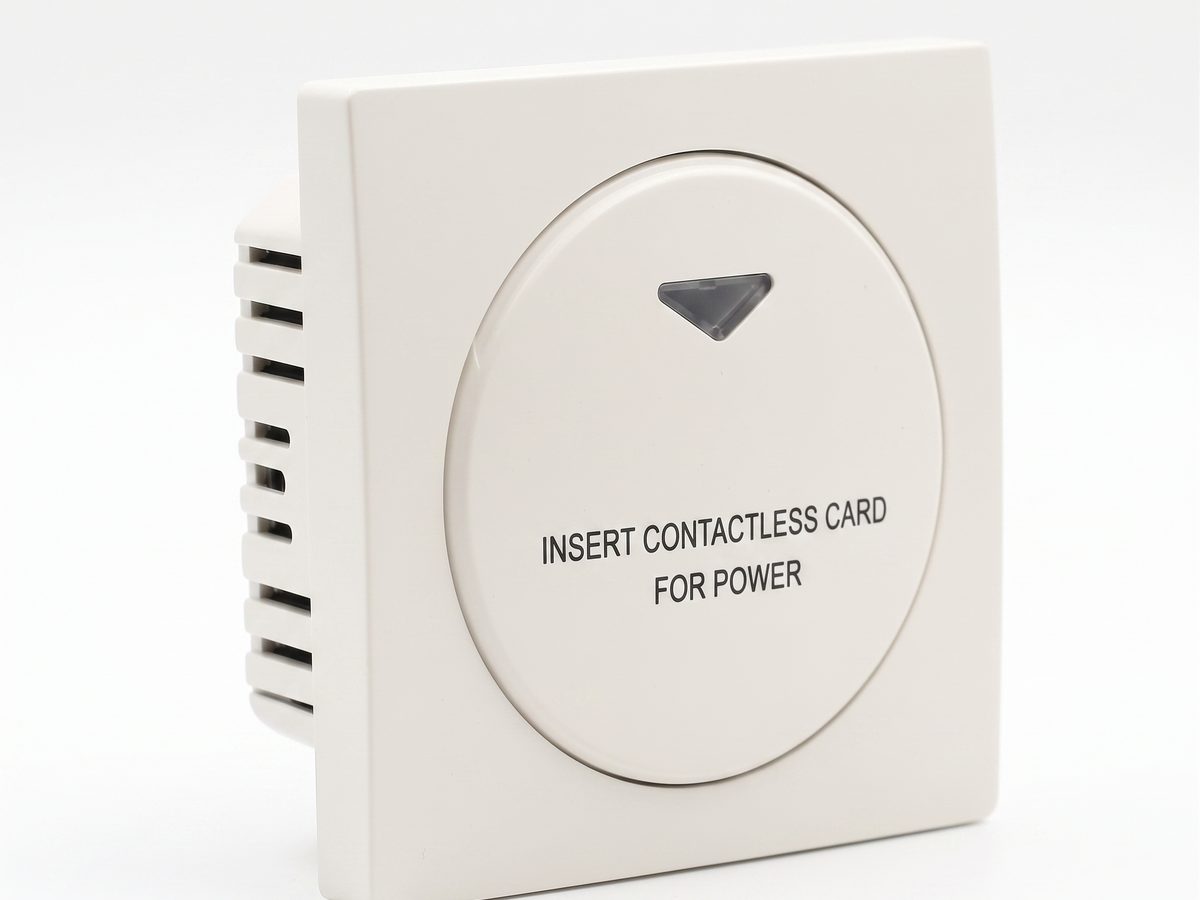
Interruptor de Tarjeta Hotel — Control Energía Habitación
Interruptor tarjeta hotel para control energía habitación. Detección RFID/IC, inserción-encendido, apagado retardado al retirar tarjeta. 220V CA, 10A-16A, RS485 o contacto seco. CE RoHS. Proveedor OEM/ODM.
Esta página ya lo señala como la siguiente referencia recomendada.
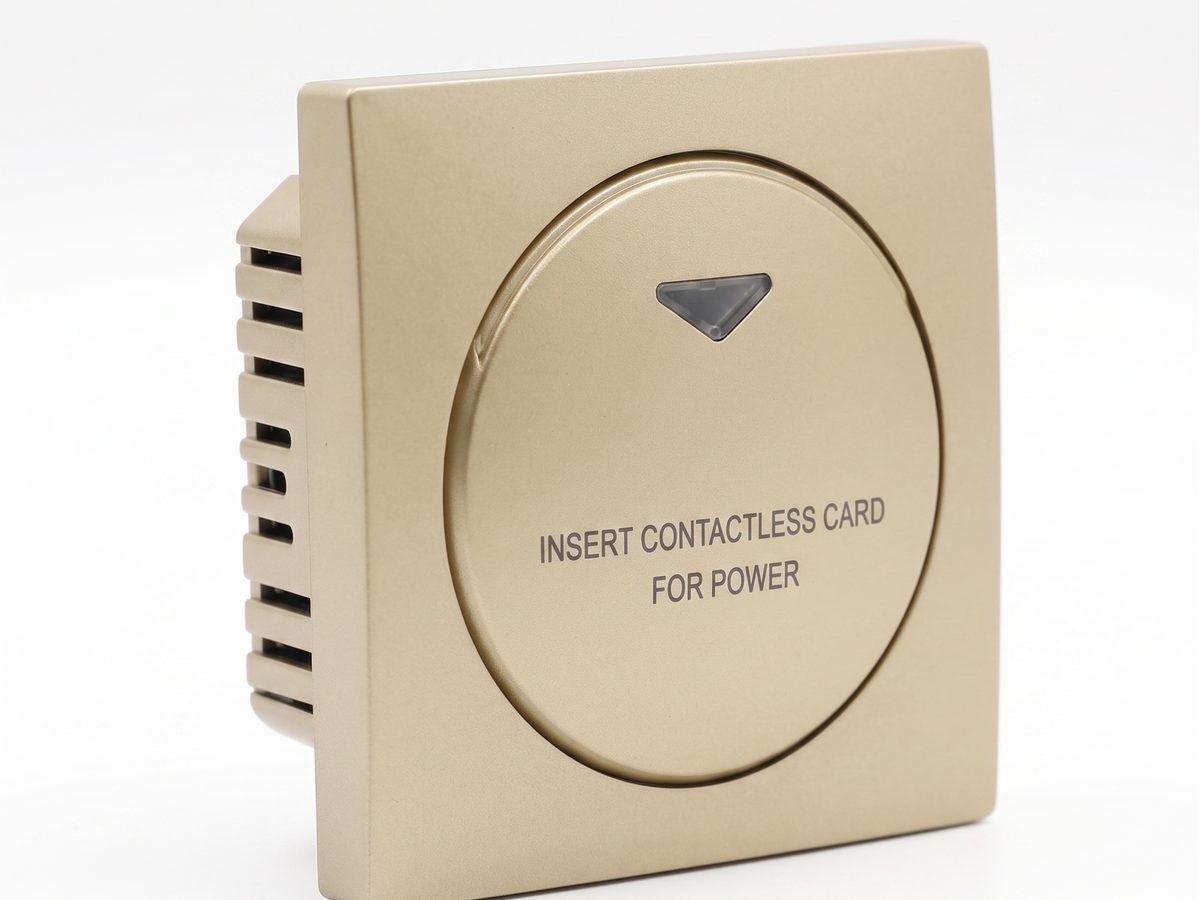
Interruptor Ahorro Energía Hotel — Control Potencia Tarjeta Huésped
Interruptor ahorro energía hotel que activa la habitación al insertar tarjeta y corta tras retardo al retirarla, sincronizado con HVAC para evitar gasto en habitaciones vacías. 220V CA, 10A-16A, RS485 o contacto seco. CE RoHS. Proveedor OEM/ODM.
Esta página ya lo señala como la siguiente referencia recomendada.
Soluciones relacionadas
3Sistema de Gestión de Habitaciones con Control por Tarjeta
Un sistema práctico de gestión de habitaciones para controlar la energía mediante interruptores de tarjeta, contactores y reglas operativas documentadas.
Respaldan el mismo contexto de producto: Interruptor de Tarjeta Hotel — Control Energía Habitación.
Ahorro energético hotelero con conmutación de energía en habitaciones
Solución de ahorro energético hotelero que usa conmutación de energía controlada por tarjeta para evitar que luces, aire acondicionado y enchufes seleccionados funcionen innecesariamente.
Respaldan el mismo contexto de producto: Interruptor de Tarjeta Hotel — Control Energía Habitación.
Control de Energía en Habitaciones con Interruptores de Tarjeta
Solución práctica de control de energía para iluminación, aire acondicionado y enchufes mediante tarjeta de habitación autorizada.
Respaldan el mismo contexto de producto: Interruptor de Tarjeta Hotel — Control Energía Habitación.
Artículos del blog relacionados
3
Interruptor de Tarjeta Hotel: Tipos, Modelos y Especificación
El interruptor de tarjeta para hotel incluye modelos universal, RFID, TTLOCK, BLE y ocupación. Guía sobre tipos, keycard switch y cómo especificar.
Respaldan el mismo contexto de producto: Interruptor de Tarjeta Hotel — Control Energía Habitación.
RFID vs NFC en interruptores de tarjeta llave de hotel: Qué elegir
RFID vs NFC en interruptores de tarjeta llave: alcance y bloqueo. RFID 125kHz/13.56MHz (MIFARE, Temic) es el estándar hotelero para energía en habitación…
Respaldan el mismo contexto de producto: Interruptor de Tarjeta Hotel — Control Energía Habitación.
Interruptor de tarjeta llave de hotel: qué es y ahorro de energía
Un interruptor de tarjeta llave de hotel enciende la habitación al insertar la tarjeta y apaga al sacarla, ahorrando típicamente un 25-40% de electricidad.
Respaldan el mismo contexto de producto: Interruptor de Tarjeta Hotel — Control Energía Habitación.
Especifica tu proyecto hotelero con nuestros ingenieros
Envíanos el número de habitaciones, tipo de techo y preferencia de protocolo. Devolveremos un plan de muestra y cotización en 24 horas laborables.
- Pase de la guía general a una discusión de producto o aplicación.
- Use RFQ cuando precio, planos, MOQ o calendario de lanzamiento necesiten estructura.
- Mantenga visible una ruta de contacto directo para aclaraciones rápidas y traspasos.