Key Card Switch vs Motion Sensor for Hotel Rooms: How to Choose
A practical comparison of key card switch vs motion sensor for hotel rooms, covering how each controls power, their energy-saving logic, response, false-trigger scenarios, costs, and when to combine both.
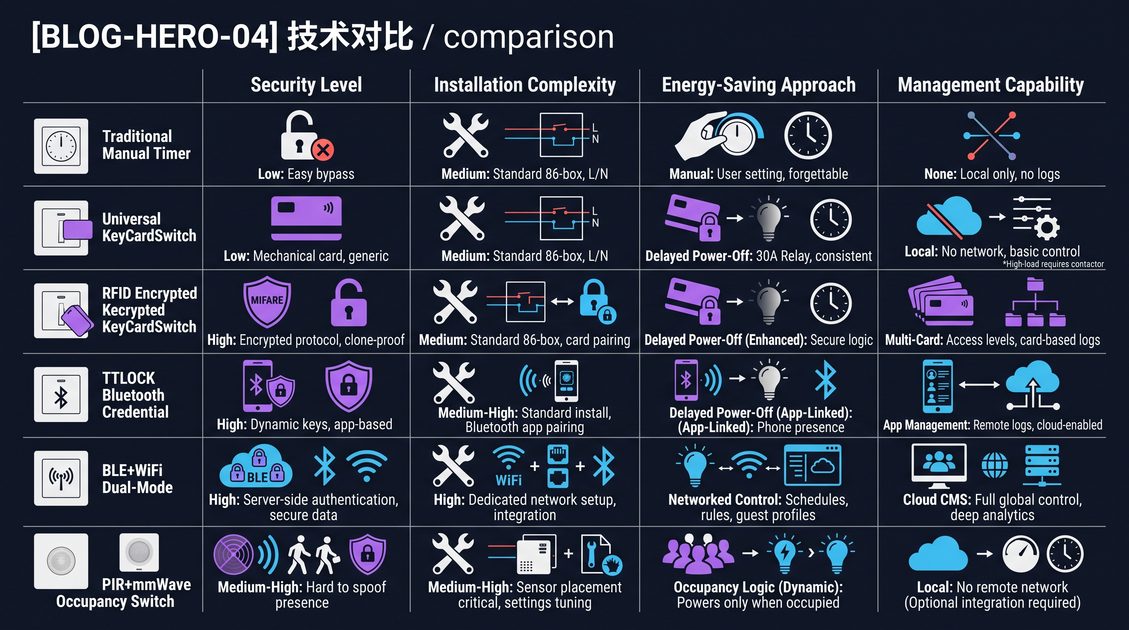
A key card switch vs motion sensor for hotel rooms is a decision every hotel owner, engineering consultant, and guest room automation integrator faces when designing occupancy-based power control. The key card switch is an insertion-door mechanism that cuts the hotel room power when the guest removes the card on leaving, while a motion sensor (most commonly a passive infrared or PIR motion detector) keeps the power on while it detects movement in the area and cuts it after a set delay when no motion is detected. The core difference is the occupancy signal: the key card switch relies on an explicit action of carrying the in-room card away, whereas the motion sensor infers presence from body heat and movement without requiring the guest to do anything. This affects response time, energy saving, false-trigger scenarios, install cost, and guest experience, so the right choice depends on your hotel's budget, wiring condition, and tolerance for accidental power cuts.
Understanding the key card switch vs motion sensor difference in hotel rooms
The key card switch vs motion sensor for hotel rooms comparison begins with what each device actually does to the guest room electrical circuit. A key card switch, sometimes called a card key power switch or a guest room energy-saving socket switch, is a mechanical or electronic relay mounted beside the room entrance. The guest inserts a key card, energy card, RFID card, or a simple plastic occupancy card into the slot, and the switch energizes the master power circuit for sockets, lights, the bathroom, and the air-conditioning terminal. When the guest leaves and pulls the card out, the switch immediately breaks the circuit after a short programmed delay, usually two to fifteen seconds, so the HVAC and lighting turn off automatically. The key card switch therefore treats the presence of the card as an explicit, deliberate signal that a person intends to occupy the room, which is why it is the traditional standard in chain and budget hotels across Asia, Europe, and the Middle East. Because the signal is binary and guest-initiated, the card switch is simple, inexpensive, and predictable in behavior.
A motion sensor, by contrast, is a passive device that watches the room for movement. The most common low-cost type is the PIR motion detector, which uses a pyroelectric sensor and a Fresnel lens to detect sudden changes in infrared radiation when a warm body, such as a guest, moves across its field of view. Some newer installations use microwave, dual-tech, or millimeter-wave occupancy sensors, but at the budget price point where a key card switch and a PIR detector compete, the PIR motion detector or a PIR-based occupancy sensor is the realistic alternative. The motion sensor keeps the room powered as long as it keeps seeing movement, and it cuts power after an adjustable time-out, usually two to thirty minutes, once the room goes still. The fundamental trade-off is that the card switch has clarity about occupancy but demands that the guest insert a card, while the motion sensor is invisible to the guest but can misread a perfectly still, occupied guest as an empty room.
From a decision standpoint, the key card switch vs motion sensor for hotel rooms question is rarely about which technology is objectively superior. It is about which occupancy signal best matches your hotel's guest behavior, electrical layout, and maintenance resources. The card switch fits a model where the hotel issues a card or a room key that acts as a power token. The motion sensor fits a model where the hotel wants zero guest involvement and is willing to accept a time-out delay and occasional false triggers. To make an informed choice you need to look at five dimensions: working principle, energy-saving logic, response time, false-trigger and missed-trigger scenarios, and total cost over the life of the room. The rest of this guide walks through each of these so that you can map the key card switch vs motion sensor decision to your specific property rather than relying on a generic recommendation.
How a key card switch vs motion sensor each works at the device level
The key card switch vs motion sensor for hotel rooms difference is clearest when you compare the physical components and the electrical interface each device uses. A typical key card switch is a compact panel that combines a card reader, a relay, a microprocessor or simple logic circuit, and a wiring terminal block. It is usually wired in series with the room's lighting and socket circuits, and it may carry an independent HVAC signal line or use the main power feed. When the card is inserted, the reader validates the card-that is, it detects the presence of a card or reads its RFID/magnetic data-and closes the relay so that power flows to the controlled loads. When the card is removed, the relay opens after a configurable delay. Most models consume under one watt in standby, which is negligible because the card switch only controls the loads it switches and does not itself run a sensing loop that draws current continuously. The card switch is a contactor-grade device designed to switch 220V to 240V AC circuits at ratings such as 10A to 30A, which is why it is also called an energy-saving relay socket.
A PIR motion sensor for a guest room works in a completely different way. It contains a pyroelectric detector chip divided into two sensing segments, a Fresnel lens that focuses infrared from a wide angle onto the chip, a small amount of signal-conditioning circuitry, and a relay or triac that switches the controlled load. The detector reacts to changes in infrared energy across its two segments; a moving warm body creates a differential signal that the circuit amplifies and turns into a trigger. Because PIR is passive, it consumes very little power, typically a few tens of milliwatts, and it can be battery-powered or hard-wired. It offers a wide detection area, commonly a 90 to 120 degree cone with a range of 5 to 12 meters on the axis, but it is blind to objects that are completely still and to movements that do not shift the infrared differential, such as a guest breathing under a cover on a sofa. Some occupancy sensors add dual-element or dual-technology designs and a small photodetector for daylight sensing, but the basic PIR principle stays the same.
| Dimension | Key card switch | PIR motion sensor (occupancy detector) |
|---|---|---|
| Occupancy signal | Explicit: guest inserts a card | Implicit: detects moving body heat |
| Guest action required | Yes, insert card on entry, take on exit | None |
| Detection method | Card reader + relay | Pyroelectric infrared + Fresnel lens |
| Typical range | Whole controlled circuit when card in | 90-120 degree cone, 5-12 meter axis range |
| Power to detect | None needed, card is the signal | Always on, standby in milliwatts |
| Controlled loads | Lights, sockets, HVAC via relay | Same loads via internal relay or triac |
| Failure mode | Power off if guest loses card | Power off if guest sits still too long |
When you compare the key card switch vs motion sensor at this level, the important engineering point is that both devices are simply relays that switch the same kind of load, but they get their "room occupied" signal from entirely different sources. The key card switch gets a deterministic signal from a card, so it never mistakes a still room for an occupied one as long as the card stays in. The motion sensor gets a probabilistic signal from the environment, so it must decide between cutting power and leaving it on based on a time-out, and that decision is where energy savings, guest comfort, and reliability all live. The motion sensor also has the advantage that it can be mounted on the ceiling or above the entrance to cover the whole space, whereas the card switch must sit at the door where the card is inserted, which constrains where the controlling relay can physically live.
Energy saving in the key card switch vs motion sensor for hotel rooms comparison
The key card switch vs motion sensor for hotel rooms energy comparison is where most purchasers place their attention, because guest rooms are a large share of a hotel's electricity bill and the HVAC is the dominant load. The logic of the key card switch is to guarantee that power is removed from sockets, lights, and especially the air-conditioning the moment the guest takes the card and closes the door. In hotels that use a card-as-token system, this approach produces a hard cut: there is no residual stretch during which a room heats or cools with the HVAC running at setpoint while empty. The main energy-saving weakness of the key card switch is that the guest may leave the card in the slot while spending hours out, for example leaving the room for breakfast or a meeting and taking no card, or forgetting to pull the card out at all. In those cases the room runs fully powered for an empty room, and the card switch cannot help because the explicit signal says occupied.
The motion sensor approaches the same goal with an occupancy time-out. The sensor keeps the HVAC and lights at normal power while it detects movement, then after a configurable delay of typically two to fifteen minutes with no motion it drops the loads, usually returning the HVAC to a setback mode or cutting it and switching the lights off. This captures the guest who leaves the card behind, but it introduces a different inefficiency: the time-out delay means every time the guest leaves the room, the room is powered for the full delay period whether it is two minutes or fifteen, and settled-for example a bathroom where a guest is showering without visible motion-when the sensor misses the person, the room can be powered down as an occupied one. An even larger problem for the motion-sensor-only hotel is the still guest: a guest watching television, working at a desk, or sleeping while a PIR detector sees no movement can trigger a power cut that the hotel then has to explain.
| Energy logic | Key card switch | PIR motion sensor |
|---|---|---|
| Cut condition | Card removed by guest | No motion for programmed delay |
| Cut speed | Near instant, seconds | Slow, delay of 2-15 minutes |
| Empty room with card left in | Room stays fully powered | Sensor cuts after delay |
| Guest still for a long while | Room stays powered | Risk of false cut |
| Guest moving behind obstacle | Room stays powered | Detector may or may not trigger |
| Standby draw | Under 1 watt | Milliwatts |
The honest answer in the key card switch vs motion sensor for hotel rooms energy discussion is that neither device is universally more efficient, and it is risky to quote a fixed percentage or a guaranteed saving for either one. Savings depend on room occupancy patterns, the HVAC controller's behavior in setback, the wiring topology, and guest habits. Rather than promising a percentage, the practical approach is to pick the device whose worst-case empty-room behavior you can live with. If your guests reliably carry a room card or an in-room card, the key card switch gives a cleaner, faster cut with near-zero standby loss and no sensing time-out. If your guests frequently leave without their card, the motion sensor closes that gap but adds a delay and a false-cut risk. Many operators therefore combine the two, using the card switch as the master and the motion sensor as a confirmation, or the reverse, which we cover later in this guide.
Detection reliability and false scenarios in the key card switch vs motion sensor comparison
Reliability is the dimension where key card switch vs motion sensor for hotel rooms decisions most often go wrong, because the two devices fail in opposite directions. The key card switch fails on the side of leaving power on: it never cuts power while a valid card is in the slot, so an occupied room is never accidentally darkened, but an empty room can run full power if the card was left inserted. Its failure is one of omission, not of false action. The guest is almost never harmed by the card switch, only the energy bill is. The main guest-facing annoyance with a card switch is on entry: a guest who overstays a fixed stay timer, returns an invalid or worn card, or carries a hotel card that no longer matches the reader, or arrives with a friend's card that the reader rejects, can find the room unpowered until the front desk issues a working card, which is a guest-service incident the hotel has to manage.
The motion sensor fails in the opposite direction, on the side of cutting power incorrectly. PIR motion detection is notoriously vulnerable to three false and missed scenarios. First, the still-and-occupied case: a guest reading, sleeping, or working without gross movement shows no differential signal, so the sensor times out and cuts the power to an occupied room, which is a serious comfort complaint. Second, the obstructed case: a partition, a bathroom door, or furniture can shadow part of the room, so a guest in a shower or behind a screen stays invisible to the detector. Third, the ambient-noise case is rare for PIR because it is heat-based, but some false triggers can come from a heater blast, a curtain moving near a window, or a pet or an appliance such as a fan, which makes the sensor keep a room powered longer than the guest intends. These failure modes are why a naked PIR motion detector is rarely trusted on its own for full room power control in higher-grade hotels, unless it is carefully placed and tuned.
| False or missed scenario | Key card switch | PIR motion sensor |
|---|---|---|
| Occupied but still guest | No power cut, safe | LIKELY cuts power after delay |
| Empty but card left in slot | Room stays powered, wasted energy | Sensor sees no motion and cuts |
| Guest in shower or behind door | No power cut, safe | Missed, room darkened |
| Entry with invalid or worn card | Room unpowered until new card | No door issue, always powers on motion |
| Curtain, heater, or pet noise | No effect | Possible false keep-on |
| Guest leaves without a card | Wasted energy | Normal cut after delay |
For the property owner, the key card switch vs motion sensor for hotel rooms reliability picture comes down to what you cannot tolerate. If you cannot tolerate ever darkening an occupied guest room, the card switch is the safer master because its only failure is waste. If you cannot tolerate an empty room wasting HVAC energy when a card is left in the slot, the motion sensor is your only option on its own, and you must plan for its still-guest false cuts by choosing the right time-out, sensor placement, and possibly a dual-technology element. The final section of this article shows a practical hybrid wiring that lets you get the deterministic cut of the card switch and the empty-room catch of the motion sensor at the same time, which is how most experienced hotel HVAC and automation engineers resolve the reliability dilemma rather than picking one device to do everything.
Applicable scenarios: when to choose key card switch vs motion sensor
The key card switch vs motion sensor for hotel rooms suitability depends heavily on the hotel segment, the room type, and the guest profile, because the two devices suit different levels of control confidence and tolerances for guest annoyance. The key card switch is the natural fit for economy and chain hotels, city business hotels, and properties where guests are expected to carry a room card or an in-room key card, and where a clear on-off behavior is valued over sensor intelligence. It is also the right choice for budget-conscious owners who want a low first cost, a simple three-wire or four-wire installation at the entrance, and no need to place and tune sensors across each room. Because the card switch gives a near-instant cut and a hard guarantee that an empty room, behind a closed door with the card removed, is not wasting power, it remains the default in thousands of rooms across Asia and the Gulf where staffing is thin and guest turnover is high.
The motion sensor is better suited to higher-service properties, extended-stay hotels, serviced apartments, and wellness or resort rooms where the guest should never have to touch a card to get power, and where comfort outweighs a strict instant cut. It is also the right fit when the hotel has already invested in ceiling wiring, when guest rooms have suites or bathrooms behind partitions that are hard to cover with a door switch, or when the property wants to add occupancy awareness beyond simple on-off power, such as alerting housekeeping that a room appears occupied. For very long occupancy in serviced apartments, the hidden advantage of the motion sensor is that it leaves the room powered while the resident moves and cuts only after true absence, so a desk worker or an overnight stay is not interrupted, provided the sensor is specified with a long enough time-out to cover quiet work.
| Suitability factor | Key card switch | PIR motion sensor |
|---|---|---|
| Best hotel segment | Economy, chain, city business | Extended-stay, resort, serviced apartment |
| Guest expectation | Insert a card to get power | Touch nothing, room just works |
| Install cost and wiring | Low, at door, few wires | Slightly higher, ceiling or wall placement and tuning |
| Guest who works long, still | No false cut | Needs long time-out to avoid false cut |
| Empty-room catch when card left | Weak | Strong |
| Housekeeping skill needed | Minimal | More placement and tuning care |
When you are choosing between key card switch vs motion sensor for a specific hotel, work through a short checklist: who is the guest, will they reliably carry a room card, does the room have partitions or a separate bathroom that a single sensor has to cover, can you tolerate a false power cut on an occupied guest, and who pays the energy bill for rooms left powered with the card in the slot. If the guest is a leisure traveler who carries no card and the room is a suite with several zones, the motion sensor wins. If the guest is a short-stay business traveler with a room card and the owner wants a low-cost, near-instant cut, the key card switch wins. In many properties the answer is not one or the other, and the combination is described in the next section, but the scenario mapping here gives you a defensible starting point rather than a blind guess.
Cost, installation, and maintenance in the key card switch vs motion sensor decision
Budget drives most of the key card switch vs motion sensor for hotel rooms conversation, so let us separate first cost, installation effort, running cost, and maintenance across the two devices. On first cost, a basic key card switch is typically the lower-priced item, often a compact plastic panel with a card slot, an energy card, a relay, and a small LCD or LED, aimed at volume hotel fit-out. Because it is a simple and mature product sold in large quantities for Asian and Middle-Eastern hotel projects, its unit price is competitive and predictable. Installation is straightforward: the switch sits beside the entry door, and an electrician connects the mains feed, the load wires for sockets and lights, and usually an HVAC control wire, so the labor is limited to one mounting point per room. The main trap is a single-door design that demands clean three-wire or four-wire topology and a rated current that matches your socket and HVAC loads, so an underrated or incorrectly wired device can overheat or trip.
A PIR motion sensor is usually comparable or slightly higher in first cost at the budget tier, but the hidden cost is in planning and tuning. The sensor must be placed where its 90 to 120 degree cone covers the main activity zone, often on the ceiling near the center of the room or on the wall above the door, and the installer must choose a time-out and sensitivity setting suitable for the room. Because a hotel room has beds, a bathroom, and furniture that can shadow zones, a single detector frequently cannot cover a suite, so multiple detectors or a dual-technology unit are required, which raises both hardware and wiring cost. Running cost is low for both, since the card switch draws under a watt in standby and the PIR draws milliwatts, but maintenance differs: the card switch is a wear item whose slot and switch contacts see mechanical use and may need replacement after heavy years of insert-and-pull cycles, whereas the sensor has no moving card mechanism but can need sensitivity re-tuning or a cleaned lens if false trips or missed trips appear.
| Cost area | Key card switch | PIR motion sensor |
|---|---|---|
| Unit first cost | Lower at volume | Comparable or slightly higher |
| Wiring labor per room | One point at door | One or more points, ceiling or wall |
| Number of units per suite | One per room door | Possibly several to cover zones |
| Standby running cost | Under 1 watt | Milliwatts |
| Long-term wear | Slot and contacts wear | No mechanism, but lens and tuning care |
| Typical failure | Contact or card-reader wear | False or missed triggers needing retune |
The long-term cost picture in the key card switch vs motion sensor for hotel rooms comparison is rarely decisive on hardware alone, because both devices are inexpensive relative to the wiring and the HVAC they switch. What matters more is the total cost of operation, which includes the labor to service guest complaints about a darkened room, the energy lost to a card left in the slot, and the tuning time to make a sensor behave in an awkward suite. A property that picks a cheap device but cannot afford the tuning or the guest-service time may spend more in the end. The practical recommendation is to cost the card switch and the motion sensor not as components but as systems, including installation points, sensor placement planning, and the likely number of support calls per month, and to pick the option whose failure profile you have the staff to absorb.
Combining the key card switch vs motion sensor for hybrid hotel room control
The most mature answer to the key card switch vs motion sensor for hotel rooms question is not to choose one but to combine them, because the two devices fail in opposite directions and a hybrid uses each to cover the other's weakness. The most common and reliable hybrid is the card-switch-primary configuration, where the key card switch is the master contactor that switches the main power, and one or more PIR occupancy sensors act as a guard. In this scheme, the card switch guarantees an instant, deterministic cut when the guest removes the card, so an empty room behind a closed door is never left running, and the motion sensors handle the case where the guest walks out and leaves the card in the slot or where the guest is present but still, giving the hotel both the hard cut and the empty-room catch without trusting either device alone.
There are two practical wiring patterns for the hybrid. In the first, the card switch and the motion sensor are wired in series, meaning power is available only when the card is inserted and the sensor confirms activity; this is strict but can darken a still guest, so it is less common. In the second, the card switch is the master and the sensor takes over, meaning that when the card is removed the sensor keeps the room powered for a grace period as long as it still detects movement, then cuts; and when the card stays in but the room is empty, the sensor can still return the HVAC to setback or notify housekeeping, though the master card switch cannot be pre-empted if you want a strict cut. Which pattern fits depends on whether you want the card or the sensor to hold the final veto, which is a policy decision your operations team should make before you wire a row of rooms.
| Hybrid pattern | How it works | Best for |
|---|---|---|
| Card master, sensor guard | Card cuts fast; sensor catches card-left-in cases | Economy rooms where strict cut is prized |
| Sensor master, card assist | Sensor controls; card enables or overrides | Extended-stay and quiet-guest comfort |
| Series card and sensor | Power only if both card and motion agree | Ultra-energy-sensitive fit-outs |
| Card master, sensor setback | Card cuts loads; sensor only sets HVAC to setback | Properties that want HVAC setback not full cut |
The key principle for a hybrid in the key card switch vs motion sensor for hotel rooms design is to decide which device holds the safety-critical decision, that is, which one is allowed to darken an occupied room and which one merely wastes energy when it errs. Because the motion sensor is the only one of the two that can cut power to an occupied still guest, you normally want the sensor's decision to be advisory rather than fatal, by pairing it with a card switch master or by programming it only to set the HVAC to a comfort setback rather than to switch the sockets and lights off completely. That way the sensor's still-guest false cut becomes a mild setback rather than a dark room, and the card switch's waste case is closed because the sensor still reports the absence. This hybrid is what most hotel automation contractors recommend, and it is often the configuration that delivers the best balance of comfort, energy performance, and guest satisfaction.
A selection framework for the key card switch vs motion sensor decision
The final step for any thorough decision about the key card switch vs motion sensor for hotel rooms is to turn the comparison into a scoring framework that matches your property's priorities. Because no single device wins on every axis, the correct method is to assign relative weights to the factors that matter to your operation, then test the two devices against those weights before committing a batch of rooms. The factors to weight are: determinism of the occupancy signal, energy captured when the room is actually empty, guest comfort and tolerance of annoyance, first cost and wiring labor, long-term maintenance, and how much you trust your guests to carry a card. A property that gives high weight to determinism and low first cost, and that trusts its card habit, will score the key card switch higher. A property that gives high weight to guest freedom and quiet-room comfort, and that can absorb sensor tuning, will score the PIR motion sensor higher.
| Priority | If this matters most | Lean toward |
|---|---|---|
| Instant, reliable cut on exit | Card habit reliable | Key card switch master |
| No guest card friction at all | Leisure or resort guests | PIR motion sensor |
| Never darken a still guest | Higher comfort grade | Need long time-out or hybrid veto |
| Capture energy on card-left cases | Housekeeping thin | Sensor cap or hybrid |
| Lowest first cost and wiring | Budget fit-out | Key card switch |
| Zero sensing time-out waste | Energy-first operation | Key card switch with strict cut |
The right way to use this framework is to run a small pilot before a full rollout. Wire a few adjacent rooms, one set with a key card switch only, one set with a PIR motion sensor only, and, if your budget allows, one set with the hybrid guard, and measure guest complaints, energy use, and maintenance calls over a month. Because actual room occupancy behavior, wiring, and guest habits vary from property to property, a measured pilot overrides any theoretical recommendation. This is the practical closing point of the key card switch vs motion sensor for hotel rooms guide: both devices are proven and inexpensive, neither is universally dominant, and the professional answer on most hotel projects is either a tuned key card switch for cost-sensitive standard rooms or a card-sensor hybrid for higher-grade rooms where comfort and energy control both matter.
Conclusion: the key card switch vs motion sensor choice for your hotel
Whenever you sit down to settle the key card switch vs motion sensor for hotel rooms question, the takeaway should be that you are choosing an occupancy signal and a failure trade-off, not simply a piece of hardware. The key card switch trades on an explicit card signal that gives you a fast, deterministic power cut but leaves energy on the table when a card is left in the slot. The PIR motion sensor trades on an inferred presence signal that catches an empty room without any guest involvement but can darken a still or obstructed guest and adds a time-out delay. Neither device is wrong, and both are cheap and mature enough to deploy across hundreds of rooms, which is exactly why the decision should be driven by your guest profile and your tolerance for each failure direction rather than by brand preference or a single price quote.
Our practical recommendation for most hotel projects is to let the card switch be the master for standard rooms and to add PIR occupancy sensing as a guard in higher-grade rooms where comfort weighs heavier. That hybrid configuration captures the instant cut you want on a clean exit, closes the card-left-in waste case, and gives the still guest a setback instead of a darkened room. Refine everything with a short pilot across a handful of rooms, and scale only the configuration that survives the pilot on guest complaints, energy, and maintenance. If you are evaluating switch hardware for your next fit-out, our hotel key card switch, energy-saving key card switch, and wireless key card switch are designed to drop into standard in-room wiring, and our engineering team can help you design the specific card-sensor hybrid that fits your floor plan.
A final commissioning review should record the delay setting, the sensor timeout, the circuits under control, and the guest-service response when a card is removed. This record gives the maintenance team a clear reference when room furniture changes or a new air-conditioning controller is installed. It also lets the operator compare the key card switch vs motion sensor for hotel rooms decision against real complaints and measured runtime instead of relying only on a supplier brochure. Small, documented adjustments to timeout and circuit grouping often improve the result without replacing installed hardware.
Part of this article content is generated by AI and optimized for professional accuracy and readability.
Not sure which sensor fits your project?
Talk to our mmWave application engineers for a free consultation.
Find the right presence sensor for your hotel project
Compare the 3 protocols, check hotel-specific case studies, and download the installation guide
Related products
3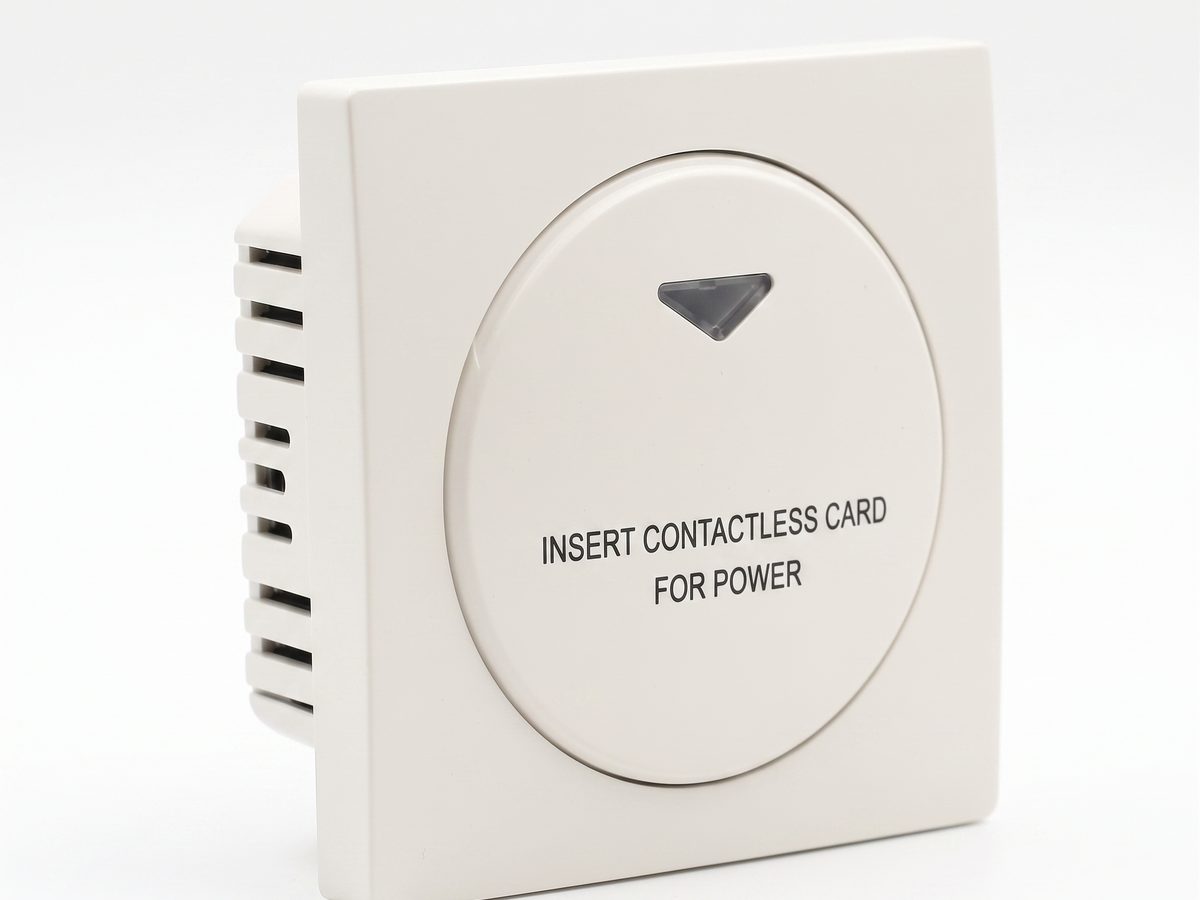
Hotel Key Card Switch — Guest Room Power Control
Hotel key card switch for guest room power control. RFID/IC card detection, insert-and-power, card removal time-delay power-off. 220V AC, 10A-16A, RS485 or dry contact. CE RoHS. OEM/ODM supplier.
This page already points to it as the next recommended reference.
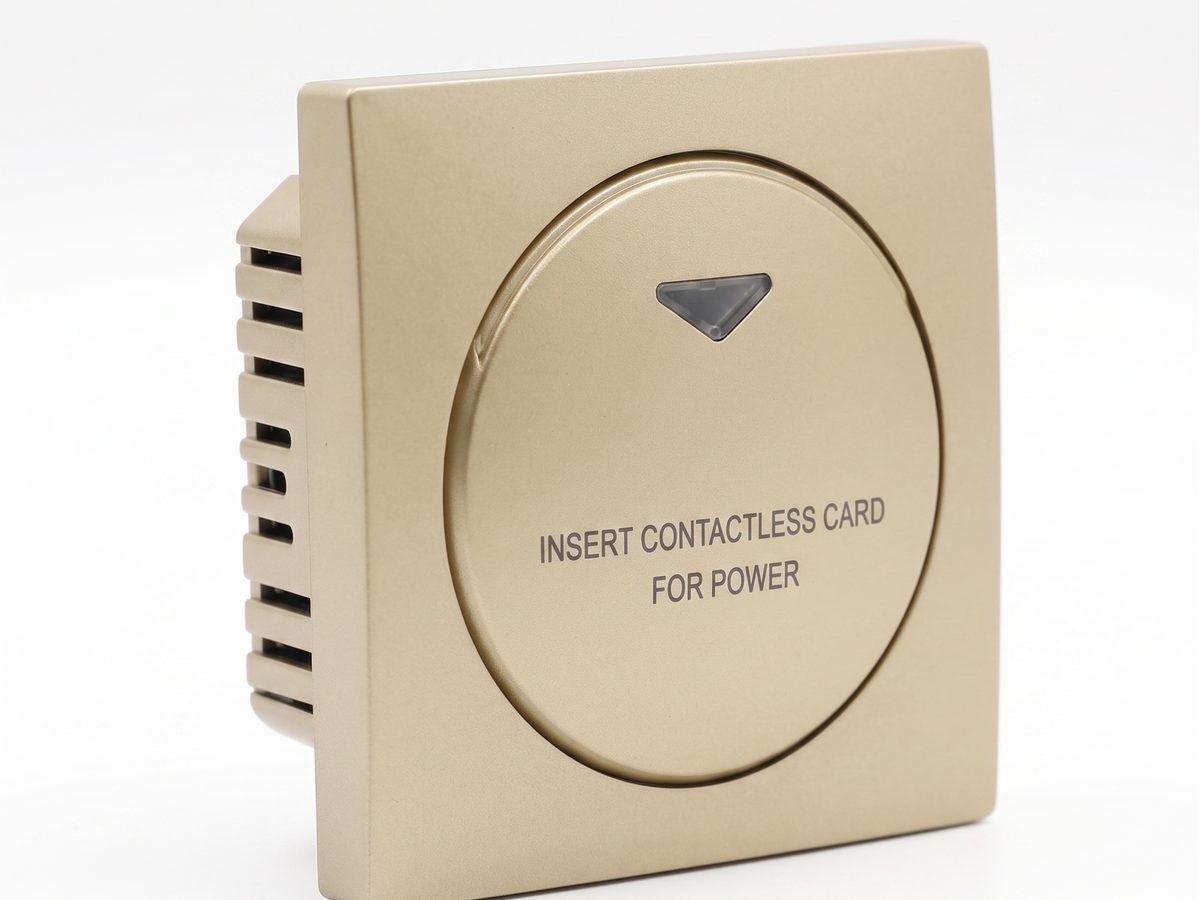
Hotel Energy Saving Switch — Insert-Card Guest Room Power Control
Hotel energy saving switch that powers a room on card insertion and cuts power after a card-removal delay, pairing with HVAC to stop empty-room waste. 220V AC, 10A-16A, RS485 or dry contact. CE RoHS. OEM/ODM supplier.
This page already points to it as the next recommended reference.
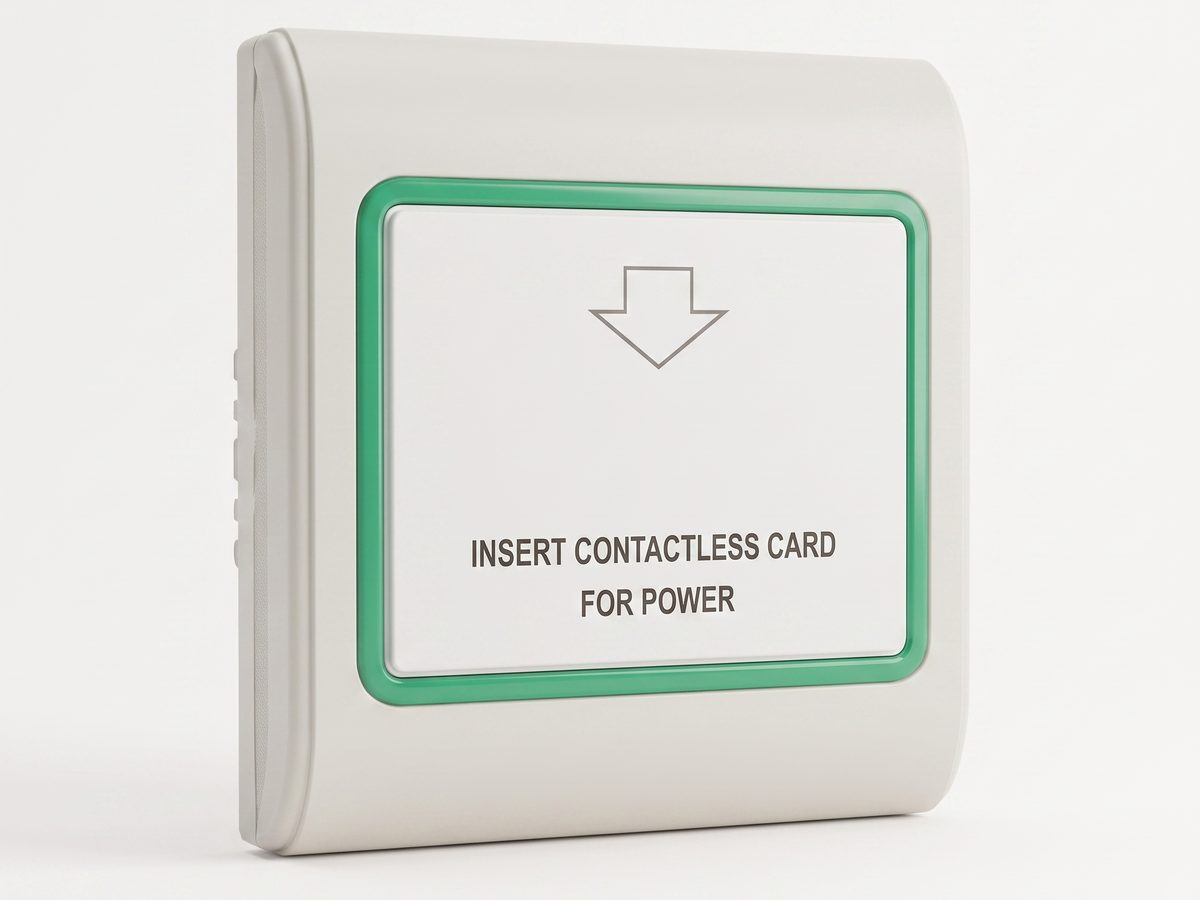
Wireless Key Card Switch — Battery or Bus Power for Retrofitting Hotels
Wireless hotel key card switch for retrofit projects. Low-frequency wake-up or RS485 wireless option, battery-powered option to avoid rewiring, room power control without new cable runs. CE RoHS. OEM/ODM supplier.
This page already points to it as the next recommended reference.
Related solutions
3Guest Room Management System Based on Card-Controlled Power
A practical guest-room management system for controlling room power through key card switches, contactors, and clearly documented operating rules.
It supports the same product context: Hotel Key Card Switch — Guest Room Power Control.
Hotel Energy Saving with Guest-Room Power Switching
A hotel energy-saving solution that uses card-controlled room power to prevent lights, air conditioning, and selected outlets from running unnecessarily.
It supports the same product context: Hotel Key Card Switch — Guest Room Power Control.
Hotel Room Power Control with Key Card Switches
A practical hotel room power control solution for switching guest-room lighting, air conditioning, and outlets from an authorized room card.
It supports the same product context: Hotel Key Card Switch — Guest Room Power Control.
Related blog posts
3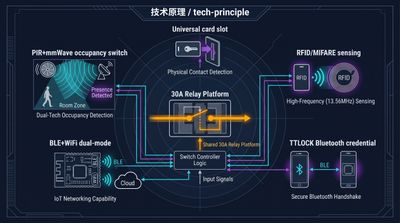
Hotel Key Card Switch: Types, Models, and How to Specify
A hotel key card switch spans universal, RFID, TTLOCK, BLE, and occupancy models. This guide to the key card / keycard switch family covers the head terms —…
It supports the same product context: Hotel Key Card Switch — Guest Room Power Control.
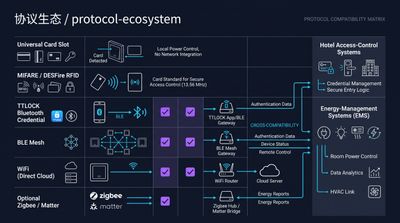
RFID vs NFC for Hotel Key Card Switches: Which Card Tech to Choose
RFID vs NFC for hotel key card switches comes down to range and lock-in: 125kHz / 13.56MHz RFID (MIFARE, Temic) is the hotel standard for room-bound power…
It supports the same product context: Hotel Key Card Switch — Guest Room Power Control.
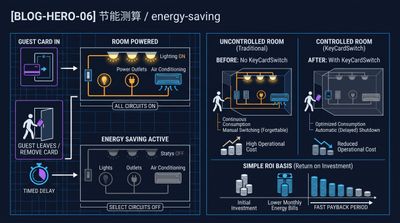
What Is a Hotel Key Card Switch and How It Saves Room Energy
A hotel key card switch is a wall device that powers a guest room when a card is inserted and cuts it when removed, typically saving 25–40% of room…
It supports the same product context: Hotel Key Card Switch — Guest Room Power Control.
Specify your hotel project with our engineers
Send your room count, ceiling type, and protocol preference. We will return a sample plan and quote within 24 business hours.
- Move from general guidance into a product or application discussion.
- Use RFQ when pricing, drawings, MOQ, or launch timing needs structure.
- Keep a direct contact path visible for fast clarifications and handoff.