Hotel Key Card Switch 220V Wiring: Installer Guide for 180–250V Rooms
A hotel key card switch 220V wiring guide covering the flush 86×86 panel, 30A room-circuit relay, and 15-second delay-off. Learn how to install a key card…
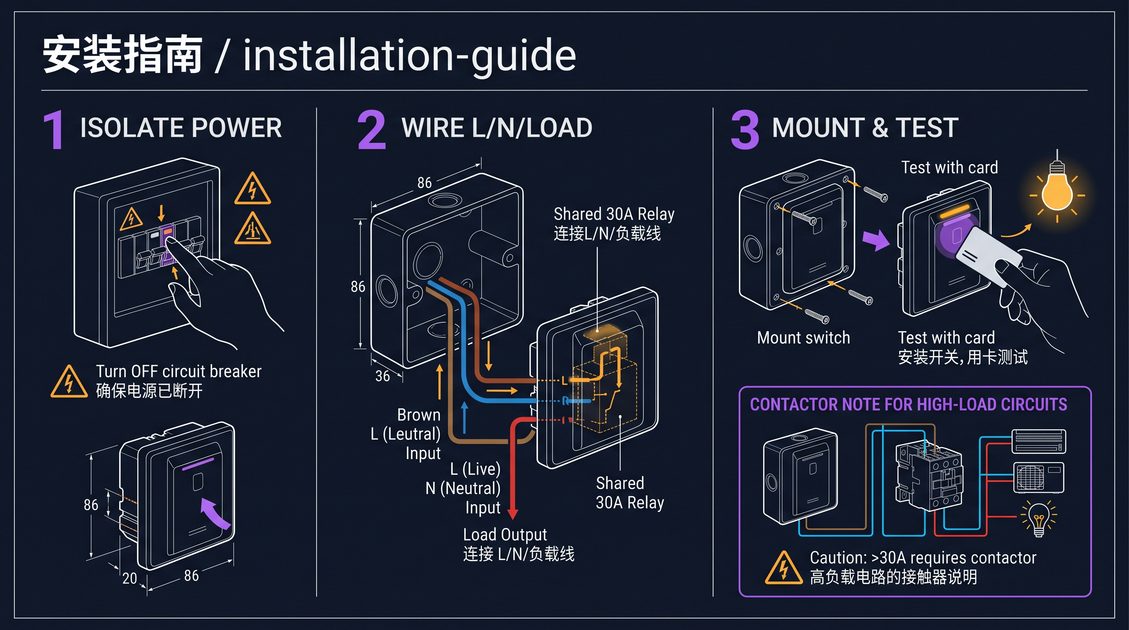
A hotel key card switch 220V unit is wired between the room's incoming line and a 30A relay that carries the full guest-room load — lights, air conditioning, and sockets — so inserting a valid card energizes the relay and removing it opens the circuit after a 15-second delay. A hotel key card switch 220V model accepts AC 180–250V input (110V available on request) and fits a standard flush 86×86×48mm single-gang box, which means a retrofit installer swaps the plate and connects the relay loop without pulling new cable. The device itself needs no neutral at the switch for basic operation on most designs, because the reader and relay coil draw from the line side. A hotel key card switch 220V install is therefore a minutes-long job per room, not a rewiring project, which is why properties retrofit hundreds of rooms without closing them.
Hotel Key Card Switch 220V: What the Wiring Connects
The wiring of a hotel key card switch 220V centers on three terminals: line-in, load-out to the 30A relay coil drive, and the relay's switched contacts that sit in the room's power feed. The switch reads the card and drives the relay; the relay — not the switch — actually carries the 30A room current. This separation matters because the flush panel stays low-current and cool, while the relay (usually mounted at the distribution board or behind the panel) handles the load. A hotel key card switch 220V thus needs the installer to route the room's live through the relay contacts and bring only a control pair to the plate. Confirm whether your model uses a built-in relay (simplest) or an external 30A relay (needed above the switch's rating) before ordering.
Step-by-Step Install of a Key Card Power Switch
Installing a key card power switch follows a fixed sequence. First, cut the room's live feed at the distribution point and land it on the 30A relay's common and normally-open contacts. Second, run the relay's coil control pair to the flush box. Third, mount the 86×86×48mm panel, connect line-in and the control pair, and secure it 29mm into the wall. Fourth, insert a test card and verify the relay closes within one second and the room powers up. Fifth, pull the card and confirm the 15-second delay-off before the circuit opens. A key card power switch install should always end with a load test on a dummy lamp, never on a live guest room on first try. Label the relay clearly so housekeeping and maintenance can trace which room it serves.
110V vs 220V Key Card Power Switch
A 220V key card power switch and its 110V sibling share the same panel and relay logic; only the input stage and any internal power supply differ. Properties in 110V regions (North America, parts of Japan) should request the 110V variant at order time rather than field-modifying a 220V unit. The 30A relay rating is unchanged, so a 110V model still switches the full room load. When specifying, state the local voltage, the panel finish (white, silver, or custom), and whether you need an external relay. A hotel key card switch 220V or 110V both retrofit into the same single-gang box, so the decision is purely electrical, not mechanical. See the hotel energy saving switch buying guide for the model table and relay specs.
Not sure which sensor fits your project?
Talk to our mmWave application engineers for a free consultation.
Find the right presence sensor for your hotel project
Compare the 3 protocols, check hotel-specific case studies, and download the installation guide
Related products
3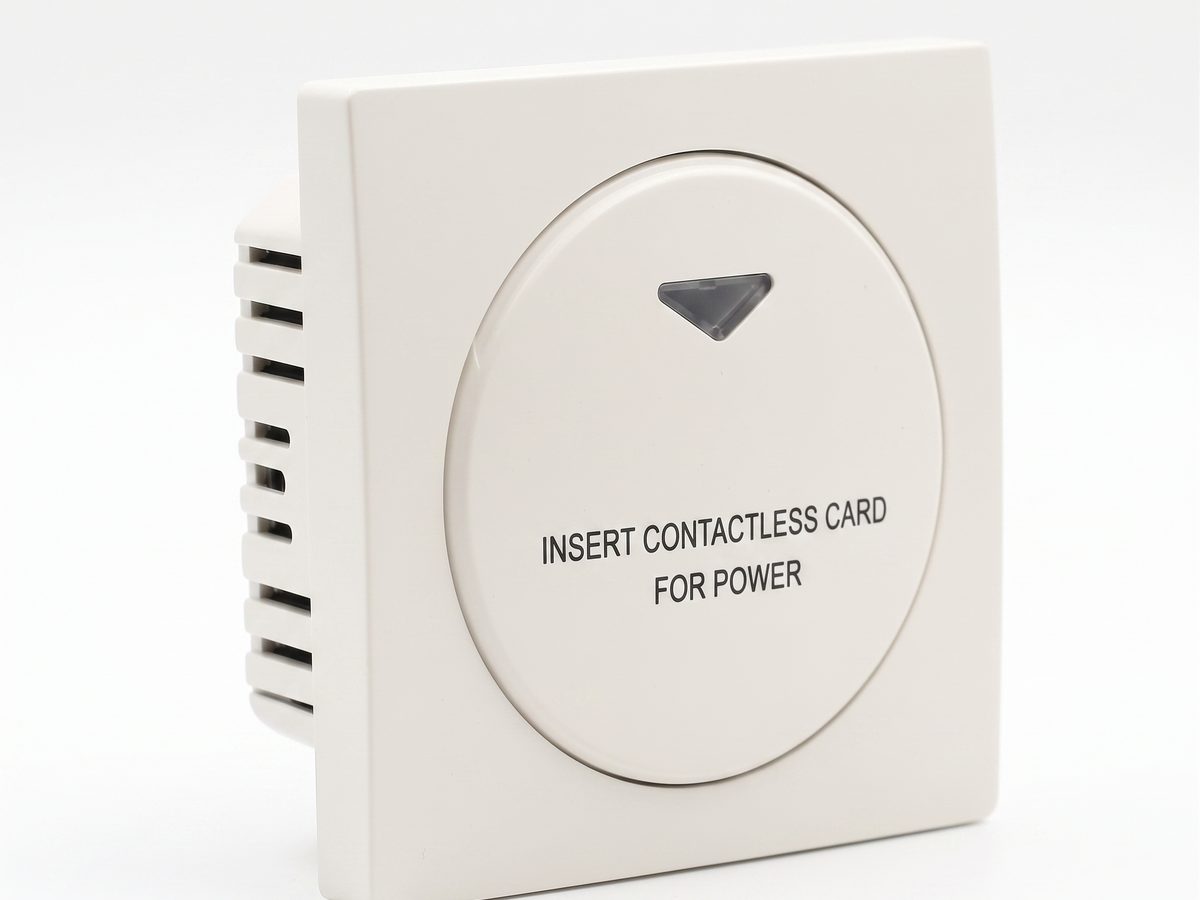
Hotel Key Card Switch — Guest Room Power Control
Hotel key card switch for guest room power control. RFID/IC card detection, insert-and-power, card removal time-delay power-off. 220V AC, 10A-16A, RS485 or dry contact. CE RoHS. OEM/ODM supplier.
This page already points to it as the next recommended reference.
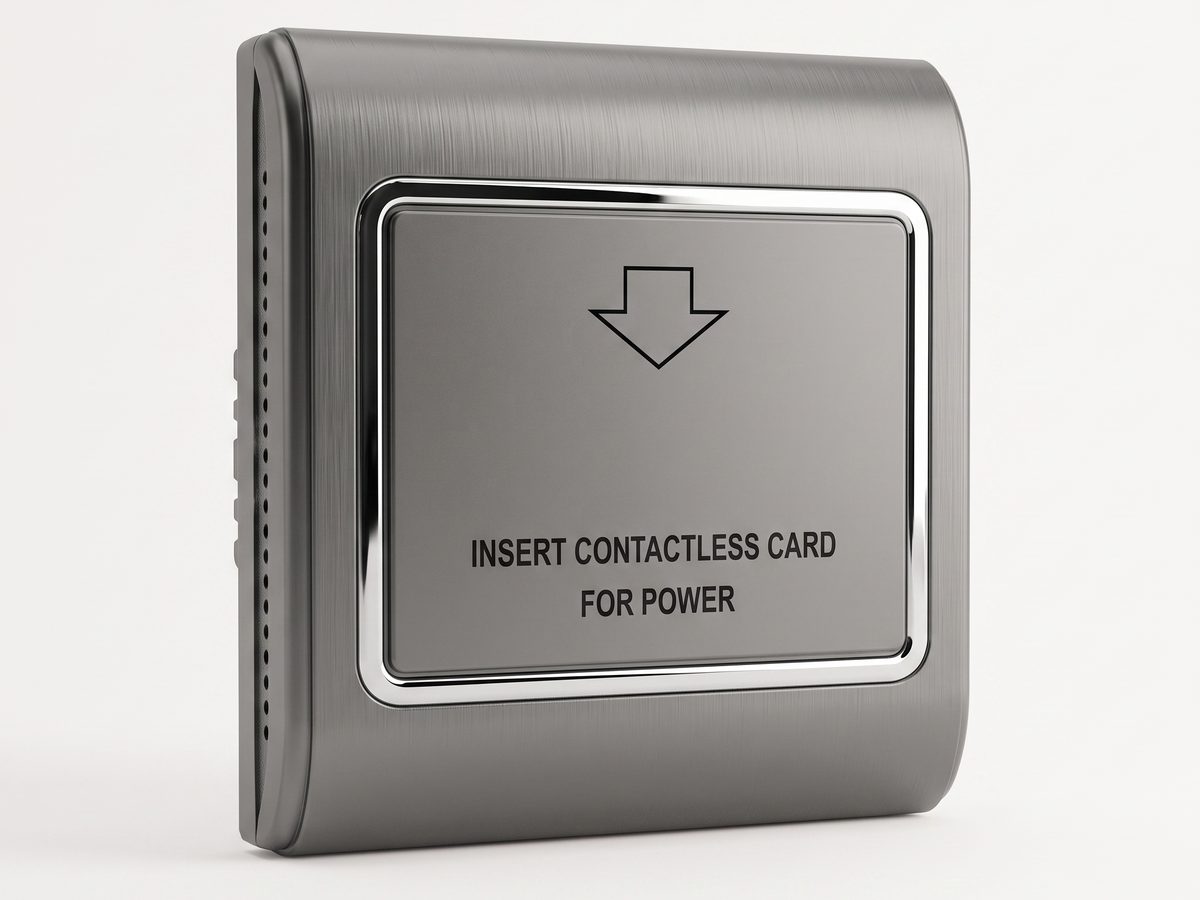
RFID Energy Saving Switch — Room-Bound MIFARE Card Switch (Type B)
RFID energy saving switch that binds power to a specific room MIFARE card. 13.56MHz MIFARE / 125kHz Temic, AC 180–250V, 30A, 15s delay-off. An RFID hotel switch that stops card-sharing between rooms and cuts 25–40% room energy.
This page already points to it as the next recommended reference.
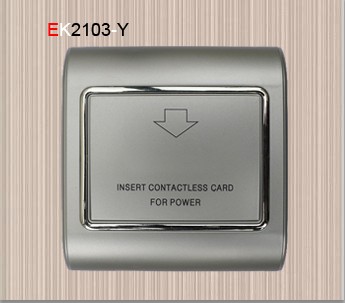
TTLOCK Compatible Energy Switch — Room-Bound + Time-Limited (Type C)
TTLOCK compatible energy switch with room ID and time limit. Works with TTLOCK / TTHotel MIFARE cards via sector-key auth, AC 180–250V, 30A. An encrypted keycard switch and TTLOCK ES2 energy switch for ecosystem-locked hotel retrofits.
This page already points to it as the next recommended reference.
Related solutions
3 Hotel Energy Saving Switch Buying Guide 2026
A hotel energy saving switch buying guide covering universal card, RFID/MIFARE, TTLOCK compatible, BLE smart, and occupancy sensor switches. Pick the right key card power switch, card insert power switch, and energy saving key switch for your rooms.
This page already points to it as the next recommended reference.
Hotel Energy Management System — Room Power Control That Pays Back
A hotel energy management system built on key card switches, RFID energy savers, and occupancy sensors that cuts 25–40% of guest-room electricity. Guest room energy controller guidance for hotels retrofitting room power.
This page already points to it as the next recommended reference.
Guest Room Management System Based on Card-Controlled Power
A practical guest-room management system for controlling room power through key card switches, contactors, and clearly documented operating rules.
It supports the same product context: Hotel Key Card Switch — Guest Room Power Control, RFID Energy Saving Switch — Room-Bound MIFARE Card Switch (Type B).
Related blog posts
3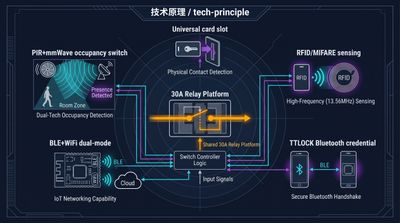
Hotel Key Card Switch: Types, Models, and How to Specify
A hotel key card switch spans universal, RFID, TTLOCK, BLE, and occupancy models. This guide to the key card / keycard switch family covers the head terms —…
It supports the same product context: Hotel Key Card Switch — Guest Room Power Control, RFID Energy Saving Switch — Room-Bound MIFARE Card Switch (Type B), TTLOCK Compatible Energy Switch — Room-Bound + Time-Limited (Type C).
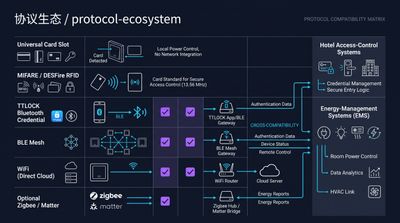
RFID vs NFC for Hotel Key Card Switches: Which Card Tech to Choose
RFID vs NFC for hotel key card switches comes down to range and lock-in: 125kHz / 13.56MHz RFID (MIFARE, Temic) is the hotel standard for room-bound power…
It supports the same product context: RFID Energy Saving Switch — Room-Bound MIFARE Card Switch (Type B), Hotel Key Card Switch — Guest Room Power Control, TTLOCK Compatible Energy Switch — Room-Bound + Time-Limited (Type C).
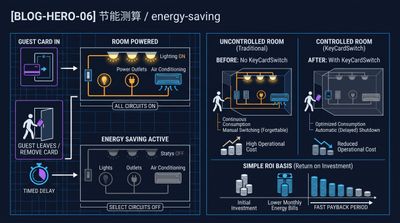
What Is a Hotel Key Card Switch and How It Saves Room Energy
A hotel key card switch is a wall device that powers a guest room when a card is inserted and cuts it when removed, typically saving 25–40% of room…
It supports the same product context: Hotel Key Card Switch — Guest Room Power Control, RFID Energy Saving Switch — Room-Bound MIFARE Card Switch (Type B), TTLOCK Compatible Energy Switch — Room-Bound + Time-Limited (Type C).
Specify your hotel project with our engineers
Send your room count, ceiling type, and protocol preference. We will return a sample plan and quote within 24 business hours.
- Move from general guidance into a product or application discussion.
- Use RFQ when pricing, drawings, MOQ, or launch timing needs structure.
- Keep a direct contact path visible for fast clarifications and handoff.