مفتاح بطاقة المفتاح مقابل مستشعر الحضور بالموجات المليمترية للفنادق: أيهما يوفر طاقة أكثر
قارن بين مفتاح بطاقة المفتاح ومستشعر الحضور بالموجات المليمترية للفنادق من حيث منطق التحكم، التكلفة، التركيب، دقة الإشغال، وتصميم احتياطي عملي يجمع البطاقة والرادار.
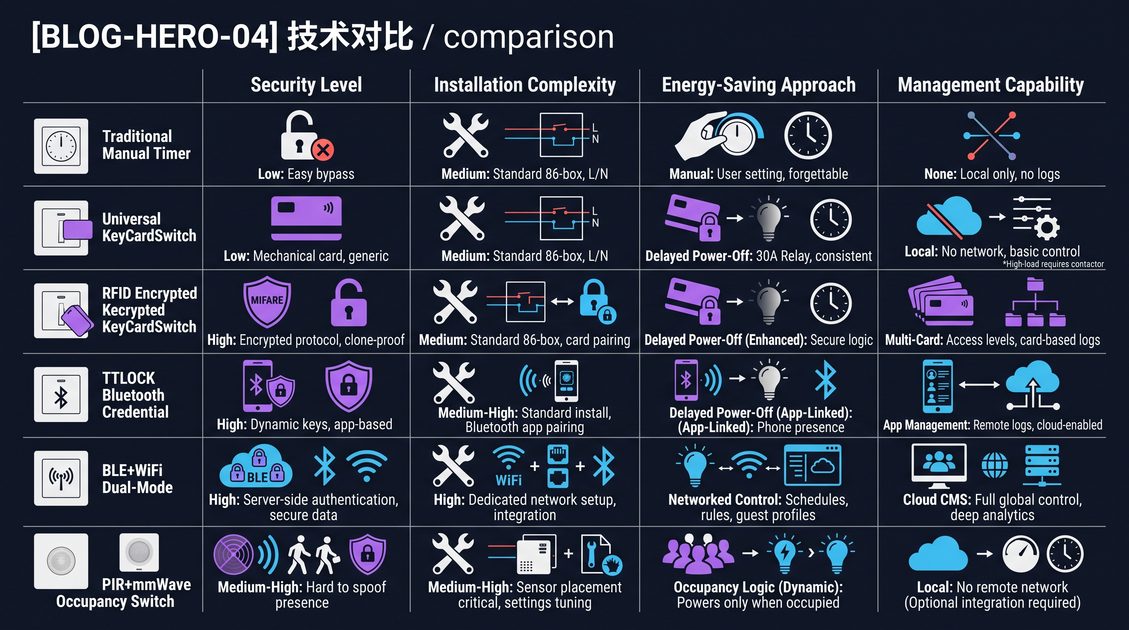
مفتاح بطاقة المفتاح مقابل مستشعر الحضور بالموجات المليمترية للفنادق ليس منافسة بين منتجين متشابهين بل قرار بين فلسفتين متقابلتين للتحكم في طاقة غرفة الضيف. مفتاح بطاقة المفتاح جهاز حتمي: يشغل الغرفة عند وجود بطاقة صالحة في الفتحة ويقطع الدائرة لحظة خروج البطاقة، دون أي حكم حول وجود شخص فعلياً بالداخل. مستشعر الحضور بالموجات المليمترية جهاز استقرائي: يستخدم رادار 24–60 جيجاهرتز لاكتشاف إنسان ثابت، بما في ذلك الحركات الدقيقة مثل التنفس، ويبقي الغرفة مشغلة فقط أثناء تأكيد الحضور. حيث يسأل مفتاح البطاقة "هل بطاقة موجودة"، يسأل مستشعر الحضور "هل جسم موجود"، وهذا الفرق الوحيد يقود كل قرار لاحق حول التكلفة، التمديدات، جهد التعديل التحديثي، وسلوك الضيف. فهم مقايضة مفتاح بطاقة المفتاح مقابل مستشعر الحضور بالموجات المليمترية مهم لأن معظم الفنادق تقرر بين معيار مثبت منذ عقدين وتقنية استشعار أحدث يمكنها، في التخطيط المناسب، القضاء على مشكلة تسليم البطاقة بالكامل.
مفتاح بطاقة المفتاح مقابل مستشعر الحضور بالموجات المليمترية للفنادق: فلسفتا تحكم
يختلف مفتاح بطاقة المفتاح مقابل مستشعر الحضور بالموجات المليمترية للفنادق على مستوى منطق التحكم قبل مقارنة أي أجهزة: مفتاح البطاقة حتمي وموجه بالأحداث، بينما مستشعر الحضور استقرائي وموجه بالحالة. يعتمد النموذج الحتمي على فعل صريح ومادي من الضيف: إدخال البطاقة يشغل الغرفة، وإزالتها تسقط الحمل بعد تأخير قصير، عادة 10 إلى 30 ثانية. لأن المشغل هو جسم مادي في فتحة، حالة الغرفة قابلة للتنبؤ الكامل وأي فشل ميكانيكي ومرئي. النموذج الاستقرائي يستنتج الإشغال من انعكاس الرادار، لذا يمكنه تشغيل الغرفة دون فعل من الضيف ويمكنه أيضاً اكتشاف بقاء شخص بالداخل بعد إزالة البطاقة. هذا يعني أن الجهازين لا يشغلان نفس موضع الحائط بشكل مختلف فقط؛ بل يجسدان افتراضات مختلفة حول من يتحكم بالغرفة. مفتاح البطاقة يثق بيد الضيف؛ مستشعر الحضور يثق بملاحظة المستشعر. لفريق المشتريات السؤال الحقيقي هو ما إذا كانت المنشأة تريد الطاقة مربوطة برمز يجب على الضيف حمله وإدخاله، أم مربوطة بالحقيقة المادية المستمرة للإشغال.
مبدأ الحتمية في مفتاح بطاقة المفتاح
يعمل مفتاح بطاقة المفتاح على قاعدة لا تتغير أبداً: بطاقة بالداخل تساوي تشغيل، بطاقة بالخارج تساوي إيقاف. الأجهزة عبارة عن مرحل مصنف لحمل الغرفة، قارئ يقبل البطاقة المصدرة، متحكم دقيق يتحقق من صلاحية البطاقة، ودائرة تأخير تمسك بالطاقة لفترة وجيزة بعد الإزالة حتى لا يغرق الضيف الذي يبدل أو ينسى بطاقة في الظلام فوراً. لأن المنطق ثنائي، النتيجة قابلة للتكرار عبر كل غرفة وكل ضيف، ويسهل على التدبير المنزلي والهندسة تدقيقها: الفتحة إما تحتفظ ببطاقة أو لا. الطبيعة الحتمية تعني أيضاً عدم وجود معايرة، ولا إعداد حساسية، ولا خطر سلبي كاذب من ضيف ساكن. تكلفة الحتمية هي مشكلة التسليم، حيث ضيف يغادر دون إزالة البطاقة، أو بطاقة متروكة في الفتحة أثناء التدبير المنزلي، يبقي الغرفة مشغلة.
مبدأ الاستقراء في مستشعر الحضور بالموجات المليمترية
يستبدل مستشعر الحضور بالموجات المليمترية البطاقة بملاحظة الرادار. يرسل إشارات موجات مليمترية في نطاق 24 جيجاهرتز أو 60 جيجاهرتز ويحلل إزاحة التردد المنعكسة لتصنيف ما إذا كان إنسان موجود، متحرك، أو ثابت. على عكس PIR، الذي يتفاعل فقط مع الحركة الإجمالية، يمكن للموجات المليمترية اكتشاف شخص جالس، نائم، أو يقرأ دون حركة كلية لأنه يستشعر الحركة الدقيقة للتنفس وتمايل الجسم الطفيف. المستشعر يبقي الغرفة مشغلة باستمرار أثناء تأكيد الحضور ويحرر الطاقة فقط بعد مهلة شغور قابلة للتعديل، عادة 5 إلى 15 دقيقة، تنتهي. لأن الكشف استقرائي، الجهاز لا يستطيع معرفة ما إذا كان الشخص ضيفاً أو عاملاً بالتدبير المنزلي، ولا يعرف ما إذا كانت الغرفة مدفوعة؛ يعرف فقط أن جسم موجود. هذا يجعل مستشعر الحضور قوياً لحقيقة الإشغال لكن أعمى للحقيقة التجارية لمن ينتمي للغرفة.
كيف يغير الفرق سلوك الضيف
الفلسفتان تغيران ما يُطلب من الضيف فعله. مع مفتاح البطاقة، يجب على الضيف إدخال البطاقة عند الوصول وتذكر إزالتها عند المغادرة، وغالباً تعتمد المنشآت على اللافتات والغريزة الطبيعية لاسترداد البطاقة من الفتحة قبل المغادرة. مع مستشعر الحضور بالموجات المليمترية، لا يُطلب من الضيف فعل شيء، لأن الغرفة تستشعر الوصول والمغادرة بنفسها. العاقبة السلوكية هي أن مفتاح البطاقة عرضة للضيف الناسي الذي يترك البطاقة في مكانها، بينما مستشعر الحضور عرضة للفشل العكسي، حيث يُحكم على ضيف نائم أو ساكن لفترة وجيزة بأنه غائب إذا كانت مهلة الشغور محددة بعدوانية شديدة. لا جهاز لا تشوبه شائبة؛ هما ببساطة يفشلان في اتجاهين متعاكسين، وهذا عدم التماثل هو الأساس لجمعهما.
مفتاح بطاقة المفتاح مقابل مستشعر الحضور بالموجات المليمترية للفنادق: كيف يقرر كل منهما طاقة الغرفة
يختلف مفتاح بطاقة المفتاح مقابل مستشعر الحضور بالموجات المليمترية للفنادق أيضاً في المسار الكهربائي الذي يتحكم فعلياً في حمل التيار المتردد. مفتاح بطاقة المفتاح عادة مرحل متصل تسلسلياً في السلك الحار يبدل دائرة 30 أمبير، لذا يجلس في الخط ويفصل الطاقة مادياً. مستشعر الحضور بالموجات المليمترية عادة وحدة رادار صغيرة، غالباً مثبتة بالسقف أو الحائط، تكتشف الإشغال ثم ترسل إشارة لمرحل منفصل أو مفتاح توفير طاقة لفتح أو إغلاق الدائرة. هذا يعني أن مستشعر الحضور غالباً ليس جهاز حمل الحمل على الإطلاق؛ هو مستشعر قبل المتحكم، الذي يمكن أن يكون مرحل DIN-rail، مفتاح ذكي، أو وحدة أتمتة مبانٍ. التموضع، التمديدات، ومصدر الطاقة تختلف تبعاً لذلك، وهذا الفرق هو ما يجعل مسارات التعديل التحديثي مختلفة جداً عن بعضها.
| السمة | مفتاح بطاقة المفتاح | مستشعر الحضور بالموجات المليمترية |
|---|---|---|
| منطق التحكم | حتمي (بطاقة بالداخل = تشغيل) | استقرائي (حضور = تشغيل) |
| المشغل | ضيف يدخل بطاقة صالحة | رادار يكتشف إنسان ثابت |
| تبديل الحمل | مرحل 30A مدمج في السلك الحار | مستشعر + مرحل/متحكم منفصل |
| الموقع النموذجي | حائط عند مدخل الغرفة | سقف أو حائط، تغطية حضور |
| فعل ضيف مطلوب | إدخال وإزالة بطاقة | لا شيء |
| تحرير الشغور | فوري + تأخير 10–30ث | مهلة قابلة للتعديل 5–15 دقيقة |
| نمط الفشل | ينسى بطاقة متروكة في الفتحة | يحكم على ضيف ساكن غائب (إذا مهلة قصيرة جداً) |
المسار الكهربائي لمفتاح بطاقة المفتاح
في مفتاح بطاقة المفتاح، المرحل هو عنصر حمل الحمل، ومصنف لتيار الغرفة الكامل، عادة 30A عند تيار متردد 180–250 فولت. المفتاح مثبت بشكل مدمج في حائط المدخل وموصل تسلسلياً مع تغذية الغرفة الحية، بحيث عند فتح المرحل، يتم قطع طاقة دائرة الغرفة بالكامل. التركيب مهمة كهربائية بنقطة واحدة: أحضر السلك الحي والمحايد للصندوق، أنهِ الحمل عبر المرحل، واضبط التأخير. لأن المفتاح يحمل الحمل، لا يحتاج مرحل إضافي أو مفتاح ذكي، مما يبقي قائمة المواد صغيرة والتمديدات بسيطة للتعديل التحديثي. يجب أن يكون الجهاز مصنفاً لتيار الطفرة في الغرفة من مكيفات الهواء وسخانات الماء، ولهذا تم تحديد تصنيف المرحل وتأخير 15 ثانية معاً.
المسار الكهربائي لمستشعر الحضور بالموجات المليمترية
مستشعر الحضور بالموجات المليمترية لا يبدل حمل الغرفة مباشرة عادة لأن وحدة الرادار جهاز تحكم منخفض الطاقة، ليس قاطع تيار عالي. في تخطيط فندقي نموذجي، المستشعر يغذى بـ 5 فولت أو 12 فولت ويخرج تلامس جاف، إغلاق مرحل، أو إشارة إشغال رقمية لمفتاح توفير طاقة أو مرحل يحمل حمل التيار المتردد. هذا يخلق معمارية من جزئين: الاستشعار والتبديل منفصلان. الميزة المرونة، لأن مستشعر واحد يمكن أن يقود مخرجات متعددة أو منطقة ممر كاملة، ومهلة الشغور معلمة برمجية وليست دائرة ثابتة. التكلفة مكونات أكثر، نقاط تمديدات أكثر، وخطوة تشغيل لربط كل مستشعر بمتحكمه وضبط منطقة كشفه ومهلته.
لماذا يهم الفرق الكهربائي للتعديلات التحديثية
الفرق الكهربائي يترجم مباشرة لصعوبة التعديل التحديثي. استبدال مفتاح حائط يدوي موجود بمفتاح بطاقة مفتاح عادة استبدال واحد بواحد: أزِل المفتاح، ركّب مفتاح البطاقة في نفس الصندوق، وأعد توصيل نفس الأسلاك الحية، ولهذا مفاتيح البطاقة مشهورة بتركيب سريع لكل غرفة. إضافة مستشعر حضور بالموجات المليمترية حيث لا توجد بنية تحتية للمستشعرات غالباً تعني إضافة جهاز جديد، تمديد تغذيته منخفضة الجهد، ودمج مخرج إشغاله مع متحكم أو مفتاح توفير طاقة، مما قد يتضمن مهن أكثر ونقاط فشل أكثر. لمنشأة موجودة، مفتاح بطاقة المفتاح يميل للفوز ببساطة التركيب الخالصة، بينما مستشعر الحضور يميل للفوز بمرونة البناء الجديد، حيث يمكن تضمين المستشعر بمرحلة البناء.
مفتاح بطاقة المفتاح مقابل مستشعر الحضور بالموجات المليمترية للفنادق: التكلفة والتركيب مقارنة
يتباعد مفتاح بطاقة المفتاح مقابل مستشعر الحضور بالموجات المليمترية للفنادق بشدة في التكلفة وجهد التركيب، ولأغلب المنشآت تكلفة الملكية الإجمالية هي العامل الحاسم. مفتاح بطاقة المفتاح جهاز مستقل بتكلفة وحدة معتدلة، صندوق حائط واحد، لا شبكة، وتعديل تحديثي سريع، لذا التكلفة المركبة منخفضة ومتوقعة. مستشعر الحضور بالموجات المليمترية عادة سعر وحدة أعلى لوحدة الرادار، بالإضافة لتكلفة متحكم أو مرحل وتركيب وتشغيل أكثر تعقيداً، لذا التكلفة المبدئية أعلى. الفجوة ليست في الأجهزة فقط بل في العمالة، لأن مفتاح البطاقة تبديل كهربائي بمهنة واحدة بينما مستشعر الحضور غالباً يتطلب تنسيق بين مهن كهربائية ومنخفضة الجهد. لمنشأة بمئات الغرف، هذا الفرق لكل غرفة يضاعف عبر المبنى بالكامل، ولهذا نمذجة التكلفة غالباً تميل القرار نحو مفتاح البطاقة في الشراء الأول.
| عامل التكلفة | مفتاح بطاقة المفتاح | مستشعر الحضور بالموجات المليمترية |
|---|---|---|
| أجهزة لكل غرفة | أقل (جهاز واحد) | أعلى (مستشعر + مرحل/متحكم) |
| التمديدات | إعادة استخدام صندوق حائط موجود | قد يحتاج تمديد طاقة منخفضة الجهد |
| عمالة لكل غرفة | أقل، مهنة واحدة | أعلى، مهنتين + تشغيل |
| أجهزة شبكة | لا شيء | متحكم، ربما بوابة |
| تشغيل | ضئيل (ضبط تأخير) | ضبط منطقة كشف + مهلة |
| سرعة التعديل التحديثي | سريعة | أبطأ |
| حساسية تكلفة الوحدة | حساس جداً | أقل حساسية |
تكلفة أجهزة مفتاح بطاقة المفتاح
تهيمن على تكلفة أجهزة مفتاح بطاقة المفتاح قائمة مواد واحدة: قارئ البطاقة، المتحكم الدقيق، مرحل 30A، واللوحة المدمجة. لأن لا وحدة راديو، لا هوائي، ولا اعتماد سحابي، تكلفة الوحدة تبقى منخفضة ومستقرة عبر الطلبات الكبيرة، ولا تتعقد مع عدد الغرف. القارئ نفسه يُختار بنظام البطاقة، ولأن نموذجاً شاملاً يقرأ أي بطاقة M1، نفس المفتاح يعمل بغض النظر عما إذا كانت المنشأة تصدر بطاقات RFID، Temic، أو TTLOCK. هذا يجعل مفتاح بطاقة المفتاح أحد أكثر أجهزة توفير الطاقة تكلفة قابلة للتنبؤ التي يمكن لفندق شراؤها، دون بنود شبكة أو برمجيات مخفية لكل غرفة.
تكلفة أجهزة مستشعر الحضور بالموجات المليمترية
توزع تكلفة أجهزة مستشعر الحضور بالموجات المليمترية عبر وحدة الرادار، مصدر طاقتها، والمرحل أو مفتاح توفير الطاقة الذي تقوده. مجموعة شرائح رادار 24 جيجاهرتز أو 60 جيجاهرتز مع هوائيها، مكبرها، وبرمجيات معالجة الإشارة أغلى من قارئ بطاقة ومرحل، والمستشعر عادة يحتاج متحكم منفصل لترجمة مخرج إشغاله لتبديل تيار متردد. في تصميم غرف متصلة قد تكون هناك بوابة أو متحكم ناقل لكل طابق. النتيجة أن حل مستشعر الحضور له مكونات أكثر للشراء، نقاط أكثر للتخزين كقطع غيار، وقائمة مواد لكل غرفة أعلى قليلاً، رغم أن سعر شرائح الموجات المليمترية انخفض بثبات والفجوة تضيق مع الحجم.
عمالة التركيب وجهد التشغيل
عمالة التركيب حيث تختلف الحلولان أكثر في الممارسة. تعديل مفتاح بطاقة المفتاح التحديثي تبديل كهربائي: الكهربائي يفتح صندوق الحائط الموجود، يركب مفتاح البطاقة، وينهي نفس أسلاك الحي والمحايد، عادة في 15 إلى 30 دقيقة لكل غرفة دون انضمام شبكة ولا إعداد برمجي سوى ضبط التأخير. تركيب مستشعر الحضور بالموجات المليمترية أكثر تعقيداً: يجب تموضع المستشعر وتوجيهه للتغطية التي يحتاجها، تغذيته بجهد منخفض، توصيله بمرحل أو مفتاح توفير طاقة، ثم تشغيله، مع ضبط منطقة الكشف حتى لا يطلق الرادار إنذاراً كاذباً على ستارة، مروحة، أو حركة في الممر. تشغيل مستشعر الحضور جيداً قد يستغرق وقتاً أطول لكل غرفة وأصعب توحيداً عبر أشكال غرف متنوعة، مما يرفع العمالة ويرفع التكلفة المركبة الإجمالية.
منظور تكلفة الملكية الإجمالية
عند مقارنة مفتاح بطاقة المفتاح مقابل مستشعر الحضور بالموجات المليمترية للفنادق، الإطار الصادق هو تكلفة الملكية الإجمالية على عمر الجهاز العامل لا السعر الظاهري وحده. مفتاح البطاقة تكلفة مبدئية أقل، تكلفة تشغيل شبه صفرية، وعمر ميكانيكي طويل، لكنه يعتمد على سلوك ضيف صحيح لتقديم التوفير. مستشعر الحضور تكلفة مبدئية أعلى ومخاطر تشغيل مستمرة، لكنه يمكن أن يلتقط التوفير دون أي تعاون من الضيف. لتعديل تحديثي بعائد سريع حيث رأس المال ضيق، مفتاح البطاقة عادة الشراء الأقل مخاطرة. لمنشأة حيث الأولوية إلغاء تسليم البطاقة وأتمتة حقيقة الإشغال عبر المبنى، تكلفة مستشعر الحضور الأعلى تشتري قدرة لا يستطيع مفتاح البطاقة توفيرها.
مفتاح بطاقة المفتاح مقابل مستشعر الحضور بالموجات المليمترية للفنادق: الكشف ودقة الإشغال
يجب أيضاً الحكم على مفتاح بطاقة المفتاح مقابل مستشعر الحضور بالموجات المليمترية للفنادق بالدقة، رغم أن الاثنين يقيسان أشياء مختلفة. مفتاح بطاقة المفتاح دقيق للبطاقة: إذا البطاقة في الفتحة، الغرفة مشغلة، وهذا صحيح 100% من الوقت، مما يجعل إشارة إشغاله دقيقة لكن مربوطة بجسم لا شخص. مستشعر الحضور بالموجات المليمترية دقيق للجسم: يمكنه اكتشاف إنسان ثابت بمعدل إيجابي حقيقي يتجاوز عادة 99% في اختبارات مضبوطة، لكن إشارة إشغاله استنتاج احتمالي خاضع لمدى الكشف، الزاوية، الحجب، والبيئة. مفتاح البطاقة له يقين تام بالشيء الخطأ، ومستشعر الحضور له يقين شبه تام بالشيء الصحيح، وهذا بالضبط لماذا الاثنان متكاملان جداً في تصميم مجمع.
| عامل الدقة | مفتاح بطاقة المفتاح | مستشعر الحضور بالموجات المليمترية |
|---|---|---|
| إشارة إشغال مبنية على | وجود بطاقة | وجود جسم |
| كشف شخص ثابت | غير متاح (يحتاج بطاقة) | نعم، عبر حركة تنفس دقيقة |
| سلبي كاذب (شاغل مفقود) | بطاقة متروكة بالخارج | ضيف ساكن محكوم غائب |
| إيجابي كاذب (فارغ محكوم ممتلئ) | بطاقة متروكة في الفتحة | ستارة/مروحة/انعكاس |
| مدى الكشف | غير متاح | 6–8 م نموذجي |
| عوامل بيئية | لا شيء | أثاث، زجاج، حجب |
| معايرة مطلوبة | لا شيء | ضبط منطقة + مهلة |
ما يكشفه مفتاح بطاقة المفتاح ونقطة عمياء
يكشف مفتاح بطاقة المفتاح شيئاً واحداً بموثوقية تامة: وجود بطاقة صالحة في الفتحة. لا يكشف ولا يستطيع كشف شخص، لذا لا وعي لديه بضيف يدخل غرفة دون بطاقة، طفل يبقى بالداخل بينما يغادر الوالدان، أو عامل تدبير منزلي يعمل بغرفة أزيلت بطاقتها بالفعل. النقطة العمياء هي البطاقة التي تبقى في الفتحة: ضيف يترك البطاقة خلفه، مسافر أعمال يتركها كعادة، أو عامل تدبير منزلي يسند الباب ببطاقة، كلها تبقي الغرفة مشغلة حتى عندما لا أحد بالداخل. لأن المفتاح لا يستطيع ملاحظة الجسم، لا يمكنه أبداً تصحيح هذه الحالات، والمنشأة تفقد الطاقة التي أملت توفيرها على الغرف التي تهزم النظام تحديداً.
ما يكشفه مستشعر الحضور بالموجات المليمترية ونقطة عمياء
يكشف مستشعر الحضور بالموجات المليمترية جسم إنسان بموثوقية عالية، بما في ذلك شخص ثابت، لأنه يقرأ الحركة الدقيقة للتنفس بمدى نموذجي 6 إلى 8 أمتار. نقطته العمياء بيئية لا سلوكية: أثاث كثيف، زجاج سميك، فحص معدني، أو مستشعر موجه بعيداً عن المنطقة المشغولة يمكن أن يضعف أو يعكس إشارة الرادار ويسبب كشفاً مفقوداً، وتيار تكييف قوي أو ستارة متحركة يمكن أحياناً تصنيفها كحضور وإبقاء الغرفة مشغلة. لأن الكشف استنتاجي، المستشعر يحتاج هامش مهلة معقول، ولهذا معظم إعدادات الشغور 5 إلى 15 دقيقة لا بضع ثوانٍ. المستشعر قوي حيث مفتاح البطاقة أعمى، وأقل قليلاً عدم كمال حيث مفتاح البطاقة حتمي.
لماذا الدقة وحدها لا تحسم الاختيار
الدقة وحدها لا تحسم قرار مفتاح بطاقة المفتاح مقابل مستشعر الحضور بالموجات المليمترية لأن الجهازين دقيقان في مجالات مختلفة. منشأة تريد يقيناً حول الحقيقة التجارية، أن الغرفة مصرح بها والبطاقة موجودة، تقدر إشارة مفتاح البطاقة الحتمية. منشأة تريد يقيناً حول الحقيقة المادية، أن جسم فعلياً بالغرفة، تقدر كشف مستشعر الحضور. لا مقياس تعريف كامل لـ "مشغولة"، ولهذا العديد من الفنادق تجمعهما: مفتاح البطاقة يثبت الإذن ويعطي إيقاف فوري حتمي عند إزالة البطاقة، بينما مستشعر الموجات المليمترية يحرس ضد البطاقة المتروكة في الفتحة والضيف الذي يبقى دون بطاقة.
مفتاح بطاقة المفتاح مقابل مستشعر الحضور بالموجات المليمترية للفنادق: الصيانة ودورة الحياة
يختلف مفتاح بطاقة المفتاح مقابل مستشعر الحضور بالموجات المليمترية للفنادق في ما يبلى، ما يحتاج صيانة، وكم يستمر كل منهما في الخدمة. مفتاح بطاقة المفتاح ميكانيفي وسلبي في الغالب: مرحل له عدد محدد من عمليات التبديل، قارئ بلا أجزاء متحركة، ولا إيقاع تحديث برمجي، لذا يميل للعمل لسنوات باهتمام قليل يتجاوز تنظيف فتحة البطاقة عرضياً. مستشعر الحضور بالموجات المليمترية جهاز إلكتروني مع مرسل/مستقبل رادار، برمجيات، وحساسية يمكن أن تنحرف أو تحتاج إعادة ضبط مع تغير تخطيط الغرفة، لذا قد يحتاج إعادة تشغيل وتحديثات برمجية عرضية. مفتاح البطاقة جهاز ركّب وانسَ؛ مستشعر الحضور جهاز مُدار. للمنشآت بفريق هندسي محدود، هذا الفرق في عبء دورة الحياة تكلفة تشغيلية حقيقية.
| عامل دورة الحياة | مفتاح بطاقة المفتاح | مستشعر الحضور بالموجات المليمترية |
|---|---|---|
| أجزاء تبلى | مرحل (دورات تبديل) | لا ميكانيكية؛ برمجيات |
| تنظيف | غبار فتحة بطاقة | عدسة/سطح مستشعر |
| تحديثات برمجية | لا شيء نموذجي | عرضية |
| إعادة تشغيل | نادرة | بعد تغييرات تخطيط الغرفة |
| متوسط وقت للفشل | عالي (أجزاء قليلة) | عالي، لكن إلكتروني |
| استراتيجية قطع غيار | احتفظ بنموذج واحد | احتفظ بنماذج مستشعر + مرحل |
| اعتماد شبكة | لا شيء | قد يعتمد على متحكم |
ملف صيانة مفتاح بطاقة المفتاح
يهيمن على ملف صيانة مفتاح بطاقة المفتاح المرحل، الذي له عدد محدود من عمليات التبديل قبل أن يصبح تآكل التلامس مصدر قلق، وقارئ البطاقة، الذي تلامساته وفتحته يمكن أن تجمع غبار أو حطام في الاستخدام الثقيل. عملياً مفتاح البطاقة سلبي، بلا رابط شبكة، لا بطارية، ولا برمجيات يمكن أن تتلف، لذا مهام الصيانة الرئيسية هي تنظيف دوري للفتحة، تحقق عرضي أن دائرة التأخير تعمل، والاحتفاظ بمخزون صغير من قطع غيار للمرحل. لأن الجهاز حتمي، الفشل عادة مرئي وسهل التشخيص: الغرفة إما تبقى مشغلة أو تبقى مطفأة. هذا الملف منخفض اللمس يناسب المنشآت التي تريد تحكم بالطاقة دون ميزانية برمجيات أو تشغيل.
ملف صيانة مستشعر الحضور بالموجات المليمترية
يتمحور ملف صيانة مستشعر الحضور بالموجات المليمترية حول البرمجيات والبيئة لا الأجزاء البالية. المستشعر بلا تآكل ميكانيكي، لكن برمجياته قد تتلقى تحديثات لخوارزميات كشف أو تغييرات بروتوكول، ومنطقة كشفه قد تحتاج إعادة تشغيل عند إعادة تأثيث غرفة، عند إضافة تلفاز أو جسم معدني كبير، أو عند إعادة تموضع المستشعر عرضياً. لأن المستشعر يبلغ عن الإشغال بالاستنتاج، سوء سلوك دقيق مثل إيجابي كاذب طفيف أو كشف مفقود عرضي قد يكون أصعب على الموظفين رصده من مفتاح بطاقة يفشل مفتوحاً أو مغلقاً ببساطة. المستشعر أيضاً حلقة واحدة في سلسلة تتضمن مصدر طاقته ومرحل حمل الحمل، لذا قائمة قطع الغيار أطول.
تكلفة دورة الحياة واستراتيجية قطع الغيار
مقارنة دورة الحياة تغذي صورة قطع الغيار والتكلفة الإجمالية. عقار مفتاح بطاقة يمكن صيانته بقطعة غيار نموذج واحد لجسم المفتاح والمرحل، مخزنة رخيصة ومبدلة في دقائق بكهربائي واحد. عقار مستشعر حضور يحتاج قطع غيار للمستشعر، مصدر طاقته، ومرحل التبديل أو المتحكم، والموظفون يجب أن يكونوا قادرين على إعادة تشغيل بديل، وهي مهارة أكثر تخصصاً. على أفق خمس سنوات، مفتاح البطاقة يميل لعمالة صيانة أقل وخط أنابيب قطع غيار أبسط، بينما مستشعر الحضور يوفر قدرة مستمرة لكن يحمل تكلفة إدارة تشغيلية أعلى قليلاً، مقايضة يجب على الفندق وزنها مقابل الطاقة التي يوفرها.
متى تختار مفتاح بطاقة المفتاح على مستشعر الحضور بالموجات المليمترية للفنادق
ينحسم مفتاح بطاقة المفتاح مقابل مستشعر الحضور بالموجات المليمترية للفنادق بوضوح لصالح مفتاح البطاقة في عدة حالات منشأة شائعة. مفتاح بطاقة المفتاح الخيار الأفضل عندما يجب أن يكون التعديل التحديثي سريعاً ورخيصاً، عندما المنشأة تصدر بطاقات بالفعل وتريد لا تغيير بسلوك الضيف، عندما فريق الهندسة صغير ويفضل جهاز ركّب وانسَ، عندما الغرف بأشكال غريبة أو أثاث ثقيل يجعل كشف الرادار غير موثوق، أو عندما الميزانية لا تمتد لأجهزة استشعار متصلة بالشبكة وتشغيل. لمالك يراعي الميزانية يعدل تحديثياً مخزون موجود من غرف قياسية، مفتاح البطاقة الحتمي عادة يوفر توفيراً متوقعاً بأقل تكلفة مركبة وأقل مطالب تشغيلية.
- تعديل تحديثي سريع ومنخفض التكلفة للعديد من الغرف في نافذة قصيرة
- منشأة تدير نظام بطاقة بالفعل وتريد استبدال واحد بواحد
- فريق صيانة صغير أو غير تقني يفضل أجهزة سلبية
- هندسة غرفة غريبة أو أثاث ثقيل سيهزم الرادار
- لا رغبة في أجهزة متصلة بالشبكة أو وقت تشغيل
- أولوية قطع طاقة مثبت، قابل للتدقيق، حتمي
عندما يكون سلوك الضيف منضبطاً بالفعل
يعمل مفتاح بطاقة المفتاح بشكل أفضل حيث يعامل الضيوف البطاقة كمفتاح غرفة، وهو معظم الفنادق القياسية. لأن الضيف يزيل البطاقة ليأخذ المفتاح بعيداً، فعل المغادرة يحفز إيقاف الطاقة طبيعياً، ولا حملة لافتات أو إعادة تدريب مطلوبة. في المنشآت حيث البطاقة مفتاح الباب، مفتاح البطاقة يوائم محفز توفير الطاقة مع فعل يؤديه الضيف بالفعل، وهو أقوى حجة وحيدة للنموذج الحتمي. التوفير يتحقق تلقائياً كلما غادر الضيف، دون حكم مستشعر ولا كشف كاذب.
عندما تكون موارد الهندسة محدودة
المنشآت بفريق هندسي صغير أو مرهق تميل لتفضيل مفتاح البطاقة لأنه لا يحتاج شبكة، لا تشغيل، لا تحديثات برمجية، ولا ضبط حساسية. فشل مفتاح البطاقة ميكانيفي ومرئي، وقطعة غيار تبدل في دقائق دون أدوات متخصصة. لفرنشايز أو فندق مستقل دون اختصاصي منخفض جهد داخلي، دورة حياة مفتاح البطاقة منخفضة اللمس ميزة تشغيلية حاسمة على مستشعر قد يحتاج إعادة تشغيل بعد أي تغيير غرفة.
عندما تكون سرعة التعديل التحديثي قيد
عندما نافذة التجديد قصيرة، مفتاح البطاقة يفوز بالسرعة. لأنه يستبدل مفتاح حائط موجود في نفس الصندوق باستخدام نفس الأسلاك الحية، كهربائي كفء يمكنه إكمال العديد من الغرف يومياً بأقل إزعاج للطوابق المشغولة. مستشعر الحضور، بالمقابل، يضيف تموضع، طاقة منخفضة جهد، تمديدات لمرحل، وتشغيل، مما يطيل دورة الغرفة وقد يتطلب أكثر من مهنة. لتجديد موسمي ضيق، مفتاح البطاقة المسار الأقل مخاطرة للإنهاء في الموعد.
متى يتفوق مستشعر الحضور بالموجات المليمترية على مفتاح بطاقة المفتاح للفنادق
يتأرجح مفتاح بطاقة المفتاح مقابل مستشعر الحضور بالموجات المليمترية للفنادق بالاتجاه الآخر عندما تحتاج المنشأة لحقيقة إشغال لا إذن بطاقة. مستشعر الحضور بالموجات المليمترية الخيار الأفضل في المباني الجديدة حيث يمكن تضمين المستشعر بالبناء، في الغرف المميزة حيث تجربة الضيف تستبعد أي تسليم بطاقة، في الأجنحة بحمامات أو زوايا لا تغطيها بطاقة، في غرف حيث الضيوف يبقون بالداخل دون بطاقة، وفي برامج الغرف المتصلة التي تريد بيانات حضور لتكييف وإضاءة آلية. مستشعر الحضور يفوز أيضاً أينما الهدف إلغاء تسرب الضيف الناسي الذي لا يستطيع مفتاح البطاقة تصحيحه.
- بناء جديد حيث المستشعرات مضمّنة وقت البناء
- غرف مميزة أو إقامة طويلة يجب أن تبدو بلا جهد
- تكييف وإضاءة واعيان للإشغال أبعد من تشغيل/إيقاف بسيط
- غرف حيث الضيوف يبقون بالداخل دون إدخال بطاقة
- منشآت تريد بيانات حضور، لا مجرد تحكم بالطاقة
- تخطيطات بخطوط رؤية نظيفة مواتية للرادار
عندما تطلب تجربة الضيف لا بطاقة
للمنشآت المميزة، مساكن الإقامة الطويلة، والأجنحة الصحية، تسليم البطاقة قد يبدو احتكاكاً، ومستشعر الحضور بالموجات المليمترية يزيله بالكامل بتشغيل الغرفة عند الوصول دون أي فعل من الضيف. في هذه الشرائح، التكلفة الدقيقة لطلب الضيف إدارة طاقة الغرفة تفوق التوفير، وخفاء المستشعر نفسه هو القيمة. المستشعر أيضاً يتعامل مع الضيف الذي يستقر بالغرفة، يعمل بمكتب، أو ينام، مبقياً الطاقة مشغلة باستمرار طالما جسم موجود، دون خطر قطع طاقة وسط الإقامة من بطاقة في غير مكانها.
عندما تقود بيانات الإشغال المبنى
عندما تريد المنشأة تجاوز تحكم تشغيل/إيقاف بسيط لتكييف واعٍ بالإشغال، مشاهد إضاءة، وأتمتة ممرات، مستشعر الحضور بالموجات المليمترية الأساس لأنه يخرج إشارة إشغال حقيقية يمكن لمتحكم استخدامها. مفتاح البطاقة يخرج فقط ثنائي بطاقة حاضرة لا يخبر شيئاً عن أين بالغرفة شخص أو ما إذا كانوا نشطين. إشارة مستشعر الحضور الأغنى تتيح تحكم لكل منطقة، مثل إبقاء الحمام مضيئاً بينما منطقة النوم معتمة، وهو مستحيل مع مفتاح بطاقة حائط واحد. لبرنامج إدارة طاقة موجه بالبيانات، مستشعر الحضور المنصة الأكثر قدرة.
عندما تكون الغرف مشغولة دون بطاقة
بعض أنماط الإشغال تهزم مفتاح البطاقة: زوجان حيث شخص يمسك البطاقة والآخر يبقى خلفاً، والد يترك البطاقة بينما طفل يغفو، أو ضيف إقامة طويلة لا يزيل البطاقة نهاراً أبداً. في كل هذه الحالات مفتاح البطاقة إما يشغل الغرفة رغم كونها فارغة أو يفشل في تشغيلها بينما مشغولة. مستشعر الحضور بالموجات المليمترية غير مبالٍ بالبطاقات ويوائم الطاقة للجسم، لذا يلتقط التوفير ويحافظ على الراحة بالضبط في الأنماط حيث مفتاح البطاقة مخطئ. للمنشآت بحصة ذات معنى من غرف متعددة الإشغال أو إقامة طويلة، هذه القدرة وحدها قد تبرر المستشعر.
الحل المجمع: الموجات المليمترية تكتشف، مفتاح بطاقة المفتاح احتياطي
مفتاح بطاقة المفتاح مقابل مستشعر الحضور بالموجات المليمترية للفنادق ليس خياراً ثنائياً، لأن أقوى تصميم يستخدم كلاهما. في الحل المجمع، مستشعر الحضور بالموجات المليمترية هو كاشف الشاغل الأساسي ومفتاح بطاقة المفتاح يعمل كاحتياطي حتمي وطبقة إذن. الاثنان يعملان معاً بحيث يغطي كل منهما نقطة عمياء الآخر: مستشعر الموجات المليمترية يحرس ضد البطاقة المتروكة في الفتحة بتحرير الطاقة عندما الغرفة فارغة حقاً، ومفتاح البطاقة يضمن أن غرفة لا يمكن أن تشغل أبعد من إشارة بطاقتها المصرح بها ويوفر إيقاف فوري حتمي لحظة إزالة البطاقة. هذه التكرار تحول زوج أجهزة ناقصة لنظام قوي واحد.
| سلوك الوضع المجمع | المستشعر | احتياطي مفتاح البطاقة |
|---|---|---|
| ضيف يزيل بطاقة ويغادر | — | إيقاف طاقة فوري (حتمي) |
| ضيف يترك بطاقة في الفتحة | يكتشف غرفة فارغة، يحرر طاقة | بطاقة وحدها ستبقيها مشغلة |
| ضيف يبقى دون بطاقة | يمسك طاقة مشغلة | بطاقة وحدها ستقطعها |
| تدبير منزلي بالداخل | يكتشف حضور | بطاقة تحكم بالإذن |
| غرفة فارغة بعد شغور | يحرر طاقة | بطاقة وحدها لا تستطيع مسح |
| تحقق إذن | غير متاح | بطاقة صالحة مطلوبة |
كيف يعمل منطق الاحتياطي
في ترتيب تمديدات مجمع نموذجي، مفتاح بطاقة المفتاح يحمل الحمل ويطلب بطاقة صالحة لتغذية الدائرة، بينما مستشعر الحضور بالموجات المليمترية يجلس قبلاً ويمكنه أيضاً إمساك الدائرة مشغلة طالما يكتشف جسم. المنطق OR على الإمساك: الغرفة تبقى مشغلة إذا البطاقة حاضرة أو المستشعر يكتشف إشغال، وتقطع الطاقة فقط عندما الشرطان يزولان، أي عندما لا بطاقة ولا جسم مكتشف. هذا يحفظ إيقاف مفتاح البطاقة الحتمي عندما يغادر الضيف بالبطاقة، ويضيف قدرة المستشعر على تحرير غرفة حيث بطاقة تركت خلفها. الشرطان يتداخلان بوضوح وكل يوفر شبكة أمان لنمط فشل الآخر.
لماذا المجمع يستحق الأجهزة الإضافية
التصميم المجمع يستحق أجهزته الإضافية في المنشآت حيث تسرب الطاقة من البطاقات المنسية كبير بما يكفي لتعويض تكلفة المستشعر. كل غرفة حيث ضيف يترك البطاقة في الفتحة كعادة هي غرفة حيث مفتاح البطاقة وحده لا يوفر شيئاً، ومستشعر الموجات المليمترية يغلق ذلك التسرب بالضبط بمسح الغرفة عندما فارغة. بالمقابل، كل ضيف مميز يستقر دون بطاقة محمي بكشف حضور المستشعر. لأن مفتاح البطاقة لا يزال يوفر الإيقاف الفوري الحتمي وفحص الإذن، المنشأة تحتفظ بتوفير قابل للتدقيق من نظام بطاقة بينما تكتسب حقيقة إشغال الرادار، ولهذا عدد متزايد من الفنادق الواعية بالطاقة تحدد الزوج لا جهاز واحد.
تشغيل الزوج معاً
تشغيل النظام المجمع يتطلب ضبط ثلاث معلمات يجب أن تتفق: تأخير إزالة مفتاح البطاقة، مهلة شغور مستشعر الحضور، وقاعدة التنسيق بينهما. مهلة الشغور يجب أن تكون طويلة بما يكفي لتجنب قطع طاقة عن ضيف ساكن، عادة 5 إلى 15 دقيقة، وأطول قليلاً من تأخير مفتاح البطاقة القصير حتى لا يحارب المستشعر المفتاح. منطقة كشف المستشعر يجب أن تغطي المنطقة المشغولة الرئيسية دون تسرب للممر أو إطلاق كاذب على ستارة. عندما تضبط هذه بشكل صحيح، الجهازان يتصرفان كنظام واحد، والمنشأة تحصل على تحكم حتمي مع شبكة أمان استشعار، أقرب ما تقترب به أي تقنية لإجابة كاملة على سؤال طاقة الغرفة.
مفتاح بطاقة المفتاح مقابل مستشعر الحضور بالموجات المليمترية للفنادق: قائمة مواصفات فحص
يضيق مفتاح بطاقة المفتاح مقابل مستشعر الحضور بالموجات المليمترية للفنادق لتمارين مواصفات بمجرد اختيار الفلسفة، وهذه القائمة تبقي القرار موضوعياً. سواء اخترت مفتاح بطاقة مفتاح، مستشعر حضور بالموجات المليمترية، أو تصميم مجمع، نفس الفئات تنطبق: جهد وتصنيف حمل، تركيب وغلاف، منطق تحكم ومهلة، بروتوكول بطاقة أو كشف، امتثال، وقطع غيار. العمل عبر هذه الحقول ضد مخزون غرفتك يحول نقاش فلسفي لقائمة مواد ملموسة، ويكشف أين نشر هجين عبر أنواع الغرف هو الإجابة الأكثر كفاءة.
| حقل مواصفات | مفتاح بطاقة المفتاح | مستشعر الحضور بالموجات المليمترية |
|---|---|---|
| الجهد | تيار متردد 180–250 فولت (110 فولت عند الطلب) | مستشعر 5–12 فولت؛ مرحل للتيار المتردد |
| تصنيف الحمل | مرحل 30A | مرحل/متحكم مصنف للحمل |
| المشغل | بطاقة صالحة (M1 / MIFARE / Temic / TTLOCK) | رادار حضور 24/60 جيجاهرتز |
| مهلة | تأخير إزالة 10–30ث | شغور 5–15 دقيقة |
| مدى الكشف | غير متاح | 6–8 م نموذجي |
| تركيب | حائط عند المدخل | سقف أو حائط |
| شبكة | لا شيء | متحكم/بوابة اختياري |
| تشغيل | تأخير فقط | منطقة + مهلة |
| امتثال | يطابق معيار كهرباء المشروع | يطابق معيار كهرباء المشروع |
| قطع غيار | مفتاح + مرحل | مستشعر + مرحل + مصدر طاقة |
الجهد، الحمل، والسلامة
أول قرار مواصفات كهربائي: أكد جهد المنشأة، وهو تيار متردد 180–250 فولت لمعظم المشاريع و 110 فولت عند الطلب في عقارات أمريكا الشمالية، وصنّف المرحل لحمل الغرفة الفعلي بما في ذلك طفرة مكيف الهواء. مفتاح بطاقة المفتاح يجب أن يحمل مرحل مصنف لتلك الطفرة، عادة 30A، حتى لا تلتصق تلامساته عند بدء الضاغط. مستشعر الحضور بالموجات المليمترية، كونه جهاز منخفض الجهد، يحتاج مصدر طاقته الخاص ومرحل أو مفتاح توفير طاقة مصنف لحمل التيار المتردد الذي يقوده. في الحالتين يجب اختيار الأجهزة لمعايير كهرباء وسلامة المشروع، واختيار الغلاف لموقع التركيب.
بروتوكول البطاقة ومنطقة الكشف
القرار التالي واجهة المشغل. لمفتاح بطاقة المفتاح، حدد القارئ ضد نظام البطاقة المستخدم بالفعل: نموذج شامل يقرأ أي UID بطاقة M1 دون إعادة إصدار بطاقات، بينما نموذج RFID مربوط بالغرفة يتحقق من مفتاح قطاع MIFARE أو Temic لربط الغرفة، ونموذج متوافق TTLOCK يقرأ نافذة وقت تسجيل الوصول. لمستشعر الحضور بالموجات المليمترية، حدد نطاق الرادار، مدى الكشف بالأمتار، نوع التركيب، ومهلة الشغور، وأكد المستشعر يمكنه تغطية المنطقة المشغولة الرئيسية دون إطلاق كاذب. مواصفات المشغل هي الحقل الوحيد الذي يجب أن يطابق باقي العقار، لذا يستحق أكبر تدقيق.
التعديل التحديثي، الامتثال، وقطع الغيار
أخيراً، أكد مسار التعديل التحديثي، وضع الامتثال، واستراتيجية قطع الغيار. لتعديل تحديثي، أكد صندوق الحائط الموجود يمكنه قبول الجهاز المختار وأن لا إعادة إصدار بطاقات مطلوبة، مما يبقي التركيب مهنة واحدة وسريع. أكد الأجهزة تلبي معايير كهرباء وبيئة المشروع للمنطقة المقصودة وموقع التركيب، دون المبالغة في أي اعتماد. واحتفظ بخطة قطع غيار للأجزاء التي يمكن أن تفشل أو تضيع، سواء كان ذلك نموذج مفتاح بطاقة ومرحل واحد أو مستشعر، مصدر طاقته، ومرحل تبديله. مواصفات تحل هذه الحقول كاملة بما يكفي للتكلفة والمناقصة.
مفتاح بطاقة المفتاح مقابل مستشعر الحضور بالموجات المليمترية للفنادق: مخاطر شائعة وتعديلات تحديثية
مفتاح بطاقة المفتاح مقابل مستشعر الحضور بالموجات المليمترية للفنادق مليء بالمخاطر العملية التي تعيق المشاريع بعد اتخاذ الاختيار الفلسفي، ومعرفتها توفر طاقة وعمالة. أكثر الأخطاء شيوعاً معاملة الاثنين كقابلة للتبديل وهما ليسا كذلك، اختيار مهلة مستشعر تقطع طاقة عن ضيف ساكن، توجيه مستشعر فيطلق كاذباً على ستارة أو ممر، طلب مفتاح بطاقة لا يقرأ البطاقة المستخدمة بالفعل، وتقليل تصنيف المرحل لتيار الطفرة. كل خطر يرتبط بعرض مستوى غرفة يسهل تشخيصه خطأ، لذا عادة استكشاف أخطاء واضحة تحمي الاستثمار.
- طلب قارئ بطاقة لا يطابق البطاقة المصدرة
- ضبط مهلة شغور قصيرة جداً لضيف نائم
- توجيه المستشعر لستارة، مروحة، أو ممر
- تقليل تصنيف المرحل لطفرة مكيف الهواء
- معاملة إذن بطاقة وحضور كإشارة واحدة
- تخطي التشغيل بعد إعادة تأثيث غرفة
- نسيان أن بطاقة متروكة في الفتحة تهزم تصميم بطاقة فقط
خطر قارئ البطاقة غير المتطابق
أكثر فشل مفتاح بطاقة شيوعاً طلب قارئ لا يستطيع قراءة البطاقة بيد الضيف بالفعل. نموذج شامل يقرأ أي UID بطاقة M1 ويتجنب هذا بالكامل، بينما نموذج RFID مربوط بالغرفة أو TTLOCK يجب أن يطابق تنسيق بطاقة المنشأة الدقيق أو المفتاح يرفض كل بطاقة وكل غرفة تبقى مظلمة. الإصلاح تحديد القارئ ضد نظام البطاقة الموجود قبل الشراء واختبار عينة ضد البطاقة المصدرة الفعلية، لا بطاقة عرض. هذه الخطوة الوحيدة تمنع تعديل تحديثي يبدو مكتملاً لكنه يفشل عند الباب.
مخاطر المهلة والتوجيه للمستشعر
أكثر فشل مستشعر شيوعاً مهلة شغور محددة قصيرة جداً ومنطقة كشف موجهة بشكل سيء. مهلة بضع دقائق يمكن أن تقطع طاقة عن ضيف مستلقٍ ساكن أو نائم، مما يفسد تجربة الضيف ويجعل النظام معطلاً من مكتب الاستقبال. مستشعر موجه لستارة متحركة، مروحة سقف، أو عبر نافذة للممر يمكن أن يطلق كاذباً ويمسك غرف مشغلة، مهزماً التوفير. العادة التصحيحية تشغيل المستشعر بمهلة واقعية 5 إلى 15 دقيقة والمشي بالغرفة أثناء التشغيل، فحص شخص ساكن وستارة متحركة قبل التوقيع.
استكشاف أخطاء ونشر هجين
عند ظهور مشكلة، ميز نوع الجهاز بتوقيع فشله: غرفة لا تشتغل مع بطاقة في مكانها تشير لمشكلة قارئ أو مرحل، بينما غرفة تشتغل فارغة أو تسقط ضيف ساكن تشير لمشكلة مهلة أو توجيه مستشعر. العديد من الفنادق تتجنب هشاشة جهاز واحد بالكامل بنشر هجين عبر أنواع الغرف، باستخدام مفاتيح بطاقة في الغرف القياسية والتصميم المجمع بطاقة-زائد-مستشعر في الأجنحة وغرف الإقامة الطويلة حيث أنماط السلوك تبرره. ذلك النهج المستهدف يركز تكلفة المستشعر الإضافية حيث تكسب أكثر، يبقي الغرف القياسية بسيطة وسريعة، ويسلم أفضل الفلسفتين دون دفع للرادار في كل غرفة.
جزء من محتوى هذه المقالة تم إنشاؤه بواسطة الذكاء الاصطناعي وتم تحسينه للدقة المهنية وسهولة القراءة. A key card switch vs mmWave presence sensor for hotels is not a contest between two similar products but a decision between two opposite philosophies of guest-room power control. A key card switch is a deterministic device: it turns the room on when a valid card sits in the slot and cuts the circuit the moment the card leaves, with no judgment about whether a person is actually inside. An mmWave presence sensor is an inductive device: it uses 24–60 GHz radar to detect a stationary human, including micro-motion such as breathing, and keeps the room powered only while presence is confirmed. Where the card switch asks "is a card present," the presence sensor asks "is a body present," and that single difference drives every downstream decision about cost, wiring, retrofit effort, and guest behavior. Understanding the key card switch vs mmWave presence sensor trade-off matters because most hotels are deciding between a proven two-decade-old standard and a newer sensing technology that can, in the right layout, eliminate the card hand-off problem entirely.
Key Card Switch vs mmWave Presence Sensor for Hotels: Two Control Philosophies
A key card switch vs mmWave presence sensor for hotels differs at the control-logic level before any hardware is compared: the card switch is deterministic and event-driven, while the presence sensor is inductive and state-driven. The deterministic model relies on an explicit, physical act by the guest: inserting the card powers the room, and removing it drops the load after a short delay, usually 10 to 30 seconds. Because the trigger is a physical object in a slot, the room state is fully predictable and any failure is mechanical and visible. The inductive model instead infers occupancy from radar reflection, so it can power the room with no guest action and can also detect when a person remains inside after the card was removed. This means the two devices do not simply occupy the same wall position differently; they embody different assumptions about who controls the room. A card switch trusts the guest's hand; a presence sensor trusts the sensor's observation. For a procurement team the real question is whether the property wants power tied to a token the guest must carry and insert, or tied to the continuous physical fact of occupancy.
The Deterministic Principle of a Key Card Switch
A key card switch runs on a rule that never changes: card in equals power on, card out equals power off. The hardware is a relay rated for the room's load, a reader that accepts the issued card, a microcontroller that verifies the card is valid, and a delay circuit that holds power briefly after removal so a guest who swaps or forgets a card is not plunged into darkness instantly. Because the logic is binary, the outcome is repeatable across every room and every guest, and it is easy for housekeeping and engineering to audit: the slot either holds a card or it does not. The deterministic nature also means there is no calibration, no sensitivity setting, and no false-negative risk from a motionless guest. The cost of determinism is the hand-off problem, where a guest who leaves without removing the card, or a card left in the slot during housekeeping, keeps the room energized.
The Inductive Principle of an mmWave Presence Sensor
An mmWave presence sensor replaces the card with radar observation. It transmits millimeter-wave signals in the 24 GHz or 60 GHz band and analyzes the reflected frequency shift to classify whether a human is present, moving, or stationary. Unlike PIR, which only reacts to gross movement, mmWave can detect a person who is sitting, sleeping, or reading with no macro motion because it senses the micro-motion of breathing and slight body sway. The sensor holds the room powered continuously while presence is confirmed and releases power only after an adjustable vacancy timeout, typically 5 to 15 minutes, clears. Because detection is inductive, the device cannot tell whether the person is a guest or a housekeeper, and it cannot know whether the room was paid for; it only knows that a body is there. This makes the presence sensor powerful for occupancy-truth but blind to the commercial fact of who belongs in the room.
How the Difference Changes Guest Behavior
The two philosophies change what the guest is asked to do. With a card switch, the guest must insert the card at arrival and remember to remove it on departure, and properties often rely on signage and the natural instinct to retrieve a card from the slot before leaving. With an mmWave presence sensor, the guest is asked to do nothing, because the room senses arrival and departure by itself. The behavioral consequence is that a card switch is vulnerable to the forgetful guest who leaves the card in place, while a presence sensor is vulnerable to the reverse failure, where a sleeping or lying-still guest is briefly judged absent if the vacancy timeout is set too aggressively. Neither device is flawless; they simply fail in opposite directions, and that asymmetry is the basis for combining them.
Key Card Switch vs mmWave Presence Sensor for Hotels: How Each Decides Room Power
A key card switch vs mmWave presence sensor for hotels also differs in the electrical path that actually controls the AC load. A key card switch is normally a series-connected relay in the live wire that switches a 30A circuit, so it sits inline and physically interrupts power. An mmWave presence sensor is normally a small radar module, often ceiling-mounted or wall-mounted, that detects occupancy and then signals a separate relay or an energy-saving switch to open or close the circuit. This means the presence sensor is frequently not the load-carrying device at all; it is a sensor upstream of the controller, which can be a DIN-rail relay, a smart switch, or a building automation module. The placement, wiring, and power supply differ accordingly, and that difference is what makes the retrofit paths so unlike each other.
| Attribute | Key card switch | mmWave presence sensor |
|---|---|---|
| Control logic | Deterministic (card in = on) | Inductive (presence = on) |
| Trigger | Guest inserts a valid card | Radar detects a stationary human |
| Load switching | Built-in 30A relay in live wire | Sensor + separate relay/controller |
| Typical location | Wall at room entry | Ceiling or wall, presence coverage |
| Guest action required | Insert and remove card | None |
| Vacancy release | Immediate + 10–30s delay | Adjustable 5–15 min timeout |
| Failure mode | Forgets card left in slot | Judges still guest absent (if timeout too short) |
The Electrical Path of a Key Card Switch
In a key card switch, the relay is the load-carrying element, and it is rated for the full current of the room, typically 30A at AC 180–250V. The switch is mounted flush in the entry wall and wired in series with the room's live feed, so that when the relay opens, the entire room circuit is de-energized. The installation is a single-point electrical task: bring the live and neutral to the box, terminate the load through the relay, and set the delay. Because the switch carries the load, no additional contactor or smart relay is needed, which keeps the bill of materials small and the wiring simple for a retrofit. The device must be rated for the room's surge current from air conditioners and water heaters, which is why the relay rating and the 15-second delay are specified together.
The Electrical Path of an mmWave Presence Sensor
An mmWave presence sensor does not usually switch the room load directly because a radar module is a low-power control device, not a high-current contactor. In a typical hotel layout, the sensor is powered at 5V or 12V and outputs a dry contact, a relay closure, or a digital occupancy signal to an energy-saving switch or relay that carries the AC load. This creates a two-part architecture: sensing and switching are separated. The advantage is flexibility, because one sensor can drive multiple outputs or a whole corridor zone, and the vacancy timeout is a software parameter rather than a fixed circuit. The cost is more components, more wiring points, and a commissioning step to pair each sensor to its controller and set its detection zone and timeout.
Why the Electrical Difference Matters for Retrofits
The electrical difference translates directly into retrofit difficulty. Replacing an existing manual wall switch with a key card switch is usually a one-for-one swap: remove the switch, fit the card switch in the same box, and reconnect the same live wires, which is why card switches are famous for a fast per-room install. Adding an mmWave presence sensor where no sensor infrastructure exists often means adding a new device, running its low-voltage power, and integrating its occupancy output with a controller or energy-saving switch, which can involve more trades and more points of failure. For an existing property, the key card switch tends to win on pure installation simplicity, while the presence sensor tends to win on new-build flexibility, where the sensor can be embedded at construction stage.
Key Card Switch vs mmWave Presence Sensor for Hotels: Cost and Installation Compared
A key card switch vs mmWave presence sensor for hotels diverges sharply on cost and installation effort, and for most properties the total cost of ownership is the deciding factor. A key card switch is a self-contained device with a modest per-unit cost, a single wall box, no network, and a fast retrofit, so the installed cost is low and predictable. An mmWave presence sensor typically has a higher per-unit price for the radar module, plus the cost of a controller or relay and a more involved installation and commissioning, so the upfront cost is higher. The gap is not only in hardware but in labor, because the card switch is a one-trade electrical swap while the presence sensor often requires coordination between electrical and low-voltage trades. For a property with hundreds of rooms, this per-room difference is multiplied across the whole building, which is why cost modeling so often tips the decision toward the card switch on first purchase.
| Cost factor | Key card switch | mmWave presence sensor |
|---|---|---|
| Hardware per room | Lower (single device) | Higher (sensor + relay/controller) |
| Wiring | Existing wall box reuse | May need low-voltage power run |
| Labor per room | Lower, one trade | Higher, two trades + commissioning |
| Network hardware | None | Controller, possibly gateway |
| Commissioning | Minimal (delay set) | Zone detection + timeout tuning |
| Retrofit speed | Fast | Slower |
| Unit cost sensitivity | Very sensitive | Less sensitive |
The Hardware Cost of a Key Card Switch
The hardware cost of a key card switch is dominated by a single bill of materials: the card reader, the microcontroller, the 30A relay, and the flush panel. Because there is no radio module, no antenna, and no cloud dependency, the unit cost stays low and stable across large orders, and it does not scale with the number of rooms in any complicated way. The reader itself is chosen by the card system, and because a universal model reads any M1 card, the same switch works regardless of whether the property issues RFID, Temic, or TTLOCK cards. This makes the key card switch one of the most cost-predictable energy-saving devices a hotel can procure, with no hidden network or software line items per room.
The Hardware Cost of an mmWave Presence Sensor
The hardware cost of an mmWave presence sensor is spread across the radar module, its power supply, and the load-carrying relay or energy-saving switch it drives. A 24 GHz or 60 GHz radar chipset with its antenna, amplifier, and signal-processing firmware is more expensive than a card reader and relay, and the sensor usually needs a separate controller to translate its occupancy output into AC switching. In a connected-rooms design there may also be a gateway or bus controller per floor. The result is that the presence sensor solution has more components to procure, more points to stock as spares, and a slightly higher per-room bill of materials, though the price of mmWave chips has fallen steadily and the gap is narrowing with volume.
Installation Labor and Commissioning Effort
Installation labor is where the two solutions differ most in practice. A key card switch retrofit is an electrical swap: the electrician opens the existing wall box, mounts the card switch, and terminates the same live and neutral wires, typically in 15 to 30 minutes per room with no network join and no software setup beyond setting the delay. An mmWave presence sensor installation is more involved: the sensor must be positioned and aimed for the coverage it needs, powered with low voltage, wired to a relay or energy-saving switch, and then commissioned, with the detection zone adjusted so the radar does not false-trigger on a curtain, a fan, or movement in the corridor. Commissioning a presence sensor well can take longer per room and is harder to standardize across varied room shapes, which raises labor and drives up the total installed cost.
Total Cost of Ownership Perspective
When comparing a key card switch vs mmWave presence sensor for hotels, the honest framing is total cost of ownership over the device's working life rather than sticker price alone. The card switch has a lower upfront cost, near-zero operating cost, and a long mechanical life, but it depends on correct guest behavior to deliver savings. The presence sensor has a higher upfront cost and ongoing commissioning risk, but it can capture savings without any guest cooperation. For a quick-return retrofit where capital is tight, the card switch is usually the lower-risk purchase. For a property where the priority is eliminating the card hand-off and automating occupancy truth across the building, the presence sensor's higher cost is buying a capability the card switch cannot provide.
Key Card Switch vs mmWave Presence Sensor for Hotels: Detection and Occupancy Accuracy
A key card switch vs mmWave presence sensor for hotels must also be judged on accuracy, though the two measure different things. A key card switch is accurate to the card: if the card is in the slot, the room is powered, and this is true 100% of the time, which makes its occupancy signal exact but tied to an object rather than a person. An mmWave presence sensor is accurate to the body: it can detect a stationary human with a true-positive rate that commonly exceeds 99% in controlled testing, but its occupancy signal is a probabilistic inference subject to detection range, angle, occlusion, and environment. The card switch has perfect certainty about the wrong thing, and the presence sensor has near-perfect certainty about the right thing, which is exactly why the two are so complementary in a combined design.
| Accuracy factor | Key card switch | mmWave presence sensor |
|---|---|---|
| Occupancy signal based on | Card presence | Body presence |
| Stationary-person detection | N/A (needs card) | Yes, via breathing micro-motion |
| False negative (occupant missed) | Card left out | Still guest judged absent |
| False positive (empty judged full) | Card left in slot | Curtain/fan/reflection |
| Detection range | N/A | 6–8 m typical |
| Environmental factors | None | Furniture, glass, occlusion |
| Calibration needed | None | Zone + timeout tuning |
What a Key Card Switch Detects and Its Blind Spot
A key card switch detects one thing with total reliability: the presence of a valid card in the slot. It does not and cannot detect a person, so it has no awareness of a guest who enters a room without a card, a child who stays inside while the parents leave, or a housekeeper working in a room whose card was already removed. The blind spot is the card that stays in the slot: a guest who leaves the card behind, a business traveler who leaves it as a habit, or a housekeeper who props the door with a card, all keep the room powered even when nobody is inside. Because the switch cannot observe the body, it can never correct for these cases, and the property loses the energy it hoped to save on exactly the rooms that defeat the system.
What an mmWave Presence Sensor Detects and Its Blind Spot
An mmWave presence sensor detects a human body with high reliability, including a stationary person, because it reads the micro-motion of breathing at typical ranges of 6 to 8 meters. Its blind spot is environmental rather than behavioral: dense furniture, thick glass, metal screening, or a sensor aimed away from the occupied zone can attenuate or reflect the radar signal and cause a missed detection, and a strong air-conditioning draft or a moving curtain can occasionally be classified as presence and hold the room on. Because detection is inferential, the sensor needs a reasonable timeout margin, which is why most vacancy settings are 5 to 15 minutes rather than a few seconds. The sensor is powerful where the card switch is blind, and it is only modestly imperfect where the card switch is deterministic.
Why Accuracy Alone Does Not Settle the Choice
Accuracy alone does not settle the key card switch vs mmWave presence sensor decision because the two devices are accurate in different domains. A property that wants certainty about the commercial fact, that the room was authorized and the card is present, values the card switch's deterministic signal. A property that wants certainty about the physical fact, that a body is actually in the room, values the presence sensor's detection. Neither metric is a complete definition of "occupied," which is why many hotels combine them: the card switch establishes authorization and gives an instant, deterministic off when the card is removed, while the mmWave sensor guards against the card left in the slot and the guest who stays without a card.
Key Card Switch vs mmWave Presence Sensor for Hotels: Maintenance and Lifecycle
A key card switch vs mmWave presence sensor for hotels differs in what wears out, what needs maintenance, and how long each lasts in service. A key card switch is mostly mechanical and passive: its relay has a defined number of switching operations, its reader has no moving parts, and it has no firmware update cadence, so it tends to run for years with little attention beyond an occasional cleaning of the card slot. An mmWave presence sensor is an electronic device with a radar transceiver, firmware, and a sensitivity that can drift or need re-tuning as the room layout changes, so it may require occasional re-commissioning and software updates. The card switch is a fit-and-forget device; the presence sensor is a managed device. For properties with limited engineering staff, that difference in lifecycle burden is a real operational cost.
| Lifecycle factor | Key card switch | mmWave presence sensor |
|---|---|---|
| Wearing parts | Relay (switch cycles) | None mechanical; firmware |
| Cleaning | Card slot dust | Sensor lens/surface |
| Firmware updates | None typical | Occasional |
| Re-commissioning | Rare | After room layout changes |
| Mean time to failure | High (few parts) | High, but electronic |
| Spare strategy | Keep one model | Keep sensor + relay models |
| Network dependency | None | May depend on controller |
Maintenance Profile of a Key Card Switch
The maintenance profile of a key card switch is dominated by the relay, which has a finite number of switching operations before contact wear becomes a concern, and by the card reader, whose contacts and slot can collect dust or debris in heavy use. In practice a card switch is passive, has no network link, no battery, and no firmware that can corrupt, so the main maintenance tasks are periodic cleaning of the slot, occasional verification that the delay circuit works, and keeping a small stock of spares for the relay. Because the device is deterministic, a failure is usually visible and easy to diagnose: the room either stays on or stays off. This low-touch profile suits properties that want energy control without a software or commissioning budget.
Maintenance Profile of an mmWave Presence Sensor
The maintenance profile of an mmWave presence sensor is centered on firmware and environment rather than on wearing parts. The sensor has no mechanical wear, but its firmware may receive updates for detection algorithms or protocol changes, and its detection zone can need re-commissioning when a room is refurnished, when a TV or large metal object is added, or when the sensor is accidentally repositioned. Because the sensor reports occupancy by inference, a subtle misbehavior such as a slight false-positive or an occasional missed detection can be harder for staff to spot than a card switch that simply fails open or closed. The sensor is also only one link in a chain that includes its power supply and its load-carrying relay, so the spares list is longer.
Lifecycle Cost and Spare-Parts Strategy
The lifecycle comparison feeds a spare-parts and total-cost picture. A card switch estate can be maintained with a single spare model for the switch body and relay, stocked cheaply and swapped in minutes by one electrician. A presence sensor estate needs spares for the sensor, its power supply, and the switching relay or controller, and the staff must be able to re-commission a replacement, which is a more specialized skill. Over a five-year horizon, the card switch tends to have lower maintenance labor and a simpler spares pipeline, while the presence sensor offers ongoing capability but carries a slightly higher operational-management cost, a trade-off a hotel must weigh against the energy it saves.
When to Choose a Key Card Switch Over an mmWave Presence Sensor for Hotels
A key card switch vs mmWave presence sensor for hotels resolves clearly in favor of the card switch in several common property situations. A key card switch is the better choice when the retrofit must be fast and cheap, when the property already issues cards and wants no guest behavior change, when the engineering team is small and prefers a fit-and-forget device, when the rooms have awkward shapes or heavy furnishings that make radar detection unreliable, or when the budget does not extend to networked sensors and commissioning. For a budget-conscious owner retrofitting an existing stock of standard rooms, the deterministic card switch usually delivers predictable savings at the lowest installed cost and the fewest operational demands.
- Fast, low-cost retrofit of many rooms in a short window
- Property already runs a card system and wants a one-for-one swap
- Small or non-technical maintenance team that prefers passive devices
- Awkward room geometry or heavy furniture that would defeat radar
- No appetite for networked hardware or commissioning time
- Priority is a proven, auditable, deterministic energy cut
When Guest Behavior Is Already Disciplined
A key card switch works best where guests already treat the card as a room key, which is most standard hotels. Because the guest removes the card to take the key away, the act of leaving naturally triggers power-off, and no signage campaign or retraining is needed. In properties where the card is the door key, the card switch aligns the energy-saving trigger with an action the guest already performs, which is the single strongest argument for the deterministic model. The savings are realized automatically whenever the guest leaves, with no sensor judgment and no false detection.
When Engineering Resources Are Limited
Properties with a small or overstretched engineering team tend to prefer the card switch because it needs no network, no commissioning, no firmware updates, and no sensitivity tuning. A card switch failure is mechanical and visible, and a spare is swapped in minutes without specialized tools. For a franchise or independent hotel without an in-house low-voltage specialist, the card switch's low-touch lifecycle is a decisive operational advantage over a sensor that may need re-commissioning after any room change.
When Retrofit Speed Is the Constraint
When the renovation window is short, the card switch wins on speed. Because it replaces an existing wall switch in the same box using the same live wires, a competent electrician can complete many rooms per day with minimal disruption to occupied floors. The presence sensor, by contrast, adds placement, low-voltage power, wiring to a relay, and commissioning, which lengthens the per-room cycle and can require more than one trade. For a tight seasonal renovation, the card switch is the lower-risk path to finishing on schedule.
When an mmWave Presence Sensor Beats a Key Card Switch for Hotels
A key card switch vs mmWave presence sensor for hotels swings the other way when the property needs occupancy truth rather than card authorization. An mmWave presence sensor is the better choice in new builds where the sensor can be embedded at construction, in premium rooms where the guest experience rules out any card hand-off, in suites with bathrooms or corners a card would not cover, in rooms where guests commonly stay inside without a card, and in connected-rooms programs that want presence data for HVAC and lighting automation. The presence sensor also wins wherever the goal is to eliminate the forgetful-guest leak that a card switch cannot correct.
- New construction where sensors are embedded at build time
- Premium or long-stay rooms that must feel effortless
- Occupancy-aware HVAC and lighting beyond simple on-off
- Rooms where guests stay inside without inserting a card
- Properties that want presence data, not just power control
- Layouts with clean sight lines favorable to radar
When the Guest Experience Demands No Card
For premium properties, long-stay residences, and wellness suites, the card hand-off can feel like friction, and an mmWave presence sensor removes it entirely by powering the room on arrival without any guest action. In these segments, the subtle cost of asking the guest to manage the room's power outweighs the energy savings, and the presence sensor's invisibility is itself the value. The sensor also handles the guest who settles into the room, works at a desk, or sleeps, keeping power on continuously as long as a body is present, with no risk of a mid-stay power cut from a misplaced card.
When Occupancy Data Drives the Building
When the property wants to go beyond simple on-off control to occupancy-aware HVAC, lighting scenes, and corridor automation, the mmWave presence sensor is the foundation because it outputs a real occupancy signal that a controller can use. A card switch outputs only a card-present binary that tells nothing about where in the room a person is or whether they are active. The presence sensor's richer signal enables per-zone control, such as keeping the bathroom lit while the sleeping area is dimmed, which is impossible with a single wall card switch. For an energy-management program that is data-driven, the presence sensor is the more capable platform.
When Rooms Are Occupied Without a Card
Some occupancy patterns defeat the card switch: a couple where one person holds the card and the other stays behind, a parent who leaves the card while a child naps, or a long-stay guest who never removes the card during the day. In all these cases the card switch either powers the room despite being empty or fails to power it while occupied. The mmWave presence sensor is indifferent to cards and keys the power to the body, so it captures savings and maintains comfort in exactly the patterns where the card switch is wrong. For properties with a meaningful share of multi-occupant or long-stay rooms, this capability alone can justify the sensor.
The Combined Solution: mmWave Detects, Key Card Switch Falls Back
A key card switch vs mmWave presence sensor for hotels is not a binary choice, because the strongest design uses both. In the combined solution, the mmWave presence sensor is the primary occupant detector and the key card switch acts as the deterministic fallback and the authorization layer. The two work together so each covers the other's blind spot: the mmWave sensor guards against the card left in the slot by releasing power when the room is genuinely empty, and the key card switch guarantees that a room cannot be powered beyond its authorized card signal and provides an instant, deterministic off the moment the card is removed. This redundancy converts a pair of imperfect devices into a single robust system.
| Combined-mode behavior | Sensor | Card switch fallback |
|---|---|---|
| Guest removes card and leaves | — | Instant power-off (deterministic) |
| Guest leaves card in slot | Detects empty room, releases power | Card alone would keep it on |
| Guest stays without card | Holds power on | Card alone would cut it |
| Housekeeping inside | Detects presence | Card governs authorization |
| Empty room after vacancy | Releases power | Card alone can't clear |
| Authorization check | n/a | Valid card required |
How the Fallback Logic Works
In a typical combined wiring arrangement, the key card switch carries the load and requires a valid card to energize the circuit, while the mmWave presence sensor sits upstream and can also hold the circuit on for as long as it detects a body. The logic is an OR on hold: the room stays powered if the card is present or if the sensor detects occupancy, and it cuts power only when both conditions clear, that is, when there is no card and no detected body. This preserves the card switch's deterministic off when the guest leaves with the card, and it adds the sensor's ability to release a room where a card was left behind. The two conditions overlap cleanly and each provides a safety net for the other's failure mode.
Why the Combination Is Worth the Extra Hardware
The combined design is worth its extra hardware in properties where the energy leakage from forgotten cards is large enough to offset the sensor cost. Every room where a guest habitually leaves the card in the slot is a room where the card switch alone saves nothing, and the mmWave sensor closes exactly that leak by clearing the room when it is empty. Conversely, every premium guest who settles in without a card is protected by the sensor's presence detection. Because the card switch still provides the instant, deterministic off and the authorization check, the property keeps the auditable savings of a card system while gaining the occupancy truth of radar, which is why an increasing number of energy-conscious hotels specify the pair rather than one device.
Commissioning the Pair Together
Commissioning the combined system requires setting three parameters that must agree: the card switch's removal delay, the presence sensor's vacancy timeout, and the coordination rule between them. The vacancy timeout must be long enough to avoid cutting power to a still guest, typically 5 to 15 minutes, and slightly longer than the card switch's short delay so the sensor does not fight the switch. The sensor's detection zone must cover the main occupied area without spilling into the corridor or false-triggering on a curtain. When these are set correctly, the two devices behave as one system, and the property gets deterministic control with a sensing safety net, the closest either technology comes to a complete answer to the room-power question.
Key Card Switch vs mmWave Presence Sensor for Hotels: Specification Checklist
A key card switch vs mmWave presence sensor for hotels narrows to a specification exercise once the philosophy is chosen, and this checklist keeps the decision objective. Whether you select a key card switch, an mmWave presence sensor, or a combined design, the same categories apply: voltage and load rating, mounting and enclosure, control logic and timeout, card or detection protocol, compliance, and spares. Working through these fields against your room stock turns a philosophical debate into a concrete bill of materials, and it exposes where a hybrid deployment across room types is the most efficient answer.
| Specification field | Key card switch | mmWave presence sensor |
|---|---|---|
| Voltage | AC 180–250V (110V on request) | Sensor 5–12V; relay for AC |
| Load rating | 30A relay | Relay/controller sized to load |
| Trigger | Valid card (M1 / MIFARE / Temic / TTLOCK) | 24/60 GHz radar presence |
| Timeout | 10–30s removal delay | 5–15 min vacancy |
| Detection range | n/a | 6–8 m typical |
| Mounting | Wall at entry | Ceiling or wall |
| Network | None | Optional controller / gateway |
| Commissioning | Delay only | Zone + timeout |
| Compliance | Match project electrical standard | Match project electrical standard |
| Spares | Switch + relay | Sensor + relay + PSU |
Voltage, Load, and Safety
The first specification decision is electrical: confirm the property voltage, which is AC 180–250V for most projects and 110V on request in North American estates, and size the relay to the room's actual load including air-conditioner surge. A key card switch should carry a relay rated for that surge current, typically 30A, so it does not weld contacts on compressor start. An mmWave presence sensor, being a low-voltage device, needs its own power supply and a relay or energy-saving switch rated for the AC load it drives. In both cases the hardware should be selected for the project's electrical and safety standards, and the enclosure chosen for the mounting location.
Card Protocol and Detection Zone
The next decision is the trigger interface. For a key card switch, specify the reader against the card system already in use: a universal model reads any M1 card UID with no re-carding, while an RFID model validates a MIFARE or Temic sector key for room binding, and a TTLOCK-compatible model reads the check-in time window. For an mmWave presence sensor, specify the radar band, the detection range in meters, the mount type, and the vacancy timeout, and confirm the sensor can cover the main occupied area without false-triggering. The trigger specification is the single field that must match the rest of the estate, so it deserves the most scrutiny.
Retrofit, Compliance, and Spares
Finally, confirm the retrofit path, the compliance posture, and the spares strategy. For a retrofit, confirm the existing wall box can accept the chosen device and that no re-carding is required, which keeps the installation one-trade and fast. Confirm the hardware meets the project's electrical and environmental standards for the intended region and mounting location, without overstating any certification. And keep a spares plan for the parts that can fail or be lost, whether that is a single card switch and relay model or a sensor, its power supply, and its switching relay. A specification that resolves these fields is complete enough to cost and tender.
Key Card Switch vs mmWave Presence Sensor for Hotels: Common Pitfalls and Retrofits
A key card switch vs mmWave presence sensor for hotels is full of practical pitfalls that trip up projects after the philosophical choice is made, and knowing them saves both energy and labor. The most common mistakes are treating the two as interchangeable when they are not, choosing a sensor timeout that cuts power to a still guest, aiming a sensor so it false-triggers on a curtain or corridor, ordering a card switch that does not read the card already in use, and under-specifying the relay for surge current. Each pitfall maps to a room-level symptom that is easy to misdiagnose, so a clear troubleshooting habit protects the investment.
- Ordering a card reader that does not match the issued card
- Setting a vacancy timeout too short for a sleeping guest
- Aiming the sensor at a curtain, fan, or corridor
- Under-rating the relay for air-conditioner surge
- Treating card authorization and presence as the same signal
- Skipping commissioning after a room is refurnished
- Forgetting that a card left in the slot defeats a card-only design
The Mismatched Card Reader Pitfall
The most common card switch failure is ordering a reader that cannot read the card already in the guest's hands. A universal model reads any M1 card UID and avoids this entirely, while a room-bound RFID or TTLOCK model must match the property's exact card format or the switch rejects every card and every room stays dark. The fix is to specify the reader against the existing card system before purchase and to test a sample against the actual issued card, not a demo card. This single step prevents a retrofit that looks complete but fails at the door.
The Timeout and Aiming Pitfalls of a Sensor
The most common sensor failures are a vacancy timeout set too short and a detection zone aimed poorly. A timeout of a few minutes can cut power to a guest lying still or asleep, which ruins the guest experience and gets the system disabled by the front desk. A sensor aimed at a moving curtain, a ceiling fan, or through a window into the corridor can false-trigger and hold rooms on, defeating the savings. The corrective habit is to commission the sensor with a realistic timeout of 5 to 15 minutes and to walk the room during commissioning, checking both a still person and a moving curtain before signing off.
Troubleshooting and Hybrid Deployment
When a problem appears, distinguish the device type by its failure signature: a room that will not power on with a card in place points to a reader or relay issue, while a room that powers on when empty or drops a still guest points to a sensor timeout or aiming issue. Many hotels avoid single-device fragility entirely by deploying a hybrid across room types, using card switches in standard rooms and the combined card-plus-sensor design in suites and long-stay rooms where the behavior patterns justify it. That targeted approach concentrates the extra sensor cost where it earns the most, keeps standard rooms simple and fast, and delivers the best of both philosophies without paying for radar in every room.
Part of this article content is generated by AI and optimized for professional accuracy and readability.
غير متأكد أي مستشعر يناسب مشروعك؟
تحدث مع مهندسي تطبيق الموجات المليمترية لدينا للحصول على استشارة مجانية.
ابحث عن مستشعر الحضور المناسب لمشروع فندقك
قارن بين 3 بروتوكولات، راجع دراسات حالة الفنادق، وحمّل دليل التركيب
منتجات ذات صلة
2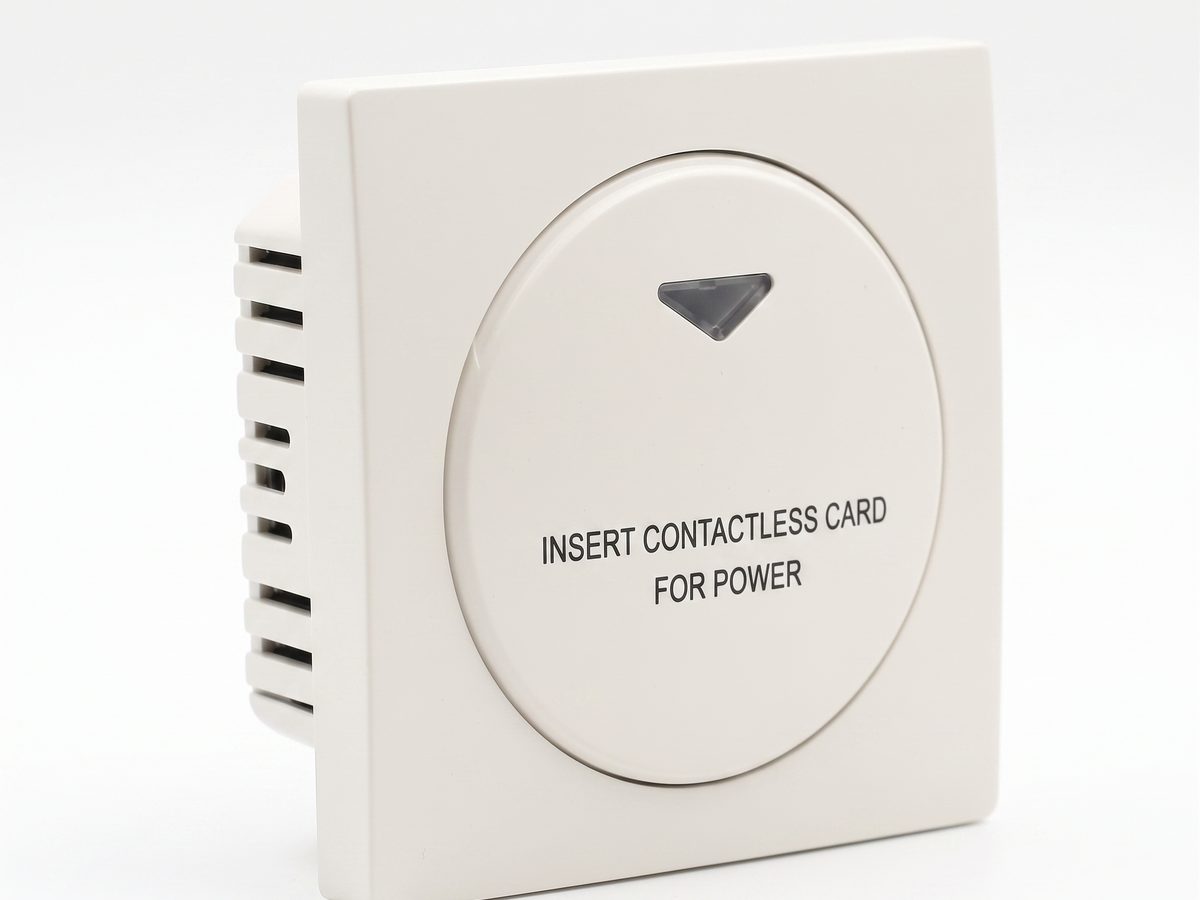
مفتاح بطاقة الفندق — التحكم في طاقة غرفة الضيوف
مفتاح بطاقة الفندق للتحكم في طاقة غرفة الضيوف. كشف بطاقة RFID/IC، إدخال البطاقة لتشغيل الطاقة، فصل الطاقة بتأخير زمني عند إزالة البطاقة. تيار متردد 220 فولت، 10A-16A، RS485 أو تلامس جاف. CE RoHS. مورد OEM/ODM.
تشير هذه الصفحة بالفعل إليه كمرجع تالٍ موصى به.
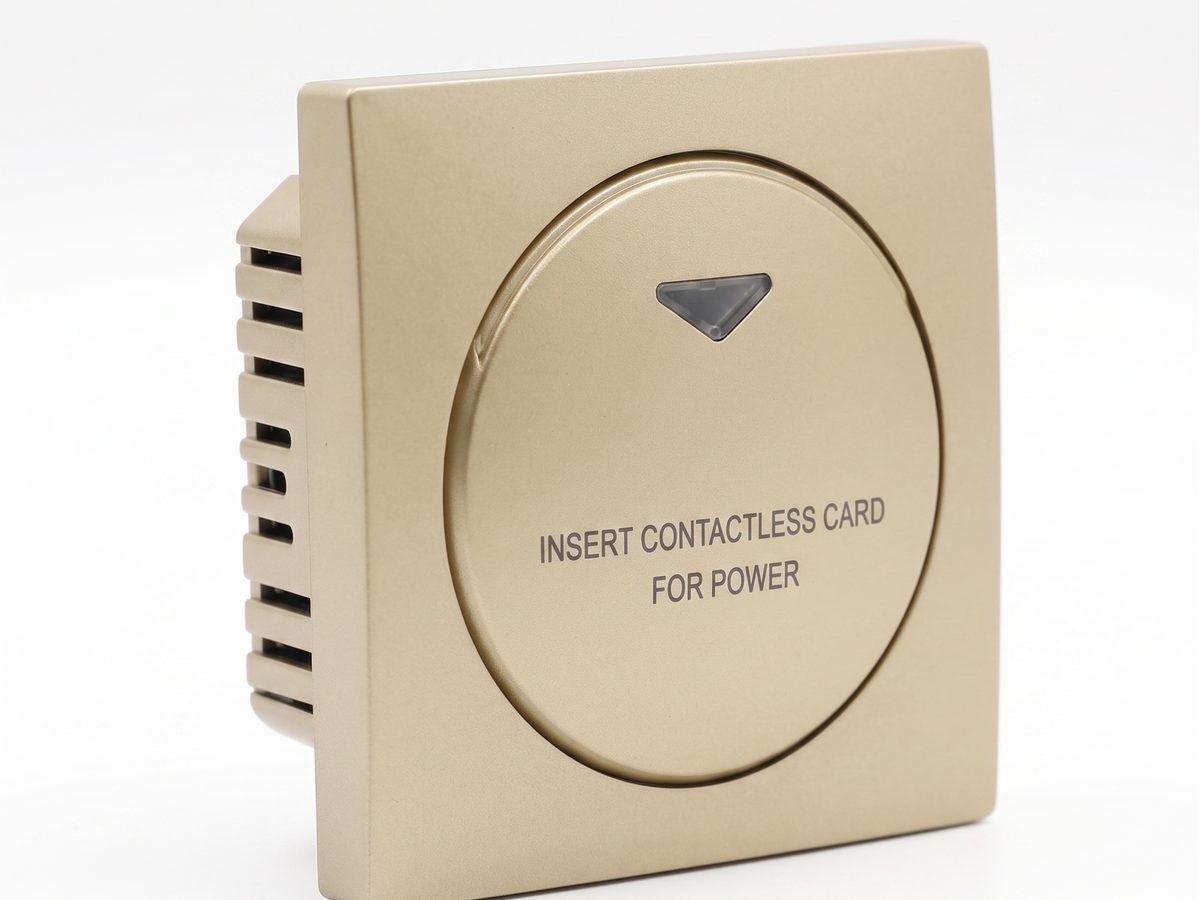
مفتاح توفير طاقة الفندق — التحكم في طاقة غرفة الضيوف بإدخال البطاقة
مفتاح توفير طاقة الفندق يشغل الغرفة عند إدخال البطاقة ويقطع الطاقة بعد تأخير إزالة البطاقة، مقترنًا بنظام التدفئة والتهوية وتكييف الهواء لإيقاف هدر الغرف الفارغة. 220 فولت تيار متردد، 10A-16A، RS485 أو تلامس جاف. CE RoHS. مورد OEM/ODM.
تشير هذه الصفحة بالفعل إليه كمرجع تالٍ موصى به.
حلول ذات صلة
3نظام إدارة الغرف الفندقية القائم على التحكم بالطاقة عبر البطاقة
نظام عملي لإدارة الغرف الفندقية للتحكم في طاقة الغرفة عبر مفاتيح البطاقة، والموصلات، وقواعد التشغيل الموثقة بوضوح.
إنه يدعم نفس سياق المنتج: مفتاح بطاقة الفندق — التحكم في طاقة غرفة الضيوف.
توفير طاقة الفندق باستخدام مفتاح تشغيل غرفة الضيوف
حل لتوفير طاقة الفندق يستخدم تشغيل الغرفة المتحكم به بالبطاقة لمنع الأضواء وتكييف الهواء والمآخذ المختارة من العمل دون داعٍ.
إنه يدعم نفس سياق المنتج: مفتاح بطاقة الفندق — التحكم في طاقة غرفة الضيوف.
التحكم في طاقة غرفة الفندق باستخدام مفاتيح البطاقات
حل عملي للتحكم في طاقة غرفة الفندق لتشغيل إضاءة وتكييف ومنافذ غرفة الضيوف من بطاقة غرفة مصرح بها.
إنه يدعم نفس سياق المنتج: مفتاح بطاقة الفندق — التحكم في طاقة غرفة الضيوف.
مقالات المدونة ذات الصلة
3
مفتاح بطاقة الفندق: الأنواع، الموديلات، وكيفية المواصفات
يغطي مفتاح بطاقة الفندق موديلات العام، RFID، TTLOCK، BLE، والإشغال. يرشدك هذا الدليل لعائلة مفتاح البطاقة المصطلحات الرئيسية والمواصفات.
إنه يدعم نفس سياق المنتج: مفتاح بطاقة الفندق — التحكم في طاقة غرفة الضيوف.
RFID vs NFC لمفاتيح بطاقات الفنادق: أي تقنية بطاقة تختار؟
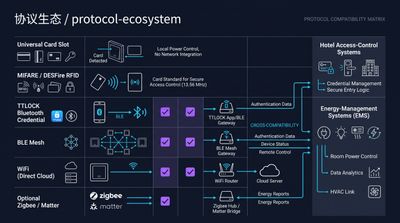
يعتمد الاختيار بين RFID و NFC لمفاتيح بطاقات الفنادق على المدى والقفل: RFID بتردد 125 كيلوهرتز / 13.56 ميجاهرتز (MIFARE، Temic) هو المعيار الفندقي لتغذية الغرف
إنه يدعم نفس سياق المنتج: مفتاح بطاقة الفندق — التحكم في طاقة غرفة الضيوف.
ما هو مفتاح بطاقة الفندق وكيف يوفر طاقة الغرفة
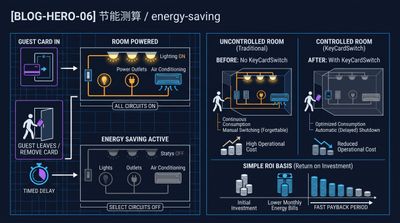
مفتاح بطاقة الفندق هو جهاز حائطي يشغل غرفة الضيف عند إدخال البطاقة ويفصل التيار عند سحبها، مما يوفر عادةً 25-40% من كهرباء الغرفة.
إنه يدعم نفس سياق المنتج: مفتاح بطاقة الفندق — التحكم في طاقة غرفة الضيوف.
حدد مشروع فندقك مع مهندسينا
أخبرنا بعدد الغرف ونوع السقف والبروتوكول المفضل. سنعود إليك بخطة عينات وعرض سعر خلال 24 ساعة عمل.
- انتقل من الإرشادات العامة إلى نقاش حول المنتج أو التطبيق.
- استخدم RFQ عندما يحتاج التسعير أو الرسومات أو MOQ أو توقيت الإطلاق إلى هيكلة.
- أبقِ مسار اتصال مباشر ظاهرًا للتوضيحات السريعة والتسليم.